Dear friends,
I grew up believing that mountains are eternal. Their silence felt powerful, their glaciers unshakeable. Like many across the Hindu Kush Himalaya (HKH), I never saw them as geological formations, but as guardians, sanctuaries of our rivers, our forests, and our lives. Today, I know those silent giants are speaking louder than ever, and we cannot afford to ignore them.
This year’s theme for International Mountain Day, ‘Glaciers matter for water, food, and livelihoods in mountains and beyond’, is deeply personal to me, not only as someone working for mountain sustainability, but as someone shaped by these landscapes and protected by their generosity. In the HKH, glaciers are not just symbols of beauty or adventure, they are custodians of daily life, silently feeding the taps in our homes and watering the fields that sustain our communities.
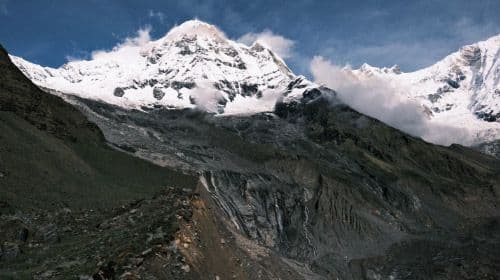
The HKH is a global treasure. It holds the largest volume of snow and ice outside the Arctic and Antarctica, home to more than 54,000 glaciers, nearly 9% of the world’s total. These frozen reservoirs feed ten major rivers that support over two billion people downstream. From farms and fisheries to hydropower, remote villages, towns, cities, and megacities, our lives are shaped by what happens to these rivers and the glaciers that feed them.
We often treat glaciers as metaphors. In our region, they are infrastructure: natural water tanks that secure food, energy, and human security. To protect them is not just to save their majestic forms, but also to safeguard the future of economies, cultures, and generations.
But they are disappearing faster than expected. Glacier mass loss in the HKH has increased by 65% in just one decade. If emissions continue as they are, we could lose up to 80% of our ice by the end of this century.
The science continues to warn us. The HKH Snow Update 2025 shows:
three consecutive years of below-average snow across key basins
dangerously reduced spring snow
shifts in snowmelt already disrupting agriculture, hydropower, and daily life
For farmers, this means less water for crops. For families, greater struggle to access clean water. For downstream regions, it threatens food, water, and energy security while increasing disaster risks for millions.
Yet I want to pause here, because urgency does not mean hopelessness.
Across the HKH, I witness extraordinary resilience: farmers adopting climate-smart irrigation, women leading community-based restoration, and youth mapping glacial lakes with drones. Governments are beginning to recognise that mountains no longer remain in the realm of peripheral references in national discourses, but they are being recognised as national priorities. Mountain communities have already shown great resilience to devastating changes. What we need now is to scale up the investment to match the urgency.
Cooperation is our only realistic strategy
Mountains ignore political borders. Rivers do not stop at national frontiers. Glaciers do not melt according to geopolitics. Fragmented action in mountain regions is not only inadequate, but it is also dangerous.
The future of the HKH depends on collaboration across borders, sectors, and generations. This is not only an environmental imperative, it is a question of stability, security, and peace.
A call to act while there is time
We stand at a crossroads: choose reactive crisis response, or proactive resilience building. The glaciers that shaped us are changing rapidly; our response must be faster still.
Mountains have taught us so much. They have taught resilience, standing firm against storms. They have taught humility, reminding us that ambition must respect nature’s limits. They have taught patience, that real change, like geological time, demands persistence. Above all, they have taught balance: to take only what we need, and give back more than we take.
On this International Mountain Day, let us honour those lessons. I call on governments, development partners, businesses, researchers, and citizens to treat mountains with respect and care for their sustainability as a shared responsibility by:
investing urgently in mountain resilience
funding cryosphere protection as a global necessity
supporting communities as custodians of climate solutions
protecting our water towers, not only in words, but through action
Because protecting glaciers is not about saving ice. It is about saving lives, livelihoods, cultures, and possibilities.
The mountains have sustained us for centuries. Let us act now to help them sustain our future generations.
Happy International Mountain Day.
Sincerely,
Pema Gyamtsho,
Director General,
International Centre for Integrated Mountain Development.