18 December 2025
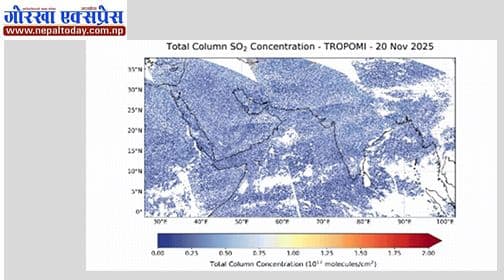
Time series (data collected at regular time intervals allowing patterns, trends, and changes to be analysed over time) captured from the European Space Agency’s TROPOspheric Monitoring Instrument (TROPOMI) shows sulphur dioxide released from the Hayli Gubbi volcano, transported across the Gulf and parts of the Indo-Gangetic Plain and Himalayan Foothills between 23–27 November of this year. Source: Copernicus, European Space Agency
Highlights:
ICIMOD analysis finds Ethiopia’s volcanic eruption did not worsen the dangerous air pollution in South Asian cities.
The region’s pollution crises are caused by local and regional emissions from transport, industry, agriculture, and domestic sources, trapped by seasonal weather conditions.
Satellite and ground data show no increase in pollution particles linked to the volcano, confirming the problem is human made.
The results highlight the urgent need for countries to strengthen and implement their national clean air plans.
Kathmandu, 18 December 2025 - A new scientific analysis concludes that the recent major volcanic eruption in Ethiopia did not increase the dangerous levels of air pollution plaguing South Asia. Research from the International Centre for Integrated Mountain Development (ICIMOD) shows the pollution choking cities from Lahore to Dhaka is homegrown, stemming from local and regional sources and weather patterns.
The eruption of Ethiopia’s Hayli Gubbi volcano released sulphur dioxide (SO2), a gas that can be a hazardous air pollutant with severe effects on health and the environment. However, satellite tracking by ICIMOD scientists revealed the gas plume travelled high in the atmosphere, passing over the region without mixing down to ground level where people breathe.
“While we tracked the volcanic plume moving eastwards across parts of Asia, our data clearly shows it moved at high altitude,” said Ashish Tiwari, Air Lead at ICIMOD. It had little to no impact on the severe pollution already present at ground level across South Asia.”
Scientists used satellite measurements of Aerosol Optical Depth (AOD), a key indicator of how many particles are in the air column to support this finding. The data showed no significant spike in pollution following the eruption.
“The pollution levels were already high before the eruption and remained constantly high after it,”explained Abhishek Kumar Upadhyay, Energy and Emission Specialist at ICIMOD. The volcano did not add to the public health crisis happening on our streets.”
The analysis spotlights the region’s ongoing air quality emergency. In the same period, major cities including Islamabad, Lahore, Delhi, Kathmandu, Thimphu, and Dhaka all experienced dangerous peaks in PM2.5, the tiny particles most harmful to health. Experts point to a combination of calm winds, cool temperatures, and emissions from transport, industry, agriculture, and domestic sources.
“Calm weather creates a ‘lid’ over the region, trapping pollution from local sources close to the ground,” said Arshini Saikia, Air Quality Modelling Analyst at ICIMOD. “Our October data shows an increase in PM2.5, PM10, and carbon monoxide, all linked to human activity.”
Recent monitoring data reveals the scale of the challenge:
In Dhaka daily PM2.5 levels exceeded WHO health guidelines on 7 days between August and October, with PM10 levels exceeding guidelines on 24 days. The concentration of an air pollutant is given in micrograms per cubic metre of air or µg/m3; WHO’s 24-hour guideline is 15 µg/m³.
While Bhutan has the cleanest air in the region, winter PM2.5 levels in its capital, Thimphu, regularly soar past 60 µg/m3 .
Kathmandu saw a brief improvement in October due to heavy rains from the Cyclone Montha, but pollution quickly returned.
These findings reinforce the critical importance of local and national action. Countries like Nepal and Bhutan have recently launched their National Clean Air Action Plans, focusing on reducing emissions to protect public health.
Technical analysis for this report was done with support from Manohar Dahal, Air Quality Application Development Associate at ICIMOD, Manjil Raut, Air Quality Instrumentation Consultant and Arshini Saikia, Air Quality Modelling Analyst
About International Centre for Integrated Mountain Development (ICIMOD)
The Hindu Kush Himalaya (HKH) region stretches 3,500km across Asia, spanning eight countries – Afghanistan, Bangladesh, Bhutan, China, India, Myanmar, Nepal, and Pakistan. Encompassing high-altitude mountain ranges, mid-hills, and plains, the zone is vital for the food, water, and energy security of up to two billion people and is a habitat for countless irreplaceable species. It is also acutely fragile, and vulnerable to the impacts of the triple planetary crisis of climate change, pollution, and biodiversity loss.
The International Centre for Integrated Mountain Development (ICIMOD), based in Kathmandu, Nepal, is an international organisation established in 1983, that is working to make this critical region greener, more inclusive and climate resilient. For more information, read our Strategy 2030 and explore our website.
For media inquiries, please contact:
ICIMOD (Kathmandu)
Raz Tuladhar, Media Officer
Anshu Pandey, Senior Media Associate
Email: media@icimod.org