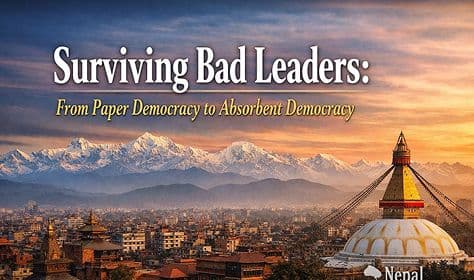
Focus not how to find perfect leaders, but how to design institutions robust enough to survive imperfect, even bad, ones.
Dr. Alok K. Bohara
Dec 23
“If men were angels, no government would be necessary.”
— James Madison
These words, spoken nearly two and a half centuries ago by one of the founding architects of the American republic, remain as relevant today as ever—especially for Nepal, given its recurring cycles of institutional failure.
What we hear in our public discourse—particularly after the fateful events of September 8 and 9—is almost the opposite of Madison’s warning. Instead of sober reflection on institutional breakdown, we hear mockery of government, the Constitution, and even of those who fought for their future and lost their lives on September 8 while trying to make their voices heard.
This is paper democracy in full display—and a far cry from the middle corridor of liberal democracy.
Is it over then? No.
This essay argues instead for a gradual transition toward an absorbent democracy—by which I mean institutions designed to absorb abuse, error, and ambition without collapsing. It calls for a necessary shift in thinking: away from the search for perfect leaders, and toward the design of institutions robust enough to survive imperfect—even bad—ones.
The Records
Nepal, in a remarkably short span of time, experienced two record-breaking political events. The first—often recounted in comparison with similar episodes elsewhere—was the collapse of a regime within thirty-six hours, followed by a so-called “civilian” caretaker government with Gen-Z support. The second, no less striking, was the rapid re-emergence of deposed leaders back at the very center of power. In one case, this took the form of near-total consolidation and capture of party machinery; in the other, it involved continued high-stakes maneuvering and the reassertion of a power base amid ongoing internal party turbulence—spanning both the Communist Party of Nepal (Unified Marxist–Leninist) and the Nepali Congress.
Notably, these two parties—then in coalition—were toppled simultaneously after those fateful days, with many leaders fleeing the capital, at times reportedly rescued by army helicopters.
Instead of humility and remorse over the events and the human loss, the political landscape has been marked by threats, intimidation, and pressure on investigative bodies, accompanied by growing murmurs about bringing down the current government altogether—or even boycotting the upcoming election.
In this churn, any early expectation of soul-searching, self-reflection, or institutional renewal quickly evaporated. The old guards regrouped and reset the agenda. Confusion—and at times posturing—among would-be Gen-Z mentors further diluted the possibility of a credible, fresh leadership challenge to the entrenched political machine, even as more than seventy lives were lost during those fateful September days. This is hardly a sign of a healthy transition.
The Repeating Cycle
It is difficult not to notice how such episodic collapses seem to recur every decade. The 1990 movement that established multiparty democracy was a genuine achievement. In its aftermath, many—including myself—argued for constitutional safeguards, institutional strengthening, and the familiar liberal-democratic language of checks and balances. There was, at least briefly, a sense that the lesson had been learned, especially after yet another shake-up for the republican order.
What was largely missed, however, was a deeper lesson: that democracy requires rules, procedures, and constraints beyond individual goodwill. Even after the loss of more than 17,000 lives, and even after the promulgation of a new constitution—the second within two decades—this lesson remained only partially internalized.
When institutional learning stalls, the political imagination often looks elsewhere.
This longing often takes the form of nostalgia. The public imagination repeatedly returns to figures such as B. P. Koirala or Manmohan Adhikari, as if the absence of leaders of that stature alone explains Nepal’s present impasse. The implicit assumption is that if only leaders with similar moral authority and integrity were to reappear, the system would correct itself. What this framing misses is that both leaders operated within specific historical moments—and within institutional arrangements that no longer exist in the same form. Treating their legacy as a substitute for institutional redesign turns history into comfort rather than lesson.
Against this backdrop, public discourse repeatedly circled back to a different question altogether: Nepal’s supposed lack of leaders with ethics, integrity, and honesty. In the abstract, this concern sounds principled—even necessary. In practice, it has increasingly bordered on the delusional, especially when set against what we are witnessing in the post-uprising landscape.
Accountability for the killings of September 8 does not appear to be on the government’s agenda. Televised visuals of rooms filled with burnt currency—recovered from leaders’ residences during the September riots—are casually dismissed as AI-generated fabrications. Meanwhile, Gen-Z participants are summarily vilified, mocked, and blamed for infrastructure damage that occurred on the 9th, even as public discourse amongst the party leadership remains largely muted about the killings of the 8th. Civil society, for the most part, has remained silent.
In such a context, continued lamentation about moral leadership feels detached from reality, even evasive. The problem is no longer the absence of ethical language; it is the absence of institutional consequence.
This tendency toward misdiagnosis takes other, more revealing forms as well. Some senior figures—even a senior party personality from a major political formation—went so far as to advocate for the return of the king after losing internal party battles. Others turned inward, psychoanalyzing the ego, temperament, or arrogance of individual leaders, as if personality diagnosis could substitute for institutional design.
Together, these responses reveal a deeper pattern. When institutions repeatedly fail under stress, the political conversation retreats into nostalgia, moral lament, or psychological speculation—anything except a hard reckoning with institutional architecture itself. The focus remains on people and personalities, while the systems that enable abuse, impunity, and repetition remain largely untouched.
The Question We Keep Avoiding
This brings us to the question Nepal’s democratic conversation continues to avoid.
Why does our political imagination remain so fixated on leaders—good or bad—rather than on the institutions meant to constrain them? And why has Madison’s core insight—that democracy survives not by assuming virtue, but by planning for its absence—never been fully internalized in our democratic design?
This question came into sharper focus while reflecting on a recent essay in the Annapurna Express by Dr. Minendra Rijal, which described the Nepali Congress (NC) as “the principal institutional carrier of Nepal’s democratic imagination.” It is a refreshingly candid and self-aware framing, acknowledging both historical contribution and moral inheritance.
That legacy deserves to be stated plainly. The Nepali Congress played a central role in carrying Nepal’s democratic struggle through exile, imprisonment, underground organization, and negotiated transition, especially against the aristocratic and autocratic century of the Ranas. Alongside the left movement, it helped normalize constitutionalism, pluralism, and electoral politics in a society emerging from absolutism. For many years, NC functioned not just as a party competing for power, but as a broad democratic platform—keeping space open for dissent, continuity, and democratic aspiration when formal institutions were still weak.
Yet embedded within Dr. Rijal’s assessment is a paradox. The moral authority and legacy of the party’s founding leadership helped democratic forces survive difficult periods and gave the party historical depth and legitimacy. At the same time, that same legacy may have slowed a deeper reckoning with a basic institutional lesson: democracy lasts not by placing leaders above institutions, but by placing institutions above leaders. In this way, the party—and at times its leaders—may have become victims of their own legacy, using it as a comfort zone that offers reassurance in hard moments, even as the harder work of institutional redesign is postponed.
I recounted one such missed opportunity in my piece Might Nepal Have Developed a Middle Corridor of Liberal Democracy if Girija P. Koirala Had Heeded the Advice of His Younger Colleagues?
Paper Democracy and the Leadership Trap
This legacy nostalgia—shared not only by party leaders but also by the wider public—has kept attention focused on the search for “good” or even “ideal” leaders, often romanticized through figures from the past. What has received far less attention is a harder but more durable question:
not how to find perfect leaders, but how to design institutions robust enough to survive imperfect, even bad, ones.
This is the essence of paper democracy: a system rich in constitutional language and moral expectation, yet thin in its ability to absorb stress. Paper democracy asks leaders to behave. When they do not, institutions hesitate, bend, or collapse.
Absorption Before Liberalism
This gap becomes especially visible in the emerging Gen-Z political vocabulary. Their skepticism is directed less at individual leaders and more at systems that appear incapable of constraining failure, abuse, or capture. The frustration is not with democracy as an ideal, but with its fragility in practice.
What this points toward is not a rejection of liberal democracy, but a different route to it. Liberal democracy does not endure by moral appeal alone; it endures through institutions capable of absorbing pressure—not through heroism, but through rules and constraints.
In that sense, the task ahead may be a gradual movement—from paper democracy toward an absorbent democracy—one that can hold the system together under stress, and only then sustain the deeper freedoms and restraints of a mature liberal democratic order.
Concluding Remark
The central thesis of this essay is straightforward: Nepal does not need to search for perfect leaders; it needs institutions capable of handling imperfect ones.
With that in mind, this writer has written extensively on a range of institutional reform propositions—internal party democracy and a citizen democracy watchdog; a genuinely civilian anti-corruption body; electoral reforms to minimize the abuse of proportional-representation mathematics; public financing of elections; among others. Many others, too, have articulated thoughtful and useful reform agendas.
But for now, what is urgently needed is a suspension of our endless quest for dream leaders—and a pause in wasting time preaching ethics to those already in power. Instead, the task is to rally around a civic campaign to design institutional architecture that can absorb failure, constrain abuse, and correct deviation. Let the system take care of behavior, rather than hoping that behavior will take care of the system.
Dr. Alok K. Bohara, Emeritus Professor of Economics at the University of New Mexico, writes as an independent observer of Nepal’s democratic evolution through the lens of complexity and emergence science. His systems-policy essays on Nepal’s socio-economic and political landscape appear on Nepal Unplugged.