Dr. Ghulam Nabi Fai---Chairman
------------World Forum for Peace & Justice--------------
January 26, 2026
India is celebrating its 77th Republic Day to honor a constitution that came into force on January 26, 1950. Yet for the people of Jammu and Kashmir, this celebration has little meaning. The world’s largest self-proclaimed democracy has never extended the same democratic rights to Kashmir that it celebrates elsewhere.
Just two years before India adopted its Constitution, the United Nations Security Council passed resolutions on Kashmir establishing a ceasefire and, crucially, calling for a UN-supervised plebiscite. The people of Jammu and Kashmir were promised the right to decide their own future in an atmosphere free from coercion, intimidation and external compulsion. More than seven decades later, that promise remains unfulfilled.
Indian leaders often stress that citizens must preserve the unity and integrity of the nation and resist divisive forces in the interest of harmony and brotherhood. In Kashmir, however, such rhetoric is accompanied by overwhelming militarization—armed patrols, drones overhead, sealed neighborhoods, and severe restrictions on movement. This reality bears little resemblance to democratic celebration or constitutional values.
The contradiction is stark. Republic Day symbolizes democratic governance, yet Kashmir remains governed through force rather than consent. One is reminded of Bob Dylan’s Blowing in the Wind: “How many roads must a man walk down before you call him a man?” How many roads must Kashmiris Walk before they are allowed to exercise their most basic democratic right—the right to choose their own destiny?
India’s unilateral refusal to permit a plebiscite, followed by its assertion that Jammu and Kashmir and its people are an integral and inseparable part of the state, has defined the conflict between India and Pakistan for decades. The cost has been enormous: hundreds of thousands of lives lost, generations traumatized, and a region kept perpetually on edge. For what purpose?
India unquestionably has the right to celebrate Republic Day within its internationally recognized boundaries. But under UN Security Council resolutions and established international consensus, Jammu and Kashmir remains a disputed territory. India therefore lacks the legal and moral authority to celebrate Republic Day in Kashmir as though its status were settled. This insistence has only deepened suffering, sustained violations along the Ceasefire Line, and perpetuated the risk of wider conflict in South Asia.
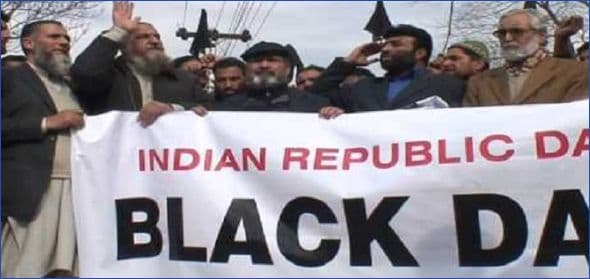
The historical record is clear. On October 27, 1947, Indian forces entered Jammu and Kashmir against the wishes of its people. The Maharaja, Hari Singh, soon fled the Valley, raising serious questions about his legitimacy to decide the fate of an entire population. For Kashmiris, January 26 is not a day of celebration; it is a day of mourning—a reminder of when their right to self-determination was effectively denied.
India claims to be the world’s largest democracy, yet impartial international voices have long challenged this claim in the context of Kashmir. Bertrand Russell once observed that “the high idealism of the Indian government in international matters breaks down completely when confronted with the question of Kashmir.” More recently, following India’s actions of August 5, 2019, Huffington Post wrote that Indian democracy is “dying in silence in Kashmir.”
Basic freedoms—speech, expression, movement, assembly, and political choice—remain severely restricted. Any genuine democratic choice must occur in an atmosphere free from coercion and intimidation. Instead, Kashmir remains one of the most heavily militarized regions in the world, with nearly 900,000 troops shaping daily life.
Even Mahatma Gandhi recognized that Kashmir’s true rulers were its people, not its Maharajas. He stated that if Kashmiris chose Pakistan, “no power on earth can stop them,” but that they must be left free to decide for themselves.
Peace and stability in South Asia cannot be achieved without a just resolution of Kashmir. That resolution requires meaningful dialogue involving all parties: India, Pakistan, and the authentic representatives of the people of Jammu and Kashmir.
If India genuinely wishes to honor the democratic ideals enshrined in its Constitution, it must release all political prisoners, including Mohammad Yasin Malik, Shabir Ahmed Shah, Masarat Aalam, Aasia Andrabi, Fehmeeda Sofi, Nahida Nasreen, and human rights defenders such as Khurram Parvez. Draconian laws like the Public Safety Act (PSA) and the Unlawful Activities Prevention Act (UAPA) must be repealed. Above all, the people of Kashmir must be granted their fundamental freedoms—and the right to choose their own destiny.
Until then, Republic Day in Kashmir will remain not a celebration of democracy, but a painful reminder of its absence.
Dr. Ghulam Nabi Fai is also the Secretary General
World Kashmir Awareness Forum.
He can be reached at:
WhatsApp: 1-202-607-6435 / gnfai2003@yahoo.com
Kashmirawareness.org