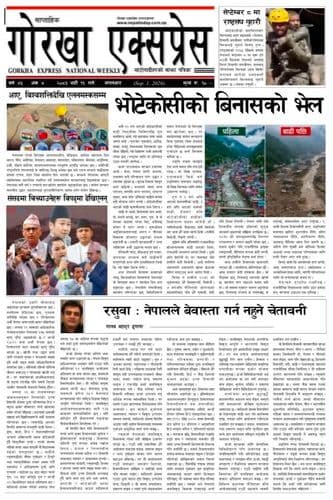
The recent report in Gorkha Express (www.nepaltoday.com.np) which alleges the government of Nepal’s preparation to hand over the responsibility of processing uranium found in Mustang to the United States, has triggered a necessary national conversation. The report further suggests that preparations may be underway to involve a joint technical team from the United States and Australia to process uranium in Lo Manthang under the coordination of the Nepalese Army. Whether every claim is substantiated is not the central issue. The real question is how Nepal should position itself in a global economy where technology, energy, and critical minerals are becoming the core drivers of power and prosperity.
Across the world, governments are reorganizing economic strategy around supply chain security. In the United States, the CHIPS and Science Act directs tens of billions of dollars toward semiconductor manufacturing and resilience. At the same time, the Minerals Security Partnership brings together the United States with partners such as Japan, Australia, and members of the European Union to diversify access to critical minerals essential for clean energy and advanced industry. These are not isolated policies. They reflect a broader shift in which economic security is increasingly tied to control over energy, data, and industrial inputs.
In policy discussions, this shift is sometimes described as a move toward a “Pax Silica.” The term is informal, but the direction is clear. Strategic ecosystems built on computing, energy, and materials are beginning to shape geopolitical influence. India’s decision to align with these supply chain frameworks in February 2026 illustrates how quickly this shift is gathering momentum.
For Nepal, this transformation presents a real opportunity. The country’s most valuable strategic asset is not speculative uranium reserves. It is electricity. Nepal’s hydropower potential offers a structural advantage at a time when reliable and clean energy is becoming the limiting factor for digital infrastructure and industrial expansion.
The policy groundwork is already visible. The Millennium Challenge Corporation Nepal Compact, a $525 million program, is investing in high-voltage transmission and grid reliability. Its objective is straightforward. Expand electricity availability and reduce costs at scale. In parallel, the World Bank approved a $50 million Digital Transformation Project in February 2026 to strengthen data governance, cybersecurity, and digital infrastructure. Together, these initiatives outline a credible strategy. Nepal can emerge as an energy-enabled and digitally connected economy that participates in global value chains.
Uranium presents a different set of considerations. Nepal’s Department of Mines and Geology has identified potential deposits, and the International Atomic Energy Agency has supported technical cooperation, including project NEP2007 on uranium prospecting and evaluation. That is where the record stands. Exploration is not extraction. It is not a commercial agreement with foreign actors. A geological survey is not a concession.
Any move beyond this stage would be significant. It would require legislation, regulatory capacity, environmental safeguards, and public accountability. It would also carry geopolitical implications. Mustang sits in a sensitive region where strategic decisions would draw attention beyond Nepal’s borders. Proximity to the northern frontier adds a layer of complexity that cannot be ignored.
This is why the current debate matters. Not because it proves the existence of a secret arrangement, but because it exposes the cost of uncertainty. When information is unclear, speculation fills the void. That speculation can unsettle partners, distort expectations, and weaken public confidence. The appropriate response is clarity. If Nepal is exploring participation in emerging supply chain and technology frameworks, it should say so openly. If it is not, that should also be stated plainly. Transparency builds credibility. Silence invites interpretation.
Nepal has long followed a policy of non-alignment, supported by its aspiration to be recognized as a Zone of Peace. This approach has allowed the country to engage globally without being drawn into great-power competition. As geopolitical rivalry intensifies, maintaining that balance will become more difficult and more important.
In this environment, engagement with new economic frameworks should not be viewed as a risk in itself. It may be necessary for long-term growth and for strengthening national sovereignty. The real question is whether such engagement is deliberate and transparent, or whether it unfolds by default and without public understanding. That distinction is strategic.
Nepal stands at the intersection of a major global transition. Energy, technology, and industrial systems are converging in ways that will shape economic outcomes for decades. Managed well, this shift can unlock significant value, particularly through the productive use of clean energy.
The foundation of that opportunity is not secrecy. It is trust. In a world where capital and partnerships follow clarity, transparency is no longer just a principle of good governance. It is a competitive advantage.