Kathmandu, 24 April 2026 — Snow cover across the Hindu Kush Himalaya (HKH) has fallen to 27.8% below the long-term average, breaking last year’s record low and marking the fourth consecutive year below-normal snow persistence, according to the Snow Update 2026 released today by the International Centre for Integrated Mountain Development (ICIMOD).
The persistent decline signals a systemic collapse of seasonal snow reserves across the world’s highest mountain range, posing an immediate and escalating threat to water security for nearly two billion people who depend on the 12 major river basins originating in the HKH.
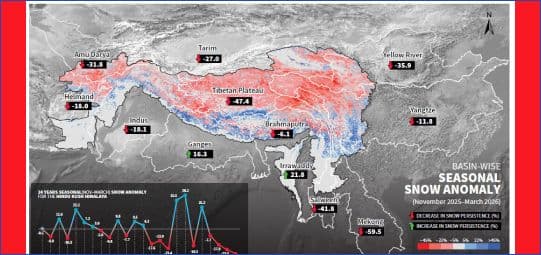
Ten of those basins now have below-normal snow persistence. The Mekong, Tarim, and Tibetan Plateau have recorded their lowest levels in 24 years of monitoring.
“What we are seeing is a persistent trend where the seasonal snow reservoir is shrinking, year after year”, said Sher Muhammad, author of the HKH Snow Update 2026. “The 2026 numbers confirm a breaking point: ten out of twelve basins are below normal, and several have hit their lowest recorded persistence in two decades.”
Seasonal snowmelt contributes up to 77.5% of annual runoff in the Helmand basin and 74.4% in Amu Darya, meaning reduced snow this year will directly impact water availability for drinking, irrigation, hydropower, and ecosystem. This situation is particularly concerning for water supply and flood management. Reduced snowmelt will lower spring runoff and intensify water scarcity in downstream areas, especially in the western river basins.
Farmers in the Indus, Helmand, and Amu Darya basins face irrigation shortfalls during early growing seasons. Hydropower operators in the Mekong, Yangtze - where the Three Gorges Dam operates - and Brahmaputra should anticipate below-normal generation in the early summer.
Compounding the crisis, consecutive low-snow years have prevented groundwater and soil moisture from replenishing, increasing vulnerability to future droughts. “Every dry spell will hit harder,” the report warns. “Regional cooperation on these interconnected issues has now become urgent. We need to shift from emergency response to proactive, science-based governance.”
Only two basins recorded above-normal snow persistence: the Ganges at plus 16.3% and the Irrawaddy at plus 21.8%, offering limited local relief but insufficient to offset the regional crisis. In contrast, extreme deficits persist in the Mekong at minus 59.5%, the Tibetan Plateau at minus 47.4%, and the Salween at minus 41.8%.
ICIMOD urges national and local agencies to activate drought preparedness and response plans immediately, integrate real-time snow data into water management decisions, invest in water storage and efficiency measures, and strengthening transboundary cooperation on water use.
The Hindu Kush Himalaya (HKH) region stretches 3,500km across Asia, spanning eight countries – Afghanistan, Bangladesh, Bhutan, China, India, Myanmar, Nepal, and Pakistan. Encompassing high-altitude mountain ranges, mid-hills, and plains, the zone is vital for the food, water, and energy security of up to two billion people and is a habitat for countless irreplaceable species. It is also acutely fragile, and vulnerable to the impacts of the triple planetary crisis of climate change, pollution, and biodiversity loss.
The International Centre for Integrated Mountain Development (ICIMOD), based in Kathmandu, Nepal, is an international organisation established in 1983, that is working to make this critical region greener, more inclusive and climate resilient.
For more information, read our Strategy 2030 and explore our website.
For media inquiries, please contact:
ICIMOD (Kathmandu)
Raz Tuladhar, Media Officer
Anshu Pandey, Senior Media Associate
Email: media@icimod.org