
Prem Sagar Poudel------------
President Donald Trump’s three-day visit to China is being interpreted by international relations analysts as a decisive turning point in global politics. Touching down in Beijing after eight years, Trump’s journey is far more than a mere diplomatic formality; it is a powerful signal of a shifting geopolitical reality. On one hand, the American leadership projects military self-assurance, declaring that it needs no one’s help to conclude the Iran war. On the other, the President’s own compulsion to travel to Beijing to mend ties with the world’s second-largest economy lays bare the complex and contradictory character of contemporary international relations.
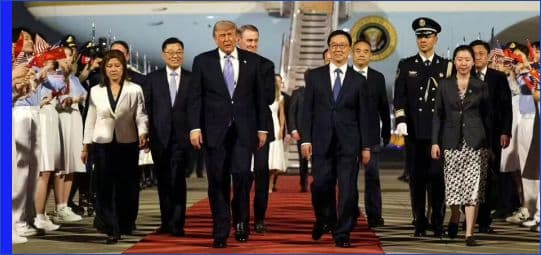
At Beijing’s Capital International Airport, it was not merely the presence of Vice President Han Zheng and senior diplomat Xi Feng that conveyed a message. The sight of three hundred children, dressed in blue and white uniforms, waving the flags of both nations while chanting “Welcome” in Mandarin was itself a potent diplomatic statement. In the arena of international diplomacy, the level and protocol of a welcome signals the depth, priority, and future outlook of any bilateral relationship. In this sense, the standard China set for Trump’s reception makes it clear that Beijing places its relationship with Washington at the very heart of its foreign policy. A similar level of hospitality was extended during Trump’s first-term visit in 2017. However, the context back then was primarily an attempt to build a personal rapport between the two leaders, whereas this time the context is exponentially more serious, multidimensional, and strategic. In 2017, the trade war was only just beginning; today, that competition has extended into technology, rare earth minerals, artificial intelligence, and military alliances. The State Dinner to be held at the Great Hall of the People is yet another symbol of this strategic significance. Diplomatic experts tend to interpret China’s hosting of such a grand formal honour for a foreign guest as an indicator of the relationship’s centrality.
The most intriguing part of this visit, and the finest example of diplomatic creativity, is the participation of US Secretary of State Marco Rubio. As a senator, Rubio was known as a fierce critic of China on issues concerning Uyghur Muslims and Hong Kong, and Beijing had long ago imposed sanctions on him, including a ban on entering China. Yet now, when the diplomatic necessity arose for the same Rubio to join the presidential delegation, China demonstrated a flexibility and pragmatism that constitutes a valuable case study in balancing principle and practice in international relations. By altering the Chinese transliteration of Rubio’s name, China devised a clever workaround: the sanctions applied to the old name would not automatically extend to the new one. This is not merely a testament to China’s diplomatic dexterity but proof of its ability to uphold the formal sanctity of its principled stance while accommodating a pressing practical necessity. Students of international diplomacy will likely be citing this episode for decades to come.
The presence of seventeen major American business leaders-including Elon Musk, Apple CEO Tim Cook, and the CEO of Boeing-in the delegation clearly signals that this visit is more focused on the economy than on politics alone. The prospect of a Boeing aircraft purchase deal potentially exceeding nine lakh crore rupees (approximately 110 billion US dollars), the largest in history, suggests that China is seeking to address its trade imbalance with the United States by leveraging its immense market capacity. This is not a mere commercial transaction; it is that complex structure of economic interdependence which has intertwined the two giant economies so deeply that neither side can afford the cost of total decoupling. However, the absence of Nvidia CEO Jensen Huang leaves a telling void in this picture. His absence gives tangible form to the reality that the disputes over chip sanctions and technology transfer remain far from resolved. It illustrates how the economic relationship between the two countries is locked in a simultaneous push-and-pull of cooperation and competition.
The core agenda of the Xi-Trump talks-encompassing trade, Taiwan, rare earth minerals, and artificial intelligence-addresses the central questions of contemporary geopolitics. The issue of rare earth minerals, in particular, has become the most sensitive and strategic concern in the global economy. China possesses nearly 90 percent of the world’s rare earth processing capacity, which forms the backbone of modern technology, green energy, and the defence industry. Similarly, the competition between China and the United States in the field of artificial intelligence carries a growing potential to bifurcate the world into two poles. The discussions on these two subjects could very well sketch the blueprint for the global economic and technological landscape of the coming decade, a possibility that cannot be dismissed.
The remarks Trump made to reporters before departing Washington reveal the internal contradictions of American foreign policy in a fascinating light. On one side, there is the military self-assurance that “we don’t need China’s help to end the Iran war; America will win anyway,” and on the other, the clear strategic objective that “Iran cannot have nuclear weapons.” Yet the very inclusion of the Iran war on the agenda underscores the reality that the United States cannot entirely dismiss China’s diplomatic standing on this issue. It also makes Washington’s discomfort with China’s growing influence in the Middle East plainly visible. The diplomatic stature China established by mediating between Saudi Arabia and Iran-shifting the balance of power in the Middle East-is evidently viewed by the United States as a challenge to its traditional sphere of influence.
This visit is not confined to bilateral relations; it is also a powerful signal of a multipolar world order. The notion of a unipolar world order that emerged after the end of the Cold War has lost its relevance. China’s economic rise, India’s growing strategic stature, Russia’s resurgence, and the rising collective voice of the Global South are pushing global politics towards a multipolar direction. Analysing Trump’s Beijing visit from this perspective reveals it as a vivid illustration of the complex interplay between American pragmatism and China’s strategic patience.
In conclusion, Trump’s China visit has highlighted several fundamental truths of contemporary global politics. First, economic interdependence has become so profound that total decoupling serves the interests of neither side. Second, competition and cooperation can advance simultaneously and must be understood not as mutually exclusive opposites, but as two sides of the same coin. Third, diplomatic ingenuity and pragmatism can resolve complex problems without weakening principled stances-the Rubio episode being the best lesson of this. The dual dynamic of sanctions and red-carpet welcomes, the concurrent existence of economic interdependence and strategic rivalry, the interplay of military self-assurance and economic compulsion-these very contradictions will shape the contours of the future world order. This visit has sent the message that global politics is moving not towards conflict but equilibrium, not towards isolation but engagement, and not towards unipolarity but multipolarity.
Author: Prem Sagar Poudel is a senior journalist and international relations analyst from Nepal. He has studied Nepal-China relations, the geopolitics of the Himalayan region, and Asian security issues in depth.
@Dragon Media