Nepal today stands at a critical juncture where a change of government, a change of political party, or a change of leadership alone cannot resolve the national crisis. On the surface, the debate appears divided along polarities such as monarchy versus republic, old parties versus new forces, America versus India, and federalism versus centralization. Yet beneath all these debates lies one fundamental question: does Nepal still possess the institutional capacity to protect its sovereignty, borders, diplomacy, economic policy, and statecraft?
Nepal’s crisis is not merely political. It is a crisis of state capacity. It is a crisis of governance structure. It is a crisis of institutional credibility. It is a crisis of diplomatic language. It is a gap between national claims and state preparedness. Most importantly, it is a crisis of a leadership culture that has failed to understand the relationship between words and national interest.
For a small country, geography may be destiny, but weakness is not. Nepal is situated between two major powers, India and China. This geopolitical reality directly affects Nepal’s security, economy, trade, water resources, infrastructure, border management, and foreign policy. In such a situation, Nepal needs not only emotional nationalism, but evidence-based nationalism, institutional diplomacy, and strict discipline in the use of words. For a small country, what matters more than a large army are records, maps, treaties, legal arguments, moral legitimacy, and diplomatic language.
Every word used at the highest level on border issues can become either an asset or a liability for the nation. A sentence spoken by a prime minister, minister, ambassador, or government spokesperson does not remain a private opinion. Such a sentence is read as a signal from the state. In international diplomacy, words are not merely sounds; they can become documents. A statement is not merely a reaction; it can become a reference point in future negotiations. Therefore, the use of casual language on matters of borders, sovereignty, and relations with neighbours is not merely a linguistic lapse; it is a risk to the national interest.
In the Nepal–India border dispute, issues such as Kalapani, Lipulek, Limpiyadhura, and Susta have long remained sensitive. These disputes are not matters comparable to local land conflicts or ordinary encroachment across a boundary line. In some border areas, there may be changes in river courses, ambiguity over boundary pillars, local patterns of use, or administrative complexities. But on the other hand, the question of territory linked to historical treaties, maps, strategic routes, security presence, and trilateral sensitivities is of an entirely different nature. To place these two in the same language is not factual equivalence; it is strategic ambiguity.
This is precisely why the distinction between terms such as “encroachment” and “cross-border occupation” is extremely serious. The word “encroachment” may imply a deliberate, state-level, and legally wrongful act. “Cross-border occupation,” by contrast, may describe an administrative, geographical, or riverine complexity. The first term can imply an admission of guilt; the second keeps the door open for negotiation. The first carries the risk of weakening the national claim; the second highlights the technical nature of the problem. In diplomacy, such seemingly small lexical differences can produce major strategic consequences.
This episode exposes a deep weakness within Nepal’s state apparatus. Before senior political leadership speaks on sensitive issues, there must be coordinated briefings among the Ministry of Foreign Affairs, the Department of Survey, border experts, security agencies, historians, and legal specialists. Facts, language, possible reactions, and international implications must be assessed in advance. But in Nepal, words are often spoken first and explained later. Controversies are created first, and only afterwards does the ministry issue clarifications. Political advantage is sought first, and diplomatic damage control is attempted later. This is an inverted process, and it is dangerous for a small country.
Nepal’s foreign policy has for a long time appeared to be more personality-driven than institution-driven. The personal style of a prime minister, the ideological leaning of a party, a leader’s emotional proximity to a neighbouring country, or a momentary political pressure often seems to influence the state’s permanent policy. Foreign policy should rest on continuity, restraint, and institutional memory. But when foreign policy depends on an individual’s speech, a party’s strategy, or the reaction of the crowd, the diplomatic credibility of a small country weakens.
Nepal’s Constitution defines the country as a federal democratic republic. Yet there is a deep gap between the state written in the Constitution and the state functioning in practice. Although the formal architecture of federalism, republicanism, inclusion, and democracy has been established, the governance system remains deeply marked by power-sharing arrangements, access-based politics, patronage, corruption, impunity, and institutional decay. The form of the state has changed, but the culture of running the state has not. This is why deep frustration has emerged among citizens.
Today, a harsh conclusion is taking root in the minds of many Nepali citizens: whoever comes to power, the result is the same. This sentence is a dangerous warning for democracy. When citizens see no policy difference among parties, no moral difference among leaders, and no experience of justice or opportunity in their own lives through the system, they begin to trust individuals more than institutions, strong hands more than democracy, and immediate results more than due process. This is the beginning of democratic fatigue.
The debate over the return of monarchy, speculation over the role of the army, excessive attraction toward new independent leaders, and resentment against old parties are all symptoms of this democratic fatigue. But caution is necessary here. The failure of old parties does not automatically mean the success of new forces. The weakness of the republic does not automatically prove the purity of monarchy. If anger toward leadership turns into anti-institutional impulse, it may produce not reform, but further instability. What the country needs is not the thrill of overturning the system, but the hard discipline of reforming institutions.
Corruption in Nepal is no longer merely an economic irregularity; it has become a national security problem. When corruption enters appointments, contracts, policymaking, investigations, border administration, revenue, security, and justice, the decision-making capacity of the state itself erodes. In such a situation, external pressure, diplomatic weakness, and internal instability increase. Corruption does not only consume public money; it consumes the confidence of the state, the trust of citizens, and the bargaining power of the nation. A corrupt state may have loud slogans, but it cannot conduct strong negotiations.
Nepal’s geopolitical position makes this problem even more serious. India is an indispensable neighbour for Nepal, linked through an unmanaged border, labour, trade, energy, security, culture, and people-to-people relations. China is another decisive power connected to Nepal’s northern border, Tibet’s security sensitivities, infrastructure, trade, investment, and the regional balance of power. Between these two neighbours, Nepal must adopt a balanced, self-respecting, and evidence-based policy, not one driven by emotional fluctuations. A strategy of standing under the shadow of one power and being used against another would be disastrous for Nepal in the long run. Similarly, making one’s own interests vague in the name of pleasing both sides is equally dangerous.
The foreign policy of a small country must rest on three foundations: clear national interest, institutional continuity, and linguistic restraint. Nepal must speak clearly with India on borders, trade, energy, and transit. With China, it must pursue a transparent policy on infrastructure, loans, security sensitivities, and connectivity expansion. Even in relations with Western powers, multilateral institutions, and development partners, national priorities must be clear. Diplomacy is not the art of pleasing everyone; it is the capacity to present one’s own interests in a language that everyone can understand.
Another weakness of Nepal is the lack of archival state capacity. On border disputes, there is much emotional rhetoric, but the capacity to systematically use historical maps, treaties, revenue records, administrative documents, local evidence, river flows, boundary pillars, census records, and geospatial information systems remains weak. The foundation of modern nationalism is not the voice of the crowd, but the credibility of evidence. If Nepal wishes to strengthen its claims on international platforms, it needs a permanent border research centre, a digital archival system, map diplomacy, legal preparedness, and expertise-based policy.
Nepal must move from emotional nationalism to evidence-based nationalism. Emotional nationalism can provide momentary excitement, but evidence-based nationalism provides long-term strength. Emotional nationalism creates opponents; evidence-based nationalism creates legitimacy. Emotional nationalism strengthens speeches; evidence-based nationalism strengthens one’s hand at the negotiating table. For a small country, this distinction has existential significance.
To strengthen state capacity, Nepal must undertake several fundamental reforms. First, there must be an institutional language protocol for government statements on sensitive national issues. On borders, security, foreign policy, and relations with neighbours, everyone from the prime minister to official spokespersons must follow the same factual and diplomatic line. Second, the Ministry of Foreign Affairs must be developed not merely as a formal ministry, but as a strategic brain of the state. Third, border management must be advanced not as a political slogan, but as a permanent technical and legal project.
Fourth, corruption control must be treated not only as an issue of good governance, but as an issue of national security and the protection of sovereignty. Fifth, Parliament must be made the real centre of executive accountability. When a prime minister or minister speaks on a sensitive issue, Parliament’s demand for facts is a normal democratic process, not an anti-government conspiracy. Sixth, political parties must restore internal democracy, financial transparency, and policy-based politics. Seventh, new political forces must demonstrate not only popularity, but institutional capacity and diplomatic maturity.
There is another dangerous tendency in Nepal’s political discourse: seeking the solution to every problem in a single individual. Sometimes it is the king, sometimes the army, sometimes a charismatic mayor, sometimes an old leader, and sometimes a new party. But a modern state survives not through individuals, but through institutions. An individual can inspire, but institutions provide continuity. An individual can make decisions, but institutions ensure accountability. An individual can be popular, but institutions provide legitimacy. Nepal does not need a popular saviour at this moment; it needs capable institutions.
The central argument of this article is this: Nepal’s sovereignty is being challenged not only by external powers, but also by internal institutional weakness. External pressure at the border is one kind of challenge; wrong words in the capital, weak records, corrupt administration, unclear policy, and partisan interests are another kind of internal challenge. External borders exist in geography; internal borders exist in the character of the state. When the character of the state is weak, the defence of geography also becomes weak.
Nepal must understand its size not as a weakness, but as a reason for caution. A small country survives not by making grand speeches, but by making deep preparations. A small country draws strength not from provocation, but from legitimacy. A small country must conduct foreign policy not through emotional decisions, but through institutional memory. A small country should not seek confrontation with its neighbours, but neither should it embrace ambiguity that erases its own claims.
Nepal’s relationship with India can be based neither on hostility nor on surrender. Its relationship with China can be based neither on blind faith nor on insecurity-driven distance. Nepal must maintain open, clear, self-respecting, and document-based relations with both neighbours. Where there is dispute, it must negotiate with evidence. Where there is cooperation, it must build transparent partnerships. Where there is pressure, it must respond through institutional resistance. Where there is opportunity, it must utilize it in line with the national interest.
Ultimately, Nepal’s crisis is deeper than the slogan of regime change. It is a question of whether the country will build a state or merely run governments. Nepal has changed parties, changed the Constitution, and changed the system of governance, but the intellectual, moral, and institutional reconstruction of the state remains incomplete. This is now the central task.
Nepal now needs not loud nationalism, but verified nationalism. It needs not emotional speeches, but restrained diplomacy. It needs not personality-centred politics, but an institution-centred state. It needs not power-sharing arrangements, but accountable governance. It needs not dependent reactions, but a national strategy built on prior preparation.
The sovereignty of a small country is not small. But the mistakes of a small country can be large. On border issues, one light word; in diplomacy, one careless sentence; in administration, one corrupt decision; in Parliament, one unclear answer; and in policy, one weak agreement can cause long-term damage. Nepal must therefore begin to treat words with the same seriousness as border security.
Nepal’s future will depend on whether it leaves its national interest to slogans, crowds, and emotion, or anchors it in records, institutions, law, and restraint. If Nepal learns this lesson, it can become a respected, stable, and self-confident state despite being small. If it fails to learn, systems will keep changing, but the state will continue to weaken.
The central message today is clear: before a small country speaks heavy words, it must make great preparations. Sovereignty is not merely something to be declared through emotion; it is a responsibility to be protected by institutions.
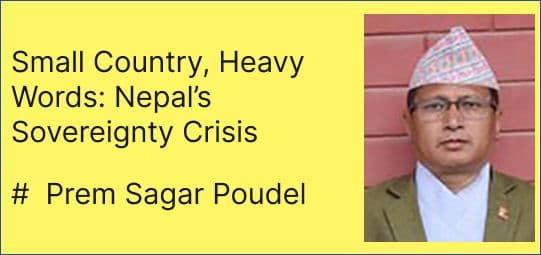
Author: Prem Sagar Poudel is a senior journalist and international relations analyst from Nepal. He has conducted in-depth studies on Nepal–China relations, the geopolitics of the Himalayan region, and Asian security issues.