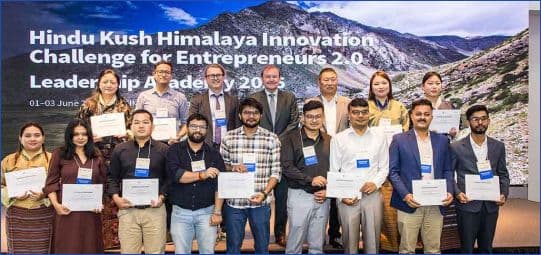
Kathmandu | 1 June 2026 – The International Centre for Integrated Mountain Development (ICIMOD), in partnership with the Global Resilience Partnership (GRP), has announced the 12 winners of the second cohort of the Hindu Kush Himalaya Innovation Challenge for Entrepreneurs (HKH-ICE).
The challenge fund, backed by the UK Government, supports and scales climate-resilient enterprises across the Hindu Kush Himalaya (HKH) region, one of the world’s most climate-vulnerable mountain systems.
The selected enterprises operate across four priority sectors: resilient agriculture, water security, sustainable tourism, and community resilience. Their solutions range from scaling high-value climate-smart mountain products to converting urban food waste into vermicompost for climate-resilient farming.
Building on the success of its first cohort, HKH-ICE 2.0 supports entrepreneurs from Bangladesh’s Chattogram Hill Tracts, Bhutan, India’s Himalayan states, and Nepal. The initiative aims to address pressing mountain challenges through locally grounded innovation and scaling solutions through market-based approaches.
“Entrepreneurs in the Hindu Kush Himalaya are uniquely positioned to deliver solutions that are both locally relevant and globally significant,” said Pema Gyamtsho, Director General of ICIMOD. “The Hindu Kush Himalaya Innovation Challenge for Entrepreneurs strengthens the region’s innovation and market ecosystem by investing in promising ideas, building entrepreneurial capacities, and fostering cross-border collaboration. With support from the UK Government, ICIMOD is backing scalable, climate-resilient solutions that contribute to sustainable and inclusive development across the region.”
“Through the HKH-ICE Challenge, we are seeing locally led initiatives bringing forward inspiring and scalable nature-based solutions to address interconnected environmental, livelihood, and economic challenges across the region. I am really encouraged by the creativity, dedication, and leadership reflected in this work. These initiatives are a powerful reminder that lasting change happens when communities shape solutions rooted in their own contexts, knowledge, and lived experiences,” said Jesper Hörnberg, CEO, Global Resilience Partnership.
“The UK Government remains committed to supporting the entrepreneurs driving climate resilience across the Hindu Kush Himalaya through our Climate Action for a Resilient Asia (CARA) programme. The ambition on display from this cohort gives us every confidence that locally-led innovation is one of the most powerful tools we have for building a sustainable future for this region,” said Rob Fenn, UK Ambassador to Nepal.
Often referred to as the “Third Pole,” the Hindu Kush Himalaya region supports more than 240 million people living in the mountains and provides water, food, and energy for around 1.65 billion people downstream. The region faces accelerating risks from climate change, ecosystem degradation, and water scarcity, threatening agriculture, tourism, and long-term resilience.
According to an ICIMOD estimate published in 2025, the region will require more than USD 12 trillion by 2050 to meet adaptation and mitigation needs. At the same time, the Climate Policy Initiative estimates that 83% of adaptation finance needs in South Asia remain unmet. Limited access to climate and private finance continues to constrain local entrepreneurs seeking to scale green and resilient innovations.
The initiative provides tailored mentorship, technical assistance, and regional exposure, helping enterprises strengthen business models, access markets, and attract investment.
The full list of the winning enterprises and their innovation is available at: HKH-ICE 2.0 Innovation Challenge for Entrepreneurs
About International Centre for Integrated Mountain Development (ICIMOD)
The Hindu Kush Himalaya (HKH) region stretches 3,500km across Asia, spanning eight countries – Afghanistan, Bangladesh, Bhutan, China, India, Myanmar, Nepal, and Pakistan. Encompassing high-altitude mountain ranges, mid-hills, and plains, the zone is vital for the food, water, and energy security of up to two billion people and is a habitat for countless irreplaceable species. It is also acutely fragile, and vulnerable to the impacts of the triple planetary crisis of climate change, pollution, and biodiversity loss.
The International Centre for Integrated Mountain Development (ICIMOD), based in Kathmandu, Nepal, is an international organisation established in 1983, that is working to make this critical region greener, more inclusive and climate resilient. For more information, read our Strategy 2030 and explore our website.
For media inquiries, please contact:
ICIMOD (Kathmandu)
Raz Tuladhar, Media Officer
Anshu Pandey, Senior Media Associate
Email: media@icimod.org