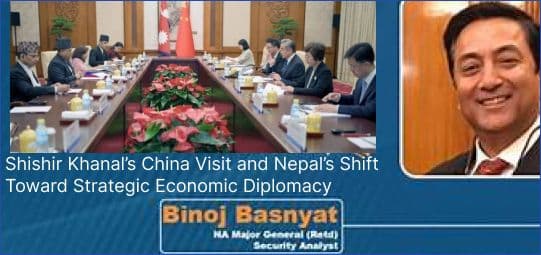
Foreign Minister Shishir Khanal’s visit to China comes at a moment when South Asia is once again emerging as a central arena of great-power competition. As the international system transitions from an American-led unipolar order toward a more contested multipolar landscape, Nepal finds itself navigating an increasingly complex strategic environment shaped by the intersecting interests of China, India, and the United States.
Kathmandu’s message to Beijing, New Delhi, and Washington appears increasingly clear: Nepal seeks investment, technology, connectivity, trade, and growth from all partners while preserving strategic autonomy and avoiding exclusive alignment with any competing power bloc.
Against the backdrop of Nepal’s emerging “Smart Neighbourhood Policy,” the visit was more than a routine diplomatic engagement. The government’s first major foreign visit to India underscored the indispensability of Nepal-India relations, while the subsequent visit to China highlighted Beijing’s importance as a source of investment, infrastructure, and connectivity. At the same time, growing interactions with American officials since April demonstrate Kathmandu’s intention to maintain broad-based international engagement. Taken together, these developments suggest a policy of strategic diversification rather than strategic alignment.
A particularly important signal from the visit was the government’s increasing emphasis on economic statecraft. Khanal repeatedly linked Nepal’s economic underperformance, trade deficits, and development challenges to political instability. The implication was clear: foreign policy should increasingly serve national economic objectives.
This represents a shift away from traditional political symbolism toward a more outcome-oriented approach focused on attracting investment, promoting exports, generating employment, facilitating technology transfer, and accelerating economic transformation.
In Beijing, Chinese Foreign Minister Wang Yi conveyed a message centered on deeper strategic cooperation and a stable environment for long-term Chinese engagement. Emphasizing that “a close neighbor is better than a distant relative,” Wang underscored China’s desire to remain Nepal’s most reliable development partner amid changing regional dynamics indicating Mongolia’s “Third Neighbourhood Policy” where he just visited. He called for expanding cooperation under the Belt and Road Initiative (BRI), strengthening connectivity, and creating a transparent, predictable, and law-based business environment to facilitate greater Chinese investment.
Wang also commended Nepal’s continued adherence to the One-China Principle and its support for China’s core interests, including Taiwan and Xizang (Tibet).
China’s message reflects broader strategic calculations. Situated between China and India and adjacent to Tibet, Nepal occupies a geopolitical position that exceeds the scale of its economy or military capabilities. For Beijing, Nepal is not merely a neighboring country but an important component of its Trans Himalayan Multi-Dimensional Connectivity Network (THMDCN) and South Asian strategy.
Three themes emerged from China’s position: continuity, connectivity, and strategic trust.
First, Beijing seeks policy stability and expects agreements reached with successive governments to be implemented consistently. Second, China continues to view cross-border infrastructure, energy cooperation, transportation networks, and digital connectivity as long-term strategic priorities. Third, Beijing places significant emphasis on political trust, particularly regarding issues related to sovereignty and territorial integrity.
Beneath the language of friendship and development, China also communicated several concerns. The first relates to Tibet and Beijing’s expectation that Nepal prevent activities that challenge Chinese sovereignty. The second concerns the expanding presence of the U.S. in Nepal. While China does not oppose Nepal’s engagement with Washington, it remains cautious about any developments that could evolve into security arrangements perceived as part of a broader Indo-Pacific strategy aimed at containing China.
In essence, Beijing’s message was straightforward: Nepal is free to engage all major powers, but it should not become a platform for activities that undermine China’s core security interests.
At the same time, the U.S. has significantly expanded its diplomatic, development, economic, and security engagement across South Asia, including Nepal. Through initiatives such as the Millennium Challenge Corporation (MCC), development cooperation, political exchanges, and institutional partnerships, Washington seeks to strengthen political influence, expand economic opportunities, deepen security cooperation, and ensure that smaller states remain sovereign, open, and not exclusively dependent on any rival power.
This reflects a broader American strategy in South Asia: engage emerging governments early, invest economically, expand security ties gradually, and compete for influence without requiring formal alliances.
For Nepal, the challenge is to manage relationships with multiple major powers without becoming overly dependent on any single actor. As strategic competition intensifies, external powers will increasingly seek influence through investment, aid, infrastructure projects, political engagement, and security cooperation.
Yet this competition also creates opportunities. Nepal can leverage the interests of China, India, the U.S., and other partners to advance its own development priorities, provided it maintains strategic clarity and policy consistency.
The fundamental lesson from Khanal’s China visit is that Nepal’s diplomacy must be guided by national interests rather than geopolitical narratives crafted elsewhere. Nepal neither benefits from choosing sides nor from becoming a proxy arena for great-power competition.
Instead, Kathmandu’s strategic objective should be clear: maintain balanced relations with all major powers, prioritize economic statecraft over geopolitical alignment, preserve sovereign decision-making, and transform external engagement into tangible gains for national development.
As South Asia enters a new era of geopolitical competition, the success of Nepal’s foreign policy will not be measured by its closeness to any particular power. It will be measured by its ability to engage all powers while remaining firmly committed to its own interests, sovereignty, and long-term development goals.
In that sense, the larger strategic signal of Khanal’s visit to China is that the new government is attempting to redefine Nepal’s foreign policy from: “balancing powers politically” to “leveraging all powers economically.” If sustained, this would represent a shift toward what might be called: Strategic Economic Diplomacy—maintaining political neutrality while maximizing economic opportunities from India, China, the U.S., and other partners.
Mr. Binoj Basnyat
Maj. General (retd), Nepali Army
Strategic Analyst
Twitter: @BasnyatBinoj
LinkedIn: http://linkendin.com/in/binoj-basnyat-6b30a6145
Line ID: bbasnyat