By REENA RATHORE
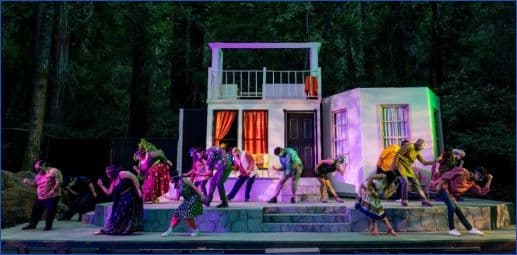
For Kunal Prasad, director of Silicon Valley Shakespeare’s production of “Much Ado About Nothing,” Shakespeare’s works are not meant to remain frozen in the past. He sees them as living art that continues to evolve when artists bring their own experiences, communities and perspectives to the stage. His version recasts the romantic comedy as a South Asian American wedding celebration, complete with Bollywood-inspired music and dance. The production unfolds beneath the redwoods at Sanborn County Park in Saratoga, blending centuries-old verse with the rituals, relationships and memories that have shaped Prasad’s sense of identity and community.
Prasad’s first encounter with Shakespeare came through his older sister. As a first grader, he watched her memorize “Romeo and Juliet’s” “rose by any other name” passage, and something about Juliet’s reflection on names and identity landed immediately. “I immediately understood, I got it,” Prasad recalled to India-West. “You can call anything by any name. It doesn’t intrinsically change what that thing is.” That childhood realization has quietly shaped his creative life since. “It’s the heart of acting and the role-playing we do in everyday life,” he said. “It’s what interests me in theater then as well as now.”
Years later, that same instinct for hidden selves drew him to “Much Ado About Nothing,” a play he sees as fundamentally about family and about the gap between who people are and who they present themselves to be.
“When you have a character like Beatrice, to me, I saw my sisters. A lot of the play is family and interpreting what a family member is saying, overhearing what someone’s doing or what little scheming plans they have — usually around trying to get someone married,” said Prasad, who first performed in “Much Ado About Nothing” himself in high school.
That instinct wasn’t abstract. “The actual marriage ceremony was always the biggest of family events,” he said. For him, adapting the play into a South Asian setting was never about layering culture on top of Shakespeare but about exploring how themes of family, expectations and relationships already existed within the play.
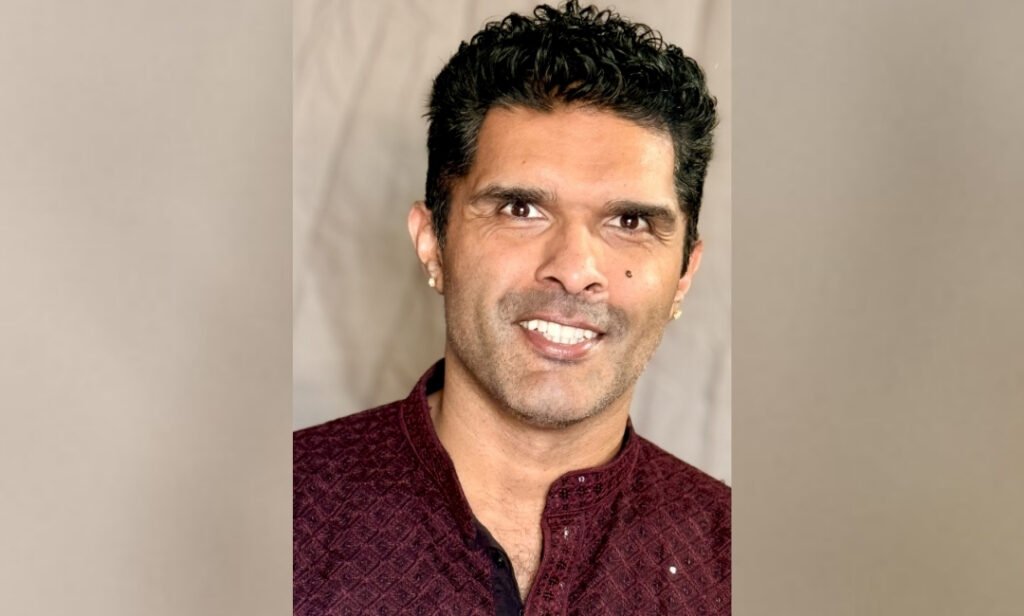
Prasad traces the idea to around 2023, when he met director and playwright Lavina Jadwani, who mentioned that she’d long imagined an all-Indian cast tackling “Much Ado About Nothing.” “I remember thinking at the time, oh, I would love to be in that,” he said. Jadwani passed away before that vision could be realized, but the desire stayed with him: “The idea of having an all Indian or Indian majority cast and told through a specific cultural experience was a desire on my part to do.” Silicon Valley Shakespeare committed to staging it roughly a year ago.
Prasad framed the production as a coexistence, not a fusion. “I see it as two things: if it’s a railway track, there are two rails,” he explained. “One being Shakespeare and one being an American South Asian Hindu household. This production is just like the planks in between. One doesn’t justify or explain the other. They just exist side by side.”
He also likened the process to jazz, where musicians share a key but never move in lockstep. “They’re riffing and playing off of each other,” he said.
That tension between structure and instinct mirrors what Prasad sees as the play’s emotional core: characters caught between social obligation and private truth. “Many characters mask their feelings,” he said. “Some characters are unabashedly themselves to negate whatever social expectations or obligations they have,” a dynamic he recognizes from his own upbringing in a traditional Hindu household. “Traditionally speaking, these expectations and obligations are product-oriented,” he pointed out. “You have almost like specific job requirements. And as a creative person, to me it’s about the experience. Sometimes those two things can rub against each other.”
That intersection between tradition and individuality also shaped the production’s physical world. With its creek, redwoods and open air, Sanborn County Park became less a backdrop than a starting point for the production. “It has a very particular vibe and energy,” Prasad said. “A human standing up on a platform and presenting something in this environment — that’s just where we begin.”
Rather than viewing outdoor theater as a limitation, Prasad embraced its unpredictability and intimacy, allowing the natural surroundings and audience presence to become part of the experience.
“I’m not trying to create a diorama piece,” he said of directing his cast. “They get specific choreography and blocking, of course, but I’m here for them to be alive and human.” It’s not about perfection, he added, but about “understanding the contours, understanding the goal, understanding what we’re aiming toward… We just create very specific parameters to make sure there’s quality control.”
The set takes shape as the rear view of a home, its backyard opening onto the redwoods and creek beyond. Ahead of designing the ritual sequences, Prasad attended several real Hindu weddings held at private residences this year, grounding the staging in something lived rather than invented.
His early ambitions ran past what the production could hold. Early notions involved Sanskrit chant and an elaborate movement sequence built from a three-hour ritual. “Of course, I start off with big grand ideas,” he said. “And then you have to come back down to earth and see what’s the capacity that we have?” What remained was the product of steady reduction.
Prasad noted that the play stays relevant because people keep reinterpreting it. “Art doesn’t live in a museum to be preserved,” he stated. “It’s there to be claimed again and presented anew.”
That belief carries into his work as a theater educator, where he tells students Shakespeare isn’t the property of institutions. “He doesn’t live in a museum, he belongs to you,” Prasad said. “You can place him in your backyard, in your household, in your school, in your neighborhood. That breathes new life into the work.”

The play’s central relationship — Beatrice and Benedick’s mutual, prickly resistance to marriage — is where Prasad finds its clearest modern echo, pointing to later marriages, declining birth rates, and a growing number of people choosing not to marry at all.
“I didn’t want to think about it as just a pithy, stubborn, prideful comment about, ‘No, I’m not getting married,’” Prasad said. “These are two adults who have lived through things, who are obviously intelligent and accomplished in their own right, saying, ‘You know what? Doing this whole marriage thing is not for me.’ And I think that definitely has a resonance today.”
For Beatrice and Benedick especially, Prasad looked for performers with a rare mix of intelligence, warmth and stage presence—people confident enough to draw audiences into their world.
“I was looking for unique, strong individuals who have their own charisma and intelligence and are willing to share that with an audience,” he said. Palak Joshi, who plays Beatrice, and Heren Patel, who plays Benedick, ultimately fit that vision.
Asked when the production started to feel like itself, Prasad described something closer to instinct than certainty. “You’re never really sure,” he said. “But there comes a point when the Jell-O is starting to set, and you go, ‘Oh, there it is.’” That moment came mid-rehearsal, when he turned to his stage manager and realized the pieces, Shakespeare, music, movement and memory, had begun moving as one.
The process of bringing those elements together, he said, also echoes how traditions themselves are created. “Someone said, ‘What is a tradition wasn’t always a tradition,’” Prasad said. “Someone took one or two or three things and made something beautiful and new. They shared it, and others decided, ‘That’s something I’d like to share, too.’”
More than romance, Prasad wants audiences to leave with something quieter: a sense of family, chosen or otherwise. “I hope that they’re surprised and that they feel a bit of romance and love—the love of family, of chosen family, of making a family,” he said. He also points to characters who care for one another without romantic or familial obligation. Ultimately, he hopes audiences leave feeling more grounded, more human, and restored. “I would like my work to do that for people in general.”
With this production, Prasad continues doing what theater does best: carrying Shakespeare somewhere new, and letting a new community decide what to make of him.
The production runs select Thursdays through Sundays through September 6 at Sanborn County Park.
@IW