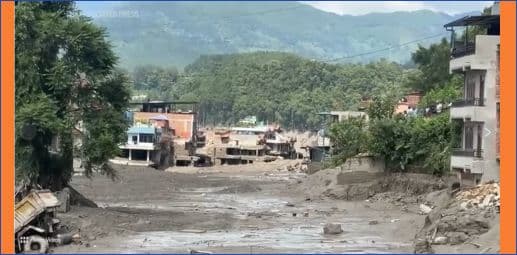
A major flash flood struck Nepal’s Rasuwa district on Wednesday morning, sending a powerful surge of water, sediment and boulders through the Bhote Koshi and Trishuli river systems, raising concerns over further potential downstream impacts.
"We are deeply saddened by this tragic disaster, which struck so suddenly and unexpectedly," said Pema Gyamtsho, Director General of ICIMOD. "We stand in solidarity with the people and Government of Nepal during this difficult time. Our thoughts and prayers are with the victims, their families and all those affected, and we are committed to providing support wherever possible."
According to local reports, water levels in the Bhote Koshi basin began rising rapidly around 9:00 AM local time on August 26. The flood breached riverbanks and travelled downstream through the Bhote Koshi River into the Trishuli River, with potential impacts extending into Nuwakot and Dhading districts.
Scientists from the International Centre for Integrated Mountain Development (ICIMOD) and partner institutions in Nepal and China are investigating whether the flood may have been triggered by an ice-rock avalanche originating from a high-altitude area.
Preliminary assessment based on video footage and information from affected areas suggest that a large volume of ice and rock debris may have entered the Lende Khola, a tributary of the Bhote Koshi River. Researchers say the event could have generated a sudden surge that carried water, sediment and large boulders downstream.
Hydrological observations indicate the exceptional speed and magnitude of the flood wave. Water levels on the Trishuli River at Galchchi reportedly rose by as much as nine metres within 30 minutes, while levels at Malekhu increased by seven metres over a similar period.
Several water monitoring stations along the Trishuli River were reportedly damaged or washed away during the event, although the Glachchi monitoring station remains operational.
Experts are also assessing whether debris temporarily blocked the river at a narrow section, forming a landslide dam. Such blockage can create secondary hazard if impounded water is suddenly released. Authorities and scientists are continuing to evaluate the size, location and stability of any potential blockage.
Preliminary analysis of seismic records has identified unusual signals recorded during the period of the disaster. Data from a seismometer in Jilong, approximately 12 kilometres from the affected area showed anomalous signals, while a second station in Zhangmu also recorded unusual activity.
Scientists are examining whether these signals are connected to the suspected avalanche. At present, no causal link has been established between seismic activity and the flood.
"The same site devastated by last year's Rasuwa flood is once again under threat," said Qianggong Zhang, Head of Climate and Environmental Risks at ICIMOD. "An ice avalanche in the Lhende Khola is the suspected trigger, but the cause remains unconfirmed. With a blockage still lodged upstream on the Nepal-China border, authorities warn a second flood is imminent and evacuation orders are now in place for Jilong port."
The flood has reportedly caused significant damage to infrastructure in the affected areas, including hydrological monitoring stations. Several hydropower facilities are located along the Bhote Koshi River and connected river systems.
"The increasing frequency of cryosphere hazards is becoming more visible than ever before. The pace of change is so rapid that current efforts are struggling to keep up," said Mohd. Farooq Azam, Senior Cryosphere Specialist at ICIMOD. "Today's disaster in the Lhende Khola underscores the need for stronger regional collaboration, with governments taking coordinated action to respond to cross-border hazards. "Experts at ICIMOD are continuing to analyse hydrological, seismic, remote-sensing and field data to better understand what triggered the event and assess ongoing risks to downstream communities.
ICIMOD remains in close communication with the Prime Minister’s Office in Nepal, scientific institutions and partners in China as assessments continue.
Scientists cautioned that while climate change is altering glaciers, snow conditions, permafrost and mountain slopes across the Hindu Kush Himalaya, it is too early to determine what role climate change played in this specific event.
Available for interview
Zhang Qianggong, Head of Climate and Environmental Risks
Mohd Farooq Azam, Senior cryosphere specialist
Saswata Sanyal, Disaster Risk Reducation Specialist