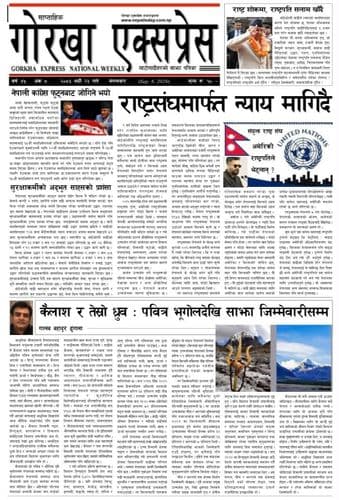
Dr. Ghulam Nabi Fai-
Chairman----World Forum for Peace & Justice
If the United Nations is serious about restoring faith in the international system, it must do more than repeat the language of the Charter. It must demonstrate that its principles apply equally to the powerful and the weak.
This has been an extraordinary week at the United Nations—extraordinary not only because of the crises confronting the world, but because of the extraordinary gap between the principles being proclaimed and the action that so often follows.
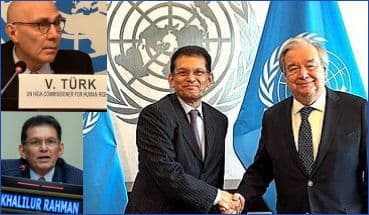
In Geneva, during the opening of the 63rd session of the UN Human Rights Council, UN High Commissioner for Human Rights Dr. Volker Türk warned on September 7 that the world had entered an increasingly dangerous period. Armed conflicts are multiplying, respect for international humanitarian and human rights law is diminishing, and even the principles of the UN Charter are being challenged.
His message was unmistakable: there is only one way out of this madness—peace negotiations conducted in accordance with the UN Charter.
He also spoke about civic space, peaceful protest, freedom of expression and access to information. These rights, he argued, create a bridge between public frustration and political dialogue. Yet governments too often respond to legitimate grievances with repression, frequently in the name of national security. Those are powerful words.
But words raise an unavoidable question: What happens when the United Nations itself has already documented serious violations and then fails to pursue the remedies it recommended? That question brings us to Kashmir.
The reports that the UN must not forget
In 2018, the Office of the UN High Commissioner for Human Rights issued its first major report on the human rights situation in Indian-administered Kashmir and Pakistan-administered Kashmir. The report documented allegations of serious human rights violations, including excessive use of force, arbitrary detention and impunity for violations in Indian-administered Kashmir. The 2019 update examined continuing allegations concerning civilian killings, excessive use of force, arbitrary detention, restrictions on expression and assembly, torture and other abuses.
The significance of these reports is not that they settled every political question surrounding Kashmir. They did something more fundamental: they placed human rights allegations before the international community and proposed mechanisms for further investigation.
Among the recommendations, proposed by the UN report was consideration by the Human Rights Council of the possible establishment of a commission of inquiry to conduct a comprehensive, independent international investigation into allegations of human rights violations in Kashmir.
The reports also called upon India to accept outstanding requests from UN Special Procedures, including the Working Group on Enforced or Involuntary Disappearances, and to facilitate their visits.
These are not casual observations. They are recommendations contained in official UN human-rights reporting. And yet, years later, the central question remains: Where is the follow-up?
When the High Commissioner speaks of the erosion of international law and the need to defend human rights, surely the United Nations must also be prepared to explain what became of recommendations contained in its own reports.
Silence on that question risks turning the language of accountability into little more than diplomatic rhetoric.
A new General Assembly president, an old test
On September 8, the 81st session of the UN General Assembly opened under its new president, Ambassador Khalilur Rahman of Bangladesh. The official UN theme for the session is “Restoring trust, managing transformation: a United Nations that delivers for all.” That phrase—restoring trust—may be the most important challenge facing the organization.
Ambassador Rahman has emphasized fidelity to the UN Charter and the mandates given to the organization by its member states. He has also identified strengthening peace and security and advancing human rights as priorities for the year ahead. Those objectives deserve support. But trust cannot be restored merely by announcing that it must be restored. Trust is earned when principles are applied consistently.
Secretary-General António Guterres has made essentially the same argument. As the 81st session begins, the UN has emphasized that international law and human rights are at the core of the organization and that all states have an obligation to ensure that the force of law prevails over the law of force.
That is precisely the standard by which the organization should be judged. Does the force of law prevail when a powerful member state rejects or contests the implications of a UN action? And, equally important: Does the UN itself act when its own human-rights machinery has identified serious concerns?
The “Correct the Map” episode. Consider what happened just days ago.
On September 4, 2026, the General Assembly adopted the resolution known as “Correct the Map,” an African-led initiative concerning the representation of the world's regions in commonly used map projections. The resolution passed overwhelmingly—164 votes in favour, one against and six abstentions. The United Nations describes the initiative as an effort to correct distortions in conventional world maps, particularly the Mercator projection.
The resolution is not about territorial sovereignty. It is primarily about cartographic representation. Yet the reaction to it illustrates a larger problem.
India voted in favour of the resolution but subsequently made clear that its support did not alter its position concerning Jammu and Kashmir and Ladakh. India said representations of those territories must conform to its official map and warned against what it called inaccurate or misleading depictions. This is where the broader question of UN credibility emerges.
If a member state can support a UN resolution while simultaneously insisting that its implications cannot affect the state's established position on a disputed territory, what exactly is the authority of a UN resolution?
Of course, not every General Assembly resolution carries the same legal force. The “Correct the Map” resolution itself concerns cartographic practice rather than adjudicating territorial sovereignty.
But the episode nevertheless exposes a fundamental tension within multilateralism: member states frequently embrace UN principles when those principles serve their interests and qualify them when they do not.
Kashmir and the forgotten language of earlier decades
There is also a historical irony that should not be ignored. The Kashmir question was brought to the United Nations by India itself in 1948.
India's representative, Sir Gopalaswami Ayyangar, addressed the Security Council during the early consideration of the dispute. The subsequent history of Kashmir became deeply contested, and India and Pakistan developed fundamentally different interpretations of the commitments made during those years.
But the historical record also contains striking statements by India's first prime minister, Jawaharlal Nehru.
In a speech in Amrita Bazar Patrika, Calcutta in January 1952, Nehru was recorded as saying that India had taken the issue to the United Nations, had given its word of honour for a peaceful solution, and had left the question of the final solution to the people of Kashmir. The statement appears in UN archival documentation.
That history deserves to be read not merely as an argument between India and Pakistan, but as a reminder of how dramatically the language surrounding Kashmir has evolved over the decades.
The question today is not whether the geopolitical circumstances of 1948 or 1952 remain unchanged. They clearly do not. The question is whether the international community is prepared to confront unresolved questions through peaceful, lawful and credible mechanisms—or whether disputes are simply allowed to harden until another crisis erupts.
The danger is not theoretical
The world does not need another reminder of how quickly a regional crisis can become an international security emergency. India and Pakistan are nuclear-armed states. Every serious confrontation between them therefore carries consequences far beyond the immediate battlefield or border.
The tragedy at Pahalgam and the military escalation that followed should remind the international community of an uncomfortable truth: waiting for the next crisis before engaging diplomatically is not a strategy. Prevention is. Facilitation is. Dialogue is. And where appropriate, credible international mechanisms for fact-finding and human-rights accountability are.
The UN Charter was created precisely because the international community understood the catastrophic consequences of allowing disputes between states to spiral into war.
Is the UN becoming a platform for speeches rather than action?
That is the uncomfortable question this week should force us to ask. The UN High Commissioner for Human Rights tells governments to respect human rights and the Charter. The President of the General Assembly pledges to lean heavily on the Charter and to restore trust. The Secretary-General reminds member states that the force of law must prevail over the law of force. All of this is necessary. But none of it is sufficient.
The United Nations cannot restore trust simply by repeating the principles on which it was founded. It must demonstrate that those principles have consequences.
If an OHCHR report recommends consideration of an independent international investigation, the organization should explain what happened to that recommendation. If governments reject or fail to implement UN human-rights recommendations, the organization should say so openly. If member states invoke sovereignty to resist scrutiny, the UN should remind them that sovereignty does not erase international obligations. And if the organization expects ordinary citizens around the world to believe in international law, it must show them that international law is more than a vocabulary used at diplomatic podiums.
A challenge for Ambassador Khalilur Rahman
Ambassador (Dr.) Khalilur Rahman's stated ambition is a United Nations that delivers for all. The theme of his presidency is restoring trust. Kashmir presents an opportunity to test that ambition.
The new President of the General Assembly does not need to prejudge the final political status of Kashmir. Nor should he substitute his judgment for that of the parties or the relevant UN bodies.
But he can insist on something much less controversial and far more fundamental: That the United Nations take its own reports seriously. He can encourage cooperation with UN human-rights mechanisms. He can urge member states to engage constructively with outstanding recommendations. He can support independent fact-finding where appropriate. And he can remind India and Pakistan that the nuclear age leaves no room for permanent reliance on crisis management.
The time for another cycle of escalation followed by international appeals for restraint should be over. The international community should be working before the next crisis, not after it.
The UN must choose between rhetoric and credibility
Eighty-one years after the creation of the United Nations, the founding principles remain indispensable. But principles have meaning only when they are applied. The world does not need another magnificent speech about peace while conflicts continue. It does not need another declaration about human rights while documented recommendations remain unanswered. It does not need another appeal for trust while governments and international institutions themselves appear selective about which principles they enforce.
What the world needs is consistency.
The UN must demonstrate that the Charter is not a menu from which powerful states—and sometimes the institution itself—can choose selectively. The people of Kashmir, like people caught in conflicts everywhere, deserve something more than speeches. They deserve a serious commitment to peace, human rights, accountability and dialogue.
India and Pakistan deserve something more than another confrontation that brings two nuclear powers to the edge. And the United Nations deserves something more than declining credibility.
Ambassador Khalilur Rahman has inherited an institution at a moment of profound global uncertainty. His call for a UN that delivers for all is therefore more than a slogan. It is a test.
Will the United Nations merely speak about restoring trust—or will it take the difficult steps necessary to earn it? The answer may determine not only how the world remembers this 81st session, but whether the United Nations can still persuade a deeply divided world that multilateralism is capable of delivering what its Charter promised: a system in which disputes are resolved through law, dialogue and peaceful means rather than through force.
The next crisis between India and Pakistan should not be allowed to become the next test of whether the world learned anything from the last one. The time for preventive diplomacy is now.
Dr. Ghulam Nabi Fai can be reached at:
WhatsApp: 1-202-607-6435
gnfai2003@yahoo.com
September 9, 2016