Ghulam-Nabi Fai, United Nations, New York — September 26, 2026:------------
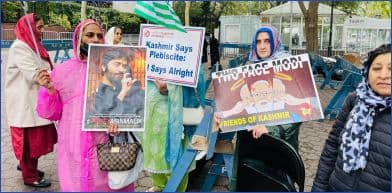
While India’s Minister of External Affairs, Dr. S. Jaishankar, addressed the 81st session of the United Nations General Assembly in New York on September 26, a peaceful demonstration was held outside United Nations Headquarters calling international attention to the unresolved question of Jammu and Kashmir and urging the United Nations to fulfill its commitments concerning the people of Kashmir.
Despite strong winds and heavy showers, demonstrators—many of them women and children—remained outside the United Nations carrying banners and placards and raising slogans in support of peace, justice and the right of the people of Kashmir to determine their political future.
Among the messages displayed by the protesters were:
“India Took Away Article 370, But Not Our Dreams, Not Our Identity.”
“Kashmir Elections Are Just a Deception: Plebiscite Is the Only Solution.”
“Kashmiris Reject Indian Occupation: UN Resolutions—The Only Solution.”
“Kashmir Needs Freedom and Justice.”
“UN Resolutions State Clearly: Kashmir Is Not an Indian Protectorate.”
The demonstrators also called for the release of Kashmiri political prisoners and named Muhammad Yasin Malik, Shabir Ahmad Shah, Masarat Alam, Aasiya Andrabi, Sofi Fehmeeda and Nahida Nasreen, among others.
The protest was sponsored by the World Kashmiri Awareness Forum. The organizers particularly acknowledged the joint efforts of Raja Mukhtar, National Spokesperson of the Jammu Kashmir Liberation Front (JKLF), North America, and Sardar Taj Khan, Senior Vice President of the Kashmiri Mission, USA. Their cooperation was described as an example of the importance of placing the Kashmir cause above organizational and political differences.
The organizers emphasized that the gathering demonstrated that Kashmiris and their supporters can work together around a common commitment to peace, justice and the rights of the people of Kashmir.
A Message to the United Nations
The protesters appealed to the United Nations to remember its historic commitments concerning Jammu and Kashmir and urged the Organization to pursue a peaceful resolution consistent with the principles and resolutions of the United Nations.
They questioned whether the international community can credibly speak of human rights, peace and the rule of law while the political aspirations of the people of Kashmir remain unresolved.
The demonstrators also criticized what they described as a contradiction between India’s public invocation of peace and Mahatma Gandhi’s philosophy and its policies in Jammu and Kashmir.
During his address to the General Assembly, Dr. Jaishankar referred to Mahatma Gandhi and cited the well-known principle that “there is no way to peace. Peace is the way.”
The protesters responded by asking whether the same principle should not also apply to Kashmir.
They pointed to Gandhi’s remarks concerning Kashmir in July 1947, as reported by The Wire, in which Gandhi emphasized the centrality of the people of the State. In that discourse, Gandhi stated that the people were the real sovereigns and said, in substance, that the ruler was secondary to the people and that “the people are everything.”
For the protesters, those words raise a fundamental question: if the people are ultimately sovereign, should not the people of Kashmir have a meaningful opportunity to determine their own future?
Questions Raised for India
The demonstrators posed two principal questions to India’s External Affairs Minister.
First, if India considers itself conscious of its global responsibilities, how does it reconcile that position with the longstanding dispute over Jammu and Kashmir and the body of United Nations Security Council resolutions concerning the question?
The protesters argued that India should address the continuing international concern over Kashmir through peaceful dialogue with Pakistan and legitimate leadership of people of kashmir.
Second, if Mahatma Gandhi’s words about peace and the importance of the people are worthy of invocation before the international community, should those principles not also apply to the people of Kashmir?
The demonstrators urged the Government of India to allow the people of Kashmir a genuine opportunity to express their wishes concerning their political future.
Yasin Malik and Other Detainees
The protesters also called particular attention to the cases of Kashmiri political figures and activists whom they regard as political prisoners.
Regarding Muhammad Yasin Malik, the organizers questioned the basis and circumstances of the legal proceedings against him and recalled that he had previously participated in political and diplomatic engagement, including a peace mission to the United States, the United Kingdom and Pakistan during the government of Prime Minister Dr. Manmohan Singh.
The protesters argued that the history of such engagement should be taken into account in assessing the broader political context of his case. They called for due process, transparency and an independent examination of allegations concerning all Kashmiri detainees.
A Call for Consistency and Dialogue
The demonstration also raised broader questions about what the organizers described as the gap between India's international diplomatic language and its policies in Kashmir.
The protesters urged the United Nations and its Member States to apply international human rights principles consistently and to ensure that the concerns of civilians affected by the Kashmir dispute are not overlooked.
They stressed that their demonstration was peaceful and that their objective was to remind the international community that the Kashmir question remains an issue of international concern for millions of people.
The gathering concluded with an appeal to the United Nations to uphold its principles of peace, human rights and self-determination and to work toward a peaceful and durable settlement of the Jammu and Kashmir dispute.
The protesters said their message was simple: peace cannot be achieved by ignoring the aspirations of the people most directly affected by a conflict. They called upon India, Pakistan and the United Nations to place the people of Kashmir at the center of efforts toward a peaceful resolution.
Those who spoke included: Sadar sawar khan; Sardar Imtiaz Gralivi; Sadar Sajid Sawar; Raja Razak Khan; Khalid Awan; Syed Raza Hussain; Amna Taj ;Asad Pervez; Mohammad Sabir; Sardar Habib Khan; Riaz Chohan; Jamshied Gujer; Maqbool Gujer; Choudhary Ishaq, Farah Sawar; Netallia Taj, Zienum and others.
Dr. Ghulam Nabi Fai, who was unable to attend the demonstration because he was participating in a global conference in Kuala Lumpur at the same time, said that the powerful message conveyed by the women and children standing outside the United Nations in drenched clothes had reached the world. “Their courage, despite the heavy rain and strong winds, has made one thing unmistakably clear: Kashmir needs the attention of the world, and its people cannot be forgotten.”