Eugene Doyle--------------
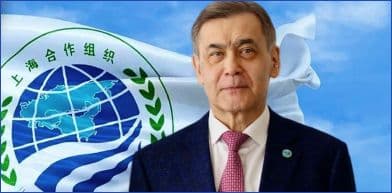
Nurlan Yermekbayev is one of those very important people most of us in the West have never heard of. I had been travelling with him for two days in the Xinjiang Region of China before I even realised who this quiet, dignified man was. As the Secretary-General of the SCO – the Shanghai Cooperation Organisation – Yermekbayev helms a multi-state organisation that is helping drive, in their own words, tectonic shifts in global politics, economy, and other spheres of international relations. How I got an interview with him was almost comedic.
I was part of a group of international journalists, politicians, academics and analysts who were hosted on a tour of Xinjiang in September and invited to attend an international conference with the region’s leaders. It turned out that the main reason the Secretary-General was in the region was for a series of meetings with Party Secretary Chen Xiaojiang and other officials of the region. Xinjiang is home to 25 million people, about 45% of whom are ethnic Uyghur. It is also China's key gateway to the rest of Eurasia and what many believe will be tomorrow’s new world order.
Our group visited a variety of sites associated with the Belt and Road Initiative, including the Khorgos Gate on the border with Kazakhstan. Khorgos is a centrepiece, a key node in the chains that are binding the countries of Eurasia into a modern Silk Road stretching from Europe to the Sea of Japan. Seeing Khorgos was Yermekbayev’s idea of a bit of R&R.
The scale of what has been – and is being – created across Xinjiang is something you have to see to believe. Long ranks and files of rail freight crossing the border, massive factories and logistics centres popping up like spring mushrooms, millions of new housing units for the population and its booming economy, the caravans of trucks, the endless fingers of pipelines and telecommunications cables extending into the distance and which eventually criss-cross the SCO member states – China, Russia, Kazakhstan, Kyrgyzstan, Tajikistan, Uzbekistan, India, Pakistan, Iran and Belarus. While the rest of the world follows Donald Trump's latest antics, these countries are quietly spending trillions of dollars to create an integrated Eurasia.
Over breakfast one day in the State Guesthouse in Yining, a Brazilian journalist, Nelson de Sá, leant towards me and whispered: “Do you know who that guy there is?” I had seen and greeted the man he was referring to but had no idea. True, I had been puzzled why, wherever we went, there was a small accompanying motorcade of black sedans, and a mini-bus out of which emerged minders, a few distinguished delegates and various athletic men in suits. “He’s the Secretary-General of the SCO,” de Sá whispered.
“[Expletive!] If I get a chance I’m definitely going to ask for an interview,” I told the Brazilian journalist. The next day at lunch Yermekbayev was seated with Bhokin Bhalakula, Thailand’s former Deputy Prime Minister who was also part of our party. I joined them and we talked about Émile Zola, the Dreyfus Affair, and geopolitics. At the end of the lunch I asked if the Secretary-General would accept a short interview. Yes. That afternoon.
Immediately before joining our tour, Yermekbayev had been with Presidents Xi Jinping, Putin, Pezeshkian and Erdoğan along with a host of other leaders, including India’s Prime Minister Narendra Modi, attending the 26th SCO Council of Heads of State summit in Bishkek, Kyrgyzstan.
The SCO members account for 40% of the world’s population, 25% of its GDP and 60% of the vast Eurasian landmass, with coastlines on the Indian Ocean, the Arctic and the Pacific. It has seven times the population of the EU, eight times the land area and more than double ($71 trillion) the EU’s GDP (PPP).
It is not a military bloc but it is worth noting that its members include four nuclear-weapons states: China, Russia, India and Pakistan. As I wrote a few years ago: when Eurasia awakes our world will shake. The organisation sees itself as the driver of a fairer multipolar world order that is slowly overtaking the Western-dominated system. This is the Quiet General’s day job.
Over a small table in the hotel in Urumqi, the capital of the Xinjiang Uyghur Autonomous Region, Yermekbayev spoke in a soft Central Asian accent; a rumbling voice, a bit like an idling tank. He is a former Defence Minister in Kazakhstan, a Lieutenant General, and a long-standing diplomat who has the wonderful title of Ambassador Extraordinary and Plenipotentiary. A graduate of Moscow’s Military Red Banner Institute, a sinologist, an author, and a PhD fluent in Mandarin and English, the Secretary-General discreetly commands attention.
Years ago, as Secretary of the Security Council in Kazakhstan he was tasked with dealing with Islamist militants within his country and cross-border counter-terrorism. As with Xinjiang, and, of course, Pakistan, Iran and others in the region, Kazakhstan had serious challenges from militants. The US war on Afghanistan was still raging, with knock-on impacts across the region.
Yermekbayev recalls that the SCO was initially formed as a security organisation in 2001 to combat terrorism, separatism and extremism within the member countries before evolving into the social, economic, security and infrastructure facilitator it is today.
“We realized that sustainable security cannot be provided without solving social and economic issues. And it can’t exist without building trust between our member countries – that's why building trust is one of the major pillars of our organization,” Yermekbayev told me.
As the US continues to weaponize the dollar-denominated global trading system, SCO countries are moving closer to the creation of alternative systems. Bilateral trading in national currencies to bypass Western sanctions is growing steadily. Russia and China, for example, settle over 90% of their bilateral commerce in rubles and yuan. Various SCO countries tap into China's CIPS (Cross-Border Interbank Payment System) for bilateral trades. The establishment of an SCO development bank capable of fully protecting Eurasia from Western coercive measures is still, however, on the drawing board.
Yermekbayev stresses the centrality of accepting different systems of governance as one of the keys to the SCO’s success.
“We have parliamentary countries like India and Pakistan. We have Iran and Pakistan which are Islamic Republics. But at the same time, we have presidential republics in Central Asia. We have Russia. We have Belarus. So location, ethnic traditions, organization of the state system may differ, but still all these countries manage to find compromise, manage to sit at the table and discuss issues.”
Yermekbayev also emphasised the “Shanghai Spirit” that drives the organisation: a commitment to multilateralism centred around an agreed code.
“There are six principles. One of them is what you just mentioned: respect for cultural and civilizational diversity. The other principles include mutual equality, mutual trust, mutual profit, and striving for common development. One more important principle is to solve all issues only through negotiations and consultations. That's why, regardless of the size of the country – for example, China is very big – all are equal. It is strictly followed at all levels: junior experts, at the level of ministers, and at the level of heads of state.”
“Regarding the multipolar world – there is a misperception that the SCO is a kind of ‘anti-somebody’ bloc. SCO is not a military-political bloc. For example, in NATO, they have so-called collective security principle (Article 5). We don't have this.
“But our leaders consistently declare – and it is written in our declaration – that we stand for a multipolar, more fair, more democratic new world order – one which will better represent the interests of the global south, of developing countries, and also which will be guided by United Nations, by the UN articles, and by international law. So it is a priority for us: international law and United Nations regulations.”
Yermekbayev believes these values and principles are acting as a magnet for new SCO members that is as powerful as the economic factors driving Eurasian expansion.
The Secretary-General is determined to accelerate the SCO’s emergence as a key international institution particularly at this time of rising tensions, unilateral wars and the constant violations of the UN Charter. He told the audience at the Shangri-La Dialogue earlier this year:
“In these conditions, the role of regional organisations continues to steadily increase, with a greater responsibility falling on their shoulders for the affairs in their regions.”
Watch this space. It’s called Eurasia.