The controversy surrounding Rastriya Swatantra Party (RSP) lawmaker Khagendra Sunar raises a question that goes beyond one politician and the allegations against him: can a new political party bring a change in political culture, or will it eventually fall into the same habits it once criticised?
The RSP entered Nepal’s politics with a promise of doing things differently. Its appeal rested partly on public frustration with established parties, their leadership and their repeated failures to meet people’s expectations. Many voters, particularly younger people, saw the party as an opportunity to move beyond familiar political faces and practices. That support came with expectations. People wanted not only new representatives but also a different standard of conduct.
That is why controversies involving some of the party’s representatives deserve serious attention. The issue is not whether every allegation against a politician is true. It is whether the party has the discipline, judgement and willingness to deal with misconduct when credible questions arise.
The allegations involving Sunar, including claims concerning a personal relationship, financial transactions and leaked audio recordings said to contain abusive language and threats, have attracted public attention. Sunar has reportedly disputed the authenticity of the recordings, suggesting that artificial intelligence or other technology may have been used to fabricate them. These claims must be examined fairly. An allegation is not proof, and a recording whose authenticity is disputed should not be treated as conclusive evidence without proper verification.
But the need for a fair inquiry does not relieve the party of its responsibility. The RSP must establish what happened, explain its decisions and ensure that its members understand the standards expected of them. If serious misconduct is established through a fair and credible process, the party should be prepared to take firm action, including expulsion where warranted. Political connections, public popularity or the fear of losing support should not determine the outcome.
There is also a wider question the party needs to confront: why do controversies involving some of its representatives keep returning? It would be unfair to treat the conduct of a few members as representative of the entire party. Yet it would be equally unwise for the leadership to dismiss each incident as an isolated problem without examining whether there are weaknesses in its own practices.
A party’s conduct begins long before a controversy reaches the headlines. It starts with the people it selects as candidates, the scrutiny it applies to them and the expectations it sets after they enter public office. Winning an election is not the only test of a candidate. Personal integrity, respect for others, financial transparency and the ability to exercise restraint are also important. If these qualities receive less attention than popularity, public speaking or the ability to attract votes, the party may find itself repeatedly dealing with problems that could have been prevented.
The RSP cannot claim to represent a new political culture simply because many of its leaders are new to parliamentary politics. Nor can it assume that public anger towards traditional parties will protect it from criticism. Voters who supported the party in the hope of seeing change may be especially disappointed when its representatives appear to repeat behaviour associated with the old political establishment.
This is where internal supervision matters. Political parties cannot control every private action of their members, nor should they intrude unnecessarily into personal lives. But elected representatives have public responsibilities, and allegations of threats, abuse, financial impropriety or other serious misconduct cannot be brushed aside as purely private matters when they raise legitimate questions about a person’s judgement and suitability for public office.
The party leadership should have clear rules for receiving complaints, conducting inquiries and imposing disciplinary measures. Those rules should apply to everyone, regardless of position or influence within the organisation.
Investigations should be timely, evidence-based and free from factional pressure. Members facing allegations must have a proper opportunity to respond, while complainants should be treated with dignity and protected from intimidation. Decisions should be explained to the public to the extent possible without compromising privacy or the fairness of the process.
Such measures would serve the party better than either reflexively defending its members or abandoning them at the first sign of controversy. Automatic defence damages credibility; punishment without proper inquiry damages justice. Responsible leadership requires the ability to distinguish between an unsubstantiated accusation, a lapse in judgement and established serious misconduct.
The public debate around Sunar has also drawn attention to the way politicians speak and behave. Social activist Nirmala Dhakal has argued that the discussion around what has been described as the Khagendra style is not merely about one person’s manner of speaking. It is also about the political culture that a new generation will build while challenging the old establishment. That is an important distinction. Changing the people in power means little if the attitudes and behaviour associated with power remain unchanged.
Strong language may sometimes be used to challenge injustice or expose failures. Politicians do not have to speak softly to be responsible, and disagreement should not be mistaken for misconduct. But there is a difference between speaking firmly and humiliating others, between holding powerful people to account and using public attention to threaten or demean someone. Political courage is not measured by how aggressively a person speaks. It is measured by the willingness to defend principles, accept scrutiny and take responsibility for one’s actions.
Human rights activist Mohna Ansari has also called for an end to the defamation of others, stressing the need for more civil ways of addressing disputes. Her concern points to a broader problem in public life: personal attacks too often replace reasoned argument. Social media can intensify this tendency, turning allegations into verdicts and disputes into public spectacles before the facts are established. Politicians, their supporters and their critics all have a responsibility not to fuel that process.
At the same time, appeals for civility must not become a convenient way to silence criticism. Public figures should expect scrutiny, and journalists and citizens must remain free to raise questions about their conduct. The answer to irresponsible accusations is not to discourage scrutiny but to insist on evidence, accuracy and accountability. A democratic society needs both a free public debate and a fair way of establishing the facts.
The responsibility does not rest with the RSP alone. Traditional parties have a longer record in government and a greater obligation to examine how they have handled misconduct within their own ranks. Too often, political leaders have defended colleagues, delayed disciplinary action or treated wrongdoing as a problem to be managed rather than a breach of public trust. The result has been a loss of confidence in parties and institutions.
New parties should not repeat these mistakes. They should be more careful precisely because they entered politics promising something better. The RSP and other emerging political forces must understand that public frustration with established parties is not a permanent guarantee of support. Voters can change their minds when promises are not matched by conduct.
Self-discipline must therefore become part of party culture, not merely a phrase used in response to a scandal. Leaders should be willing to question their own members, enforce common standards and accept that a popular representative may still be unsuitable for public office if serious wrongdoing is established. Equally, disciplinary action should never be used to settle internal rivalries or silence legitimate dissent. Rules must protect both integrity and fairness.
The RSP has an opportunity to show that it takes these responsibilities seriously. It can conduct a credible inquiry into the allegations involving Sunar, communicate its findings responsibly and act according to the evidence. If the allegations are not substantiated, that too should be made clear. If serious misconduct is established, the party should not hesitate to impose appropriate sanctions, including expulsion when justified. What matters is that the decision rests on evidence and consistent standards, not political convenience.
For Nepal, the larger lesson is straightforward. Political change cannot be judged by the age of a party, the language of its campaign or the popularity of its leaders. It must be judged by how those leaders behave when they hold power, how they respond when questions are raised and whether they are prepared to hold their own people to account.
New faces can bring fresh energy to politics, but faces alone do not change political culture. That requires discipline, honesty and the willingness to accept consequences. The RSP made its appeal by promising a break from the past. It now has to demonstrate that the promise means something in practice. The same test applies to every established and emerging party in Nepal: when a member falls short of the standards expected of public office, will the party protect the individual, or will it protect the public trust?
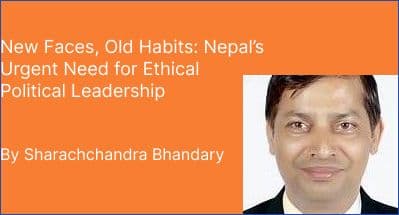
Sharachchandra Bhandary
Executive Editor
National News Agency (RSS)