
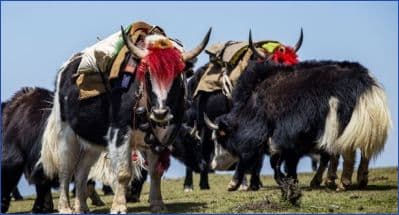
Kathmandu, 19 October 2026 – Yak herders from Bhutan, India and Nepal will formally launch the Himalayan Yak Herders' Network at Bhutan’s 9th Royal Highland Festival on 23 October, establishing the first regional platform dedicated to yak herding communities in the Himalaya.
The launch follows nearly a decade of cooperation among herders, governments and development partners and comes as mountain communities face mounting pressures from climate change, rangeland degradation and outmigration. His Majesty the King of Bhutan and the Prime Minister of Bhutan are expected to attend the festival.
What:
Official launch of the Himalayan Yak Herders' Network, a regional platform for collective advocacy, knowledge exchange, capacity building, and cooperation among yak herding communities. The network draws inspiration from the herder-owned model of the World Reindeer Herders Association in the Arctic. Yak herders will own and lead the network, with Bhutan hosting its Secretariat.
Who will participate:
Bhutan Yak Federation
Yak and Chauri Farmers Federation Nepal
Yak Federation of India
Government representatives from Bhutan, India, and Nepal
Researchers, development partners and other stakeholders
When and where:
9th Royal Highland Festival, Laya, Gasa District, Bhutan: 23 and 24 October 2026
Launch ceremony time: 23 October | 12:00 PM, Bhutan Standard Time
Why it matters?
Yak herding supports livelihoods, cultures and mountain economies across the Himalaya. Yet herding communities face growing challenges, including:
Declining yak populations
Shrinking and degraded rangelands
Climate change impacts
Loss of yak genetic diversity
Wildlife depredation
Limited access to markets and services
Youth migration from highland areas
These challenges transcend national borders and require regional solutions.
The Himalayan Yak Herders’ Network will provide a platform for collective advocacy, knowledge exchange, capacity development and cross-border cooperation. By bringing together national federations from Bhutan, India and Nepal, the network aims to strengthen resilient livelihoods, healthy rangelands, and the conservation of yak genetic resources.
Background
The idea of a regional yak herders’ network emerged in 2016 when herders, researchers and government representatives from Bhutan, India and Nepal came together through ICIMOD’s Kangchenjunga Landscape Conservation and Development Initiative.
In 2018, representatives attended the Arctic Frontiers conference in Norway and engaged with the Association of World Reindeer Herders, whose cross-border model inspired a similar platform in the Himalaya.
The three countries subsequently agreed to establish strong national federations before creating a regional network. National federations were formalised in Bhutan (2022), Nepal (2023), and India (2025).
In 2025, federation leaders and government representatives formally committed to establishing the Himalayan Yak Herders’ Network at the 10th Sustainable Animal Agriculture for Developing Countries (SAADC) conference in Vietnam.
The launch at the Royal Highland Festival in Bhutan marks the culmination of nearly a decade of collaboration among Himalayan yak herding communities and their partners.
Rangelands and yak herding at a glance
Rangelands occupy over 60% of the Hindu Kush Himalaya (HKH) land area.
They are the primary spaces and resources for 25–30 million Indigenous and culturally diverse people who depend directly for livelihoods and subsistence.
According to the National Sample Census of Agriculture (2021/22), Nepal's agricultural holdings kept an estimated 53,195 yak/nak/chauri, reared by 9,899 holdings (NSO, 2023).
In Nepal’s Karnali Province alone, rangelands accounts for 34% of Nepal’s area. This area harbor 92 medicinal species – 82 of which are actively traded in contemporary markets generating approximately 36 million NPR annually as revenue.
According to India's 20th Livestock Census (2019), the country had about 58,000 yaks (DAHD, 2019).
In 2026, as per the Yak Federation of India, 526 household members of India’s Yak Federation have approximately 32,000 yaks.
In Bhutan, as per National Statistics Bureau (NSB) 2024, the country has 746 households rearing 29,432 yaks in total. Yak herding contributes 4 percent to the nation's livestock products.
Yak populations across Bhutan, India and Nepal have declined significantly in recent decades due to changing land use patterns, rangeland degradation, climate pressures and socioeconomic change.
Story and visual opportunities
Launch of the first regional yak herders' network in the Himalaya
Yak herders from Bhutan, India and Nepal gathered in traditional highland attire
Yaks and pastoral landscapes set against the high Himalaya
Interviews with herders on climate change, migration, traditional livelihoods and rangeland conservation
Access to federation leaders, researchers, policymakers and development partners
Festival activities including yak displays, cultural performances, highland product exhibits and traditional games
Expected attendance of His Majesty the King of Bhutan and the Prime Minister of Bhutan at the festival.
Spokespersons (details available on request)
Tashi Dorji, Senior Livestock and Rangeland Specialist, ICIMOD
Email: media@icimod.org