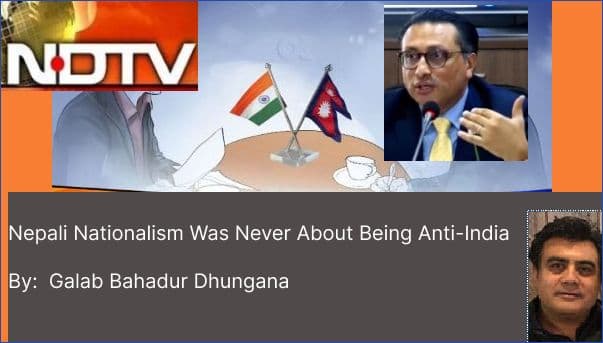
Speaking at the NDTV World Summit in New Delhi on October 23, Finance Minister Swarnim Wagle said there was a time when Nepal equated nationalism with anti-India sentiment, and that this era is now over. His emphasis on stronger economic relations is welcome and offers an opportunity to reflect on what Nepali nationalism has meant throughout our history. At its heart, Nepali nationalism has never depended on opposition to India. It has been about preserving our independence and the freedom to determine our own future.
Its foundations were laid by Prithvi Narayan Shah during the unification of Nepal in the eighteenth century. His Divya Upadesh emphasized national unity, self-reliance, and caution in dealing with powerful neighbors. Bahadur Shah continued the expansion of the kingdom, while generals such as Amar Singh Thapa and Balbhadra Kunwar defended it against the East India Company. Despite substantial territorial losses under the Treaty of Sugauli in 1816, Nepal retained its independence. Even the authoritarian Rana rulers pursued a foreign policy intended to preserve that sovereignty, culminating in the 1923 treaty with Britain.
The democratic revolution of 1950 and 1951, in which India played an important role, introduced a new dimension to nationalism through the struggle for popular sovereignty. King Mahendra later diversified Nepal's foreign relations and strengthened national connectivity through the East West Highway. The withdrawal of Indian military personnel from Nepal's northern checkposts in 1969 further asserted Nepal's independence, although Mahendra's suppression of democracy exposed the limits of nationalism without political freedom. King Birendra's 1975 proposal to declare Nepal a Zone of Peace, endorsed by more than one hundred countries but not India, reflected the continuing pursuit of peaceful coexistence and strategic independence. India could still consider supporting a renewed proposal suited to today's democratic Nepal.
Nepal and India share an exceptional relationship through an open border, cultural traditions, religion, trade, and family ties, and India was among the first to help Nepal after the 2015 earthquake. Yet friendship has occasionally been strained by political differences. When the trade and transit treaties expired in March 1989, India closed 13 of the 15 transit points through which landlocked Nepal reached the world. Fuel, insulin and baby food grew scarce. According to the US Library of Congress country study of Nepal, economic growth, which had reached 9.7 percent in 1987/88, fell to 1.5 percent in 1988/89. In September 2015, only months after earthquakes had killed nearly 9,000 people, an undeclared blockade choked supplies for four and a half months. UNICEF warned that more than three million young children were at risk. India denied responsibility for the 2015 blockade, but the hardship experienced by ordinary Nepalis was real.
Anger spilled into street slogans and cable operators pulled Indian channels off the air, yet that anger was a response to a blockade, not a founding creed. Unresolved disputes over Kalapani, Lipulekh and Limpiyadhura remain additional sources of concern in bilateral relations. These grievances should be understood in their historical context rather than automatically interpreted as hostility toward India or its people.
Nepal's independent relationships with China and Western countries are equally natural expressions of sovereignty. India pursues its own strategic interests across the world, and Nepal seeks the same freedom. Nationalism is not an economic doctrine either. India moved from extensive restrictions on foreign investment to economic liberalization without compromising its national identity. Nepal can similarly welcome foreign investment, regional integration, and diversified international partnerships while remaining firmly committed to its national interests.
Nepal's democratic movements and the Constitution of 2015 have further established that sovereignty belongs to the people. Modern nationalism must therefore embrace territorial integrity, democratic institutions, the rule of law, and equal rights for every citizen. Economic prosperity and national independence are complementary aspirations, not competing ones.
Minister Wagle's vision of closer economic cooperation with India is consistent with these principles. The two economies are already deeply intertwined. According to Department of Customs figures for the last fiscal year, India accounted for roughly three fifths of Nepal's foreign trade and bought more than four fifths of its exports, while Nepal's deficit with India alone reached Rs 952 billion, more than half the national total. That imbalance is precisely why reliable transit matters so much to Nepalis. It also points to the opportunity ahead. Under a 2024 agreement, India is to buy 10,000 megawatts of Nepali electricity within a decade, and the Nepal Electricity Authority reports that approved export capacity already stands near 1,200 megawatts. A prosperous India offers enormous opportunities for Nepal, just as a peaceful, prosperous, and independent Nepal serves India's interests. Greater mutual confidence can be built through respect for each other's foreign policy choices, constructive resolution of territorial disagreements, and a shared commitment to ensuring that political differences never again disrupt essential trade and transit.
Nepali nationalism has evolved through monarchy, oligarchy, democratic struggles, and constitutional transformation, but its central aspiration remains unchanged. It is about Nepal for Nepalis first, while seeking friendship with India, China, and the wider world on the basis of sovereign equality and mutual respect.
Being pro-Nepal has never required being anti-India.