Ambassador Annalena Baerbock, President of UN General Assembly said in September 9, 2025, “Where is the United Nations as conflict spreads, as our planet burns, as human rights are trampled?”
Antonio Guterres, the Secretary General of the United said on September 12, 2025, ““But today, peace is under siege. Conflicts are multiplying. Civilians are suffering. Human rights and international law are being trampled…”
Former UN High Commissioner for Human Rights Michelle Bachelet warned, “A world with diminished human rights is a world that is stepping backwards into a darker past.” That sobering message reflects an uncomfortable reality: despite universal declarations and solemn promises, human rights protections remain dangerously fragile across much of the world.
Ambassador Volkan Bozkir, as President of the UN General Assembly, pledged that those in need or under oppression should trust that their voices will be heard in the world’s most democratic forum. And yet, global governance continues to be shaped less by principle than by power — leaving the defenseless without genuine champions.
Nowhere is this disconnect clearer than in Indian-occupied Kashmir, where silence from the international community has enabled relentless brutality against a civilian population of more than twelve million.
The Universal Declaration at 77: Promise and Paradox
As the world marks the 77th anniversary of the Universal Declaration of Human Rights (UDHR), its principles — equality, freedom, dignity — still command global respect. It transcends religion, nationality, and ideology. All human beings stand on the same moral plane when dignity is at stake. Yet paradoxically: never have so many rights been proclaimed, yet so many violated.
The global landscape is littered with crises:
The persecution of Rohingya Muslims in Myanmar
Genocide and mass displacement in Syria
Human devastation in Yemen
The denied right of self-determination in Palestine
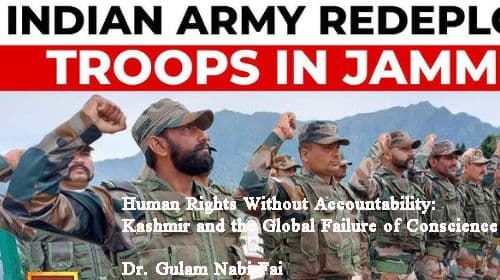
Kashmiris living under the boots of 900,000 Indian troops
These are not isolated failures — they reflect a broader collapse of moral responsibility.
International condemnation is sporadic, selective, and often guided by strategic interests rather than humanitarian need. Unless the world accepts a binding duty to defend victims of grave abuses everywhere — regardless of politics — human rights enforcement will remain inconsistent and unjust.
The UN: A Broken Promise
The United Nations was created to ensure that horrors like the Second World War never return. Conflict prevention and resolution should therefore be its top priority.
But judged on that core mission, the results have been deeply disappointing. The UN has too often watched from the sidelines as atrocities unfolded — Bosnia, Rwanda, Syria. In each case, delayed action cost countless innocent lives. That same tragic pattern is visible today in Kashmir.
Kashmir: A Dispute Ignored, A People Forgotten
Kashmir is one of the oldest unresolved conflicts on the UN Security Council’s agenda. In 1948, India and Pakistan agreed — under UN supervision — to a free and impartial plebiscite allowing Kashmiris to determine their own political future.That commitment was betrayed.
Recognizing that the people would never willingly choose accession to India, the government in New Delhi created excuse after excuse to block the vote. The UN continues to recognize Kashmir as a disputed territory, yet its resolutions remain unimplemented — a testament to the powerlessness of promises when political will is absent.
Meanwhile, Kashmiris endure a reality defined by:
Extrajudicial killings
Enforced disappearances
Systematic torture and sexual violence
Mass arbitrary detentions
Media censorship and criminalization of dissent
Even peaceful advocacy for UN-mandated resolutions is treated as a crime.
To prevent public scrutiny, India has shut out foreign media and intimidated local journalists. The Committee to Protect Journalists (CPJ) warns that independent reporting in Kashmir is on the brink of extinction. Without international eyes, the crisis remains hidden from those who might otherwise be compelled to act.
A Nuclear Flashpoint the World Cannot Ignore
This silence carries grave risks. Kashmir is the most militarized and most nuclear-volatile region on earth. India and Pakistan have fought three wars, and nearly a fourth — each time shadowed by the threat of nuclear escalation.
No conflict poses greater danger of human catastrophe far beyond its borders. Treating Kashmiris as a negotiable pawn in regional geopolitics could ignite a disaster that humanity cannot afford.
History reminds us: appeasement of aggression is not peace. Czechoslovakia learned that lesson in 1938 — the world must not relearn it in Kashmir.
Self-Determination: A Proven Path to Peace
Self-determination has resolved numerous long-standing conflicts:
Namibia
East Timor
Eritrea
Kosovo
Montenegro
South Sudan
All of these followed oppressive rule and were guided by international law and United Nations decisions. Kashmir deserves the same path to justice, stability, and dignity.
What Must Be Done
If the UDHR is to remain a credible document — not merely poetic language — the United Nations must act where its own resolutions are being violated. The Secretary-General should:
Appoint a UN Special Envoy on Kashmir
Ensure Kashmiris — the primary stakeholders — are fully represented in all negotiations
Hold Indian officials accountable for grave abuses under international law
Human rights are not symbolic entitlements. They are legal obligations.
A Window of Opportunity
In May 2025, when India and Pakistan stood at the brink of nuclear confrontation, U.S. President Donald Trump intervened and brokered a ceasefire — offering mediation to resolve the Kashmir dispute. That offer demonstrated the potential for diplomacy to avert catastrophe. But a diplomatic opportunity without follow-through is merely a pause in crisis. If mediation was worth proposing, it is worth pursuing.
A Final Word
The promise of the UDHR will ring hollow as long as the world allows millions of Kashmiris to live without rights, without justice, and without a voice. Human rights delayed are human rights denied. The world must not wait for another tragedy to awaken its conscience. Kashmiris ask for nothing more — and nothing less — than the same rights that liberated other oppressed peoples:
the right to decide their own future.
Dr. Ghulam Nabi Fai is also the Secretary General,
Washington-based World Kashmir Awareness Forum.
He can be reached at: WhatsApp: 1-202-607-6435
gnfai2003@yahoo.com
www.kashmirawareness.org