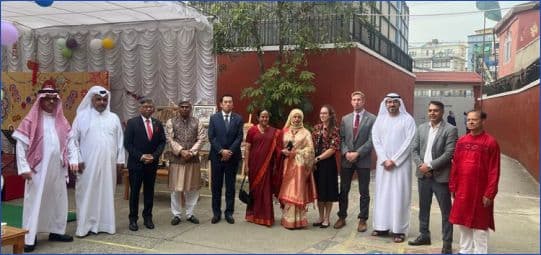
Ambassadors, Heads of Mission from various countries, senior officials from the Government of Nepal, diplomats from resident Missions, Nepali business leaders, the Bangladeshi community in Nepal, and their families all participated in the celebration.
The Secretary General of SAARC was the guest of honor at the event. Representatives from countries in the region, including India, Pakistan, Myanmar, and Sri Lanka, added a national and regional dimension to the celebration.
In a press release, the Bangladesh Embassy in Nepal highlighted the cultural significance of Pohela Boishakh, emphasizing its role in capturing the history, culture, tradition, and heritage of Bengali national identity. The festival symbolizes change and transformation throughout the centuries, marked by hall khata and new beginnings. The Ambassador mentioned that Pohela Boishakh transcends religious, societal, and geographical boundaries, reflecting the vibrant spirit of Bengali culture, customs, and traditions. The celebration promotes cultural harmony and mutual understanding among communities and nations across state boundaries, fostering friendship and cooperation.
The Ambassador also discussed the civilizational linkages between Bangladesh and Nepal, emphasizing the shared cultural heritage that forms a strong foundation for collaboration in cultural exchange and tourism. He highlighted the Charayapada, the mystical hymns of Buddhist monks from the 6th-12th centuries in South Asia, as an early written form of vernacular Bengali dialect and a shared cultural heritage of mankind. This cultural uniqueness strengthens the bilateral ties between Bangladesh and Nepal and promotes cultural exchange and tourism cooperation.
The guest of honor expressed appreciation for the rich cultural heritage and traditions of Bangladesh and emphasized the significance of regional cultural exchanges in strengthening ties among the people of South Asia. He described the festival as a celebration of harmony and uniqueness within diversity.
The event included a cultural performance featuring Bangla and Nepali songs, showcasing the deep cultural connections between Bangladesh and Nepal. Nepali artist Mr. Sabu Lama and students from a local Nepali school performed Bangla and Nepali songs alongside members of the Bangladeshi community. Children enjoyed fun games, and a prize distribution ceremony added to the festive atmosphere.
The Embassy grounds were adorned with colorful decorations and traditional Bangladeshi artifacts. Guests were treated to traditional dishes associated with New Year celebrations, such as (soaked rice served with hilsha fish), as well as traditional cakes and sweets.
The event underscored the shared cultural ties between Bangladesh and Nepal through their traditional solar calendars and New Year festivities—Pohela Boishakh in Bangladesh and Naya Barsha, the Nepali New Year—both observed in mid-April. It celebrated the common civilizational heritage and seasonal rhythms of the region, strengthening the cultural bonds between the two countries. The evening concluded with an early dinner featuring traditional Bangladeshi cuisine.
The Embassy of Nepal hosted a virtual event today to commemorate International Wellness Day 2026
The event aimed to raise awareness of Wellness Day among the Nepali diaspora in Canada as a crucial way to improve quality of life, uphold human dignity, and empower individuals to reach their full potential. The program began with a video message from Nepal's Minister for Foreign Affairs, Shisir Khanal, in honor of International Wellness Day.
In his opening remarks, Ambassador Bharat Raj Paudyal welcomed participants to the inaugural International Wellness Day event. He shared that on March 10, 2026, the United Nations General Assembly designated April 15 of each year as International Wellness Day through a resolution proposed by Nepal.
The Ambassador highlighted the importance of wellness in today's world, emphasizing the need for a focus on physical, mental, and emotional well-being through preventive, lifestyle-oriented, and person-centered approaches.
He emphasized that the tradition of wellness has been a part of Nepal's culture since ancient times and it is now our collective duty to promote it globally for the benefit of all. He urged all members of the Nepali diaspora to incorporate wellness practices into their daily routines and to promote it worldwide as a distinctive Nepali brand.
The event also included speeches by Mr. Jagannath Sapkota, President of NRNA-NCC Canada, and a brief session of guided Yoga, Pranayam, and meditation led by Ms. Priyambada Acharya, President of Jeevan Vigyan Canada, and Mr. Thaneshwor Subedi, Vice-President of Jeevan Vigyan Canada.
@ NEW SPOTLIGHT ONLINE