For some time now, a few of us—including myself—have been writing critically about the Nepal Army. Almost always, the same question comes up: Why do you side with those who have been against the Nepal Army from the start? The question is posed as a conclusion rather than a genuine inquiry. Criticism is seen as hostility; questioning is mistaken for betrayal.
The answer is neither evasive nor emotional. Critique is not hatred. Hatred is a psychological trait; critique is an intellectual responsibility. Those who despise the Army are entitled to their feelings, just as others are entitled to their respect. The concern here is different. The issue is not the idea of the Nepal Army or the ordinary soldiers whose lives are shaped by commands and constraints, but the historical and current reality that the institution, as guided by its leadership, has too often acted not for Nepal as a political community of citizens but for itself as a self-preserving power.
Understanding the difference between the Army acting independently and serving Nepal as a political community is crucial because when this distinction diminishes, democracy itself becomes vulnerable.
In Nepal, the Army holds a unique position. It is neither fully civilian nor entirely accountable, neither openly political nor genuinely non-political. It exists in a state of assumed sanctity, where reverence takes precedence over scrutiny. Once an institution achieves this status, questioning it becomes a responsibility, reminding the public of their duty to advocate for transparency and accountability.
Republics decline not only through coups but also when respect replaces rationality.
The Army is often discussed as if it were Nepal itself, rather than an institution funded by Nepal, staffed by Nepalis, and answerable to Nepali citizens. This rhetorical unity serves a purpose: criticizing the Army is seen as attacking the nation, while Army failures are protected from national consequences. A state that cannot distinguish itself from its institutions has lost rational governance.
Every critique is met with a record of sacrifice. Soldiers die. Blood is shed. History is shaped. All of this is true—and still not enough. Sacrifice does not grant moral immunity. If it did, history would lack ethical consistency. Empires and tyrannies were also built through sacrifice. The fundamental ethical question is not whether a sacrifice happened, but for what purpose, under whose authority, and who benefits.
Sacrifice makes suffering clear; it doesn’t justify power.
Like many long-standing institutions, the Army has learned to use its history as a shield against current scrutiny. History becomes an alibi. The uniform becomes a defense. Accountability is no longer debated; it is dismissed as disrespect.
The main question, then, remains unavoidable: Who does the Army serve? The Constitution? the nation as a moral project? Or the ruling elite, who control resources, promotions, and silence? Citizens can shape this answer through active engagement.
Nepal’s recent history shows a troubling pattern. During times of democratic stress, the Army often chooses caution over courage, neutrality over morals, and silence over responsibility. This strategy might be justified in strategy, but it is morally empty. Gaining stability by ignoring principles is not absolute stability; it is just a delay.
The events of September 8 and 9, 2025, clarify any remaining ambiguity. On September 8, Gen-Z protesters were killed indiscriminately by the state, randomly and without proportionality. On September 9, Singha Durbar and other major government buildings were attacked and burned. The Parliament, the Supreme Court, and even the President’s residence were targeted by others claiming to act in the name of that same generation—repression one day; institutional collapse the next.
In both instances—when public trust, constitutional order, and the country’s physical infrastructure were directly threatened—the Nepal Army observed. Intentionally. Carefully. As if democracy were something to be watched rather than a duty to defend, emphasizing how silence undermines sovereignty and should concern every citizen. Citizens must remain vigilant to protect their sovereignty.
When questions were finally raised, the explanation given was deeply revealing about the institution. We were told that the Indian Army was “ready to intervene.” This statement deserves to be taken seriously, if only for what it admits. If true, it indicates a failure of sovereignty at the level of imagination: the keepers of the republic had already accepted that another army might define the boundaries of action within Nepal’s own capital. If false, it suggests a citizenry incapable of basic reasoning.
Both interpretations arrive at the same conclusion. The Nepal Army did not present itself as an institution acting under a constitutional duty, but as one waiting for external signals before deciding if internal collapse warranted a response. Taken loosely, this is strategic caution. Taken precisely, it is abdication.
An army that justifies inaction by citing the preparedness of another army is not describing deterrence; it is admitting paralysis. It implies that its purpose isn’t to defend sovereignty but to monitor it until conditions become favorable.
The irony is unavoidable. The institution seems skilled in ceremony, discipline, and controlled visibility, yet it operates primarily at night—only alert when accountability diminishes, and political costs are lower. This may be strategically smart. However, it is not constitutionally justified.
We are repeatedly told that the Nepal Army is apolitical. This is fiction. No institution that monopolizes organized force is truly apolitical. Silence is a political act. Inaction is a political choice. Selective intervention is a political strategy. Neutrality exercised by power is rarely neutral; it is a preference without a declaration.
The question, then, is not whether the Army is political, but which politics it serves—constitutional democracy or stability as defined by those temporarily in command.
Plato warned that those who mistake shadows for reality will resist enlightenment. The cave is not just a place of ignorance; it is also a place of comfort. Institutions, like individuals, can become used to the darkness. Applause is mistaken for legitimacy, obedience for respect, and endurance for virtue.
When power ends, asking ‘Why?’ and accepting ‘Because we are’ are no longer just possibilities.
The ongoing issue is this: the Nepal Army increasingly acts like an institution focused on its own preservation. Budgets grow larger while transparency diminishes. Audits are avoided. Archives stay sealed. Addressing fears that criticizing the Army might lead to political retaliation can empower citizens and policymakers to demand accountability without fear, strengthening democratic oversight.
Power intoxicates without chemicals. It diminishes empathy and normalizes control. Extended unchecked power creates the illusion of inevitability. That’s why criticism feels like an offense: it breaks the story of permanence.
When critics are told, ‘You have been against the Army since birth,’ what is truly being asserted is simpler: You refuse to participate in institutional self-deception.
Nationalism is then used as a defense. Flags replace arguments—emotion takes the place of reason. But nationalism without accountability is just performance. Patriotism isn’t loyalty to institutions; it’s devotion to principles. Nations are harmed not by criticism, but by silence that is mistaken for unity.
Nepalis’ loyalty does not belong to uniforms, myths, or untouchable institutions. It belongs to Nepal as a moral project. A republic worthy of the name must allow its most powerful institutions to be questioned, corrected, and restrained. If the Nepal Army serves Nepal, scrutiny strengthens it. If it serves itself, critique is not hostility—it is an obligation.
History will not inquire whether the Army was feared or revered. It will only ask this: When the republic faced a test, did the guardians defend the nation—or protect themselves?
Silence in the face of unchecked power will not be seen as neutrality. It will be remembered for what it truly is: complicity.
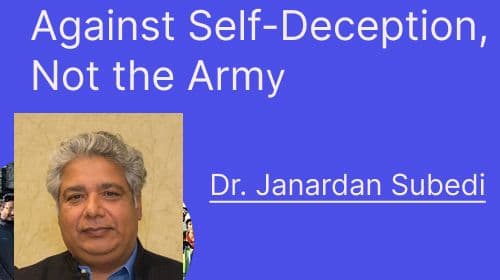
Author Subedi is a Professor of Medical Sociology at Miami University, USA
@deshsanchar