Dr. Alok K. Bohara -------------
What Changed—and Why It Matters
What struck me most about the past few days was not simply the Election Commission’s verdict, but what happened around it—before and after.
The EC moved swiftly and ruled in favor of Gagan Thapa’s special convention. That single act did something important: it closed an institutional ambiguity that had been hanging over everyone. Predictably, the intransigent leaders around the old guard—Deuba and his core circle—hardened their stance. That was expected. Power rarely yields gracefully.
Public intellectuals, on the other hand, largely embraced the change. That too was expected. Many of them had been waiting for some institutional signal—any signal—that the system could still correct itself.
But the most interesting story lies elsewhere.
It lies with the five or six respected leaders whose behavior shifted in subtle, sometimes painful ways—before the verdict, during the ambiguity, and after it was resolved.
Behavior Under Ambiguity
Some of them sat on the fence until the very end. Some even appeared at the Election Commission hearings on the side of the old establishment, despite having long expressed discomfort with it. A few went to the special convention, spoke, and then quietly stepped aside.
Dr. Chandra Bhandari and Dr. Sunil Sharma are emblematic here. Both attended the convention. Both lent moral weight to the reform impulse. And yet, when the moment required a clear institutional break, they hesitated.
Dr. Govind Pokhrel, who has never been fond of the Deuba establishment and has consistently spoken about unity, stayed away from the convention altogether. Later, when he mildly endorsed the EC’s verdict and the direction it pointed to, he was immediately subjected to intense social media backlash.
Dr. Sunil Sharma, after the EC ruling, accepted the verdict and expressed his desire to remain under the Nepali Congress flag—invoking history, continuity, and legacy.
Dr. Chandra Bhandari, even before the verdict, spoke with visible anguish about the damage done to the party, expressing the belief—rooted in experience—that “one day, we will have to come together,” even if repeated efforts failed this time.
And then there is Dr. Shekhar Koirala.
A leader many respected for his decency and long discomfort with entrenched power. He went to the EC hearing on behalf of the old establishment, and even after the verdict, continued to express his dissatisfaction about the convention. For many observers, that reaction was deeply saddening, not because of disagreement, but because it felt like a moral language struggling to explain an institutional outcome.
Another figure who belongs in this picture is Dr. Minendra Rijal.
Widely respected across party lines, Dr. Rijal has, in the past, shown uncommon courage to stand with the national interest over partisan comfort—most notably when he publicly defended the country’s position during a media debate with foreign television journalists while then–Prime Minister Oli was under attack. His resignation from a ministerial post after losing an internal party election remains one of the clearer moral gestures in recent political memory. He has never been an establishment loyalist in the narrow sense. Yet in this moment, he too appeared conflicted—accompanying Dr. Shekhar Koirala to the Election Commission hearing, not out of enthusiasm for entrenchment, but seemingly out of concern for party unity, institutional continuity, and the long history of the Nepali Congress itself. His position reflects a familiar tension: how to protect an institution’s survival when the rules governing it are themselves unclear. Again, this is not duplicity. It is what uncertainty does to even principled actors.
Taken together, these are not stories of good people and bad people. They are human stories of values encountering uncertainty —institutional ambiguities.
What Crisis Reveals—and What It Does Not
What we witnessed was not values being shaped by the crisis, but values being revealed by it.
Before the EC verdict, the system was ambiguous. No one knew which way the institutional wind would blow. In that space, hesitation was rational. Fence-sitting preserved options. Silence reduced risk. Moral appeals substituted for procedural clarity.
Once the ambiguity was removed, behavior began to settle—though not uniformly. Some aligned openly. Some accepted reluctantly. Some hardened. Some retreated further into moral language. But the overall temperature dropped.
This is exactly what behavioral science and neuroscience tell us about human behavior under stress. When rules are unclear and authority is silent, anxiety rises, narratives multiply, and people cling to familiar positions. When institutions step in and clarify—even if the decision is unpopular—cognitive load reduces. People no longer have to guess.
This is why the EC’s swift verdict mattered less for who “won” and more for what it did.
A Much Older Pattern
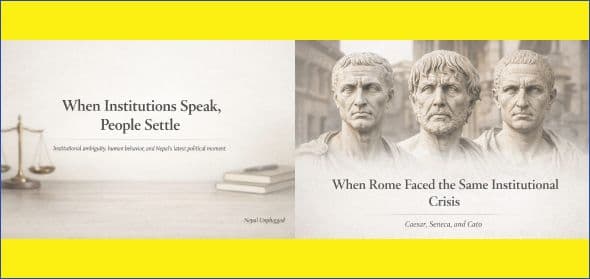
This is where the Rome analogy becomes useful—not as a flourish, but as a warning.
Two thousand years ago, the same drama played out.
There was Caesar, consolidating power through necessity and force.
There was Seneca, the philosopher-senator, endlessly reminding others to follow their North Star, to live by virtue, to discipline the self—while remaining embedded within a corrupt system he neither fully endorsed nor decisively left.
And there was Cato the Younger, rigid, rule-bound, morally uncompromising, willing to confront authority directly—even at the cost of his life.
All three coexisted.
All three were intelligent.
All three spoke of values.
What failed was not morality.
What failed was institutional constraint.
That parallel matters because Dr. Chandra Bhandari’s parliamentary speeches over the years sound uncannily Senecan. He has repeatedly warned that we embellish BP Koirala’s philosophy while violating it daily; that corruption has hollowed out the party from within; that leaders invoke ideals they no longer practice. He has spoken with moral clarity—yet when the decisive institutional crisis arrived, he stepped back rather than forward.
That does not make him hypocritical. It makes him human—caught between conscience and caution, exactly like Seneca.
Gagan Thapa, by contrast, resembles something closer to a Cato-like figure—not in temperament, but in posture. Direct, forceful, willing to confront authority openly, willing to risk isolation, and willing to force the system to choose rather than drift.
The point is not to crown heroes or villains.
Why Institutions Matter More Than Intentions
These roles recur when institutions fail to do their job early.
When ambiguity persists too long, people are forced to carry burdens institutions were designed to bear. Moral language is thrown around to show moral high ground even when what required was the procedural clarity. Alliances fracture. Friendships strain. Everyone becomes a reluctant strategist.
The EC’s verdict did not resolve all tensions. But it did something essential: it restored a feedback loop. It reminded everyone that uncertainty does not have to be permanent.
And that is why the real lesson here is not about personalities, but about institutions—and about how much human behavior depends on them, especially in moments of crisis.
When institutions speak, people may still disagree—but they no longer have to guess.
Jan 17