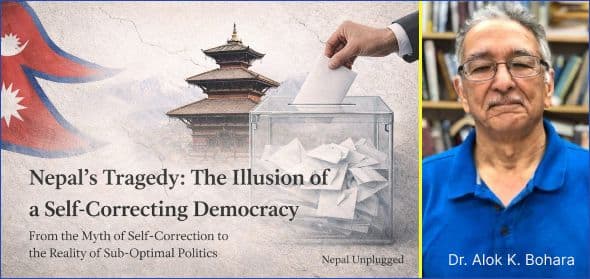
From the Myth of Self-Correction to the Reality of Sub-Optimal Politics
--------------------------------
The Puzzle That Started It All
About almost twenty-five years ago, I began to ponder the growing insurgency in Nepal. At the time, the country was humming with multiparty democratic activity—elections, political debates, party competition—yet alongside this, a violent insurgency was expanding. The coexistence of democratic engagement and insurgency felt inconsistent.
I raised this question with a political science professor, who introduced me to the core principles of liberal democracy. Elections alone, he explained, are not enough. For democracy to work, power must also be devolved, participation must be meaningful, and institutions must prevent excessive concentration of authority. That conversation led me to think seriously about federalism, proportional mixed electoral system and devolution, ideas I later wrote about in Nepali Times and other outlets.
Around the same period, I asked the same question to a well-connected, highly educated staunch democrat friend. His response was reassuring: democracy, he said, is self-correcting. The power games of Girija Prasad Koirala or Prachanda’s war against the establishment would eventually settle down. Citing other matured democracies, he assured me that multiparty system and democratic competition would take care of excesses. I was not totally convinced, but I nodded anyway.
Yet, in the years that followed, Nepal experienced not one but several political collapses, along with countless unsettling episodes. Governments fell, alliances reshuffled, constitutions were rewritten, and public anger periodically spilled onto the streets. None of this resembled the self-correcting democratic equilibrium I had been promised.
This essay returns to the original puzzle: why has Nepal’s democracy failed to self-correct? I have explored various facets of the system in earlier writings, but here I focus directly on the self-correcting mechanism—and why it appears to be missing.
A Simple Parallel: How Markets Actually Work
To understand this, it helps to look at another system we often assume to be self-correcting: markets.
In theory, markets work well when competition is strong. If a product is poor or overpriced, consumers stop buying it. Firms lose money, improve, or exit. New firms enter. Prices send signals. Over time, things adjust.
But this only happens when certain conditions exist: competition is real, information is clear, entry and exit are easy (smoother business registration mechanism) and no single firm controls the market (no monopoly). Consumer choices and product safety are protected by the government regulation or the market mechanism.
In real life, these conditions often fail.
When markets are dominated by monopolies or cartels, they settle into poor outcomes. Prices stay high. Quality remains low. Innovation slows. Consumers complain but have nowhere else to go. The market may not collapse—it settles into a bad but stable situation.
Think of a town served by only one internet provider. Everyone knows the service is slow and overpriced. Customers complain constantly, but switching is impossible because there is no alternative. The company does not improve—not because it doesn’t know better, but because it doesn’t have to.
This happens not because people are foolish, but because market power and incentives are misaligned. That is, the actors with market power—dominant firms and cartels—face incentives to preserve the status quo, while consumers and would-be competitors bear the costs without the ability to alter outcomes. The government regulatory agency fails to break the monopoly for various reasons, including the political influence.
A clear example is the U.S. pharmaceutical market. Powerful firms maintain high prices through patents, regulatory barriers, and limits on foreign competition. Consumers complain, but have few alternatives; regulators hesitate or fail to act decisively. Although antitrust laws formally exist to control the power of big firm, weak enforcement allows the system to stabilize around high prices and limited competition—an inefficient outcome.
What matters for my thesis here is not the market itself, but the logic of the system. When transparency, competition, choice, and independent oversight align, systems can correct themselves. Politics follows the same logic: it works only when rules are enforced, choices are real, and power is subject to scrutiny. I turn to that next.
Politics Is Not Very Different
As my friend said to me decades ago, democracy, just like the market, often self-corrects itself. If leaders perform badly, voters will punish them. If parties behave poorly, competition will fix it.
But this assumption holds only if political competition is real. We already know how political parties function in Nepal and what the country has endured over the past three decades.
For democracy to correct itself, citizens must have genuine choices. Political entry must be open. Parties must select candidates transparently. Rules must be enforced fairly. Power must be constrained.
When these conditions are missing, politics begins to resemble a monopolized market. When the two largest parties collude to form a government, the system is deprived of a viable opposition—this is collusionary politics, not competitive politics. We have termed that a musical chair PMship.
In Nepal, political power is often controlled through patronage networks, internal party gatekeeping, and bargaining among elites. Entry into politics is blocked not just by law, but by money, loyalty, family ties, and control over party tickets. Parties behave like cartels, protecting their turf.
Just as consumers are trapped in a monopolized market with few real choices, voters are trapped in cartel-like politics. Elections take place, but candidates are not chosen by people on the ground in the constituencies; they are decided through bargains and power-sharing deals at the center.
By the time voters go to the polls, real choices have already been removed. Promises to introduce primaries for candidate selection—even by some promising younger leaders—have remained only on paper.
Observed Elections, Filtered Choices
Nepal is not without election observers. Organizations like the National Election Observation Committee (NEOC), an ANFREL member, deploy thousands of observers, monitor codes of conduct, and issue pre- and post-election reports. Their work strengthens procedural integrity on Election Day—and that is important.
Yet what remains largely unobserved—and effectively unguarded—is the gatekeeping stage of democracy: how candidates are selected inside political parties.
Ticket distribution, proportional lists, and internal party democracy fall into this blind spot. Despite a clear constitutional mandate, the Election Commission has chosen not to enforce internal party democracy. Observers watch the polling booth; no one watches the gate.
The result is a structural gap. Elections are observed, but choices are pre-determined at the power center.
The Party-Level Myth of Self-Correction
The belief that democracy self-corrects is perhaps most visible—and most flawed—at the level of political parties themselves.
Two recent episodes illustrate this clearly.
First, within the UML, even after a period marked by deep public dissatisfaction and violence against protesting youth, the party in power did not correct course. Instead of renewal, K. P. Sharma Oli rewrote internal party rules—removing age and term limits—and secured a third term as party president. Whatever one’s partisan view, the institutional lesson is unmistakable: parties do not self-correct simply because public sentiment turns negative. This pattern cuts across parties and has been evident throughout the last three decades of Nepal’s democratic practice.
It is in this context that the recent remarks by Bidhya Devi Bhandari, a UML leader and the country’s former president, are revealing. Her call for constitutionally mandated term limits for party leadership underscores a deeper truth: internal party democracy cannot be left to voluntary restraint or to wishful faith in self-correction. This is precisely why I have repeatedly challenged the Election Commission’s constitutionally mandated role to ensure internal party democracy under Article 269(4)(a).
A similar dynamic has long existed within the Nepali Congress, where top leadership led by Girija P. Koirala routinely sidelined dissenting voices and concentrated power within a few hands. After years of internal stagnation and failure to renew leadership, correction did not come under Deuba. It came through an internal “revolt.” A younger generation of leaders—led by Gagan Thapa—challenged entrenched structures within a party carrying a long democratic legacy. Change occurred not because the party self-corrected, but because an external shock—the Gen-Z uprising of September—created a crack that internal challengers were able to exploit. Most importantly, the Election Commission’s intervention altered the internal balance of power in Gagan Thapa’s favor.
Taken together, these episodes reinforce a central point of this essay: self-correction rarely occurs on its own. Political parties behave much like monopolistic firms. When entry is blocked and rules are manipulable, power consolidates and functions like a cartel—something akin to an oil cartel such as OPEC. Correction occurs only when constraints are imposed, either from outside or through disruptive internal shocks. Without such constraints, parties stabilize in their own sub-optimal equilibria, regardless of public discontent—as the UML itself now finds, amid growing private dissatisfaction among its younger generation of leaders.
Why Nepal Keeps Repeating the Same Cycle
Nepal has experienced multiple political shocks: 1990, 2006, constitutional resets, and periodic popular uprisings. This alone should make it clear that our democratic system has not been a self-correcting one.
After every shock, the same game has been played—with the system settling back into a familiar pattern: elite power-sharing, weak enforcement of rules, murky candidate selection, and institutions reluctant to challenge party leadership, whether it be the anti-corruption body or the Election Commission.
That is, the problem is not the lack of elections. It is the absence of conditions that allow democracy to correct itself. This is what I have been calling the middle corridor of democracy.
Nepal never fully built the political equivalent of competitive markets. The anti-corruption body looked the other way when it came to corruption, just as the Election Commission did when it came to the undemocratic practices of party leaderships. As a result, the country remained trapped in a sub-optimal state—often completely dislodged by shocks that seemed to occur every ten years. It never paid attention to implementing the constraints needed to absorb shocks. Instead of correcting itself, the system kept collapsing.
The Illusion of Automatic Self-Correction
Ironically, many well-meaning intellectuals believed that democracy would fix itself over time, often appealing to the character of leaders and their personal virtues. The quality of leadership does matter in shaping the course of a country—but the experience of the last three decades should have been enough to question that belief.
Our civil society, too, became trapped in a mode of selective outrage. Some hesitated to challenge leaders they admired, while others looked the other way—raising the uncomfortable question of whether silence, action, or inaction was shaped by proximity to power and the benefits that came with it. The bottom line is that faith in self-correction, a comfortable assumption, ended up having deadly consequences for the country.
Like markets, democracies deliver outcomes consistent with their rules and incentives.
The Missing Middle Corridor
This brings me back to my original question: does democracy self-correct? I used the market system as a parallel to make my argument. Not by itself—unless institutional guardrails are deliberately put in place. Those guardrails take the form of strong law enforcement, equal justice for all, and effective checks and balances—an independent judiciary, a professional bureaucracy, and a society freed from excessive politicization by parties.
One way to think about this is through institutions that already resonate in the region. India’s creation of the Lokpal in 2013 reflected a public recognition that corruption cannot be controlled by political goodwill alone—it requires an independent body insulated from day-to-day politics. Nepal faces a similar challenge, not only in fighting corruption, but in safeguarding democratic competition itself. Just as elections need an empowered referee (an independent EC and a civic watchdog), internal party democracy and political accountability require institutions that political actors cannot easily capture, rewrite, or ignore.
In short, party leadership must be put on notice for their tendencies toward institutional capture and internal authoritarian practices.
Furthermore, Nepal’s democratic challenge today lies not only at the polling booth, but at the party gate, where candidates are selected and representatives are filtered before citizens ever get a choice.
There are several conditions required for democratic self-correction, but it can—and must—begin within the party itself: term limits, predictable leadership transitions, and transparent candidate selection.
This is the first brick we need to lay in building the middle corridor of democracy.
In short: Nepal’s political turbulence is not mysterious. It is predictable. And until the conditions for democratic self-correction are created, the idea of a self-correcting democracy will remain a pipe dream.
Conclusion: A word about the whole and its parts.
A democracy—the whole—does not become stable because its political parties—the parts—are virtuous, harmonious, or well-intentioned. It becomes stable only when party behavior is constrained by rules they cannot rewrite.
Like markets, parties must operate within firm guardrails: real competition, flexibility of entry and exit, transparent rules, and room for renewal and innovation. It is not just a moral discipline that keeps a system healthy, but institutional discipline.
A system made up of dynamic but constrained parts can adjust without collapsing. But when parties themselves are unstable, unchecked, and free to bend rules in their favor, the instability of the parts spreads to the whole.
That is where Nepal finds itself today. And until party behavior is structurally constrained, democratic stability will remain fragile—no matter how often elections are held.
Dr. Alok K. Bohara, Emeritus Professor of Economics at the University of New Mexico, writes as an independent observer of Nepal’s democratic evolution through the lens of complexity and emergence science. His systems-policy essays on Nepal’s socio-economic and political landscape appear on Nepal Unplugged.