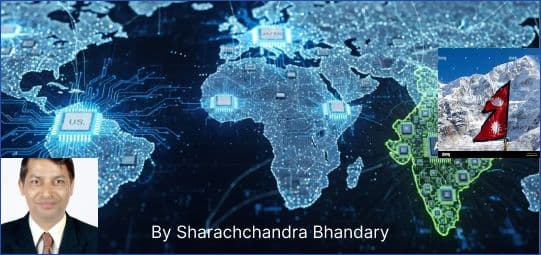
Nepal stands at a delicate crossroads in the emerging global digital order. As the world reorganizes around artificial intelligence, semiconductor supply chains, and data infrastructure, initiatives like Pax Silica are redefining not only economic cooperation but also the meaning of sovereignty itself. For a country like Nepal—rich in hydropower potential yet institutionally evolving in digital governance—the central challenge is clear: how to harness the opportunities of this new technological era without compromising its data sovereignty.
Pax Silica represents a United States-led effort to build secure and “trusted” supply chains across critical technologies, including semiconductors, artificial intelligence, energy, and data infrastructure. Unlike traditional economic partnerships, it operates at the intersection of geopolitics and technology, seeking to align participating countries around shared standards for data governance, infrastructure security, and supply chain resilience. In doing so, it effectively creates a network of “trusted partners” in the AI-driven global economy.
Countries such as India and Philippines have engaged with this framework because of their strong enabling conditions. India brings a vast digital market, industrial capacity, and growing technological capabilities, while the Philippines offers a well-established IT services sector and deep strategic cooperation with the United States. Their participation is grounded in structural strength and institutional readiness.
Nepal’s context, however, is different. The recent visit of Samir Paul Kapur, the United States Assistant Secretary of State for South and Central Asian Affairs, to Nepal in April 2026 highlighted growing engagement in areas such as technology, infrastructure, and private-sector cooperation. His discussions with political leaders and business representatives on digital infrastructure and artificial intelligence reflect a widening U.S.-Nepal technological dialogue. Although framed as economic cooperation, such engagement aligns with the broader logic of Pax Silica—bringing countries into a trusted technological ecosystem.
The idea that Nepal could be drawn into this framework is supported by several converging trends. Nepal’s hydropower resources are increasingly seen as a strategic asset in the global data economy, where energy-intensive data centers require stable and clean electricity. The government’s interest in developing Nepal as a data center hub, combined with the private sector’s promotion of a “hydro-to-data” vision in international engagements, reinforces this possibility. Additionally, the global push to diversify data infrastructure away from concentrated geopolitical risks has increased the relevance of smaller, energy-rich and politically neutral countries like Nepal.
Yet Nepal cannot simply emulate India or the Philippines. It lacks comparable industrial depth, technological ecosystems, and regulatory maturity. Participation in frameworks like Pax Silica requires strong legal systems governing data protection, cybersecurity, and investment screening—areas where Nepal is still developing. Moreover, Nepal’s long-standing policy of balancing relations with major powers makes alignment with any single geopolitical bloc a sensitive issue. Infrastructure constraints, including limited digital connectivity, skilled human resources, and institutional capacity, further complicate rapid integration.
At the center of this debate lies the question of data sovereignty—the ability of a nation to control data generated within its borders. As Dr Kamal Prasad Pokhrel, Chief Statistics Officer at the National Statistics Office, explains, data security is the practice of protecting digital information from unauthorized access, corruption, theft, or loss throughout its entire lifecycle. It relies on ensuring confidentiality, integrity, and availability through measures such as encryption, controlled access, and reliable backup systems.
For a least developed country like Nepal, however, the issue goes beyond definition and enters the realm of capacity. Building a secure digital ecosystem requires substantial investment in infrastructure, skilled manpower, and institutional readiness. Technologies such as encryption systems, access controls, and resilient backup mechanisms are not merely technical choices—they are resource-intensive commitments. Weak implementation can expose systems to cyberattacks, data breaches, and operational disruptions.
This creates a fundamental dilemma. On one hand, expanding digital infrastructure—particularly data centers powered by hydropower—offers opportunities for foreign investment, job creation, and integration into the global digital economy. On the other hand, inadequate safeguards could deepen dependency on foreign technology providers and expose national data to external control. In such a scenario, economic gains may come at the cost of strategic autonomy.
Integration into global digital systems often entails cross-border data flows, reliance on foreign platforms, and exposure to external regulatory regimes. Without adequate safeguards, Nepal risks losing control over critical national data, increasing dependency on external actors, and weakening its policy independence in the digital sphere.
However, disengagement is not a viable option. Nepal must participate in the global digital economy to achieve long-term economic growth and technological progress. The challenge is to do so on its own terms. This requires building a robust data governance framework, strengthening cybersecurity capacity, investing in digital infrastructure, and ensuring that hydropower-driven data initiatives serve national interests. Equally important is maintaining a balanced and diversified approach to international partnerships.
The rise of Pax Silica signals a new era in which technology, economy, and national security are deeply interconnected. Nepal’s growing engagement in this space presents both opportunity and risk. While the country must embrace the development of science, technology, and the digital economy, it must do so without compromising its sovereignty.
In the digital age, sovereignty is no longer defined solely by territorial boundaries—it is defined by control over data, infrastructure, and technological systems. For Nepal, safeguarding data sovereignty while pursuing innovation and growth will be the defining challenge of its digital future.