I had just finished swimming my usual mile, which I like to believe is less about fitness and more about negotiating peace with my internal chaos, when I stepped into the whirlpool at my new health club.
It was one of those modern places that looks like it has already forgiven you for sins you have not yet committed. Clean tiles. Soft lighting. Machines that promise transformation and deliver repetition. Saunas that function less as relaxation spaces and more as silent confession booths where no one confesses anything.
Three other men were in the whirlpool. Quiet. Neutral. The usual unspoken agreement is that eye contact is unnecessary and that shared existence is temporary.
Then one of them stood up.
Completely naked.
Now, nudity itself is not the problem. Biology has never been controversial. The problem was not the body. The problem was the argument the body was trying to make.
He did not simply exit the whirlpool. He exited. Slow. Deliberate. Measured, as if the room were a supporting cast in his personal documentary.
As he walked past, the space itself felt slightly reconfigured, as if the architecture had briefly become self-conscious.
So, I said, “Hey, buddy, this is not a place to demonstrate anything. Wear a swimsuit.”
He paused, mildly irritated but not surprised, as if he had heard this line before in some parallel version of his life.
Then he said the sentence that deserves its own academic department.
“If you don’t like it, that’s your problem. I love my body.”
And just like that, a quiet whirlpool became a philosophical seminar no one registered for.
I told him, “You need help, buddy.”
The core of what stayed with me was not just him. Instead, the underlying structure of entitlement behind him illustrates how societal perceptions of legitimacy are constructed through visibility and presence, which are central to understanding urban identity and societal norms.
Then presence becomes visible.
Then visibility becomes a permission.
Eventually, permission becomes assumed legitimacy.
This is how modern life works. Quietly. Incrementally. Without announcement.
We tend to think of systems as defined by law or policy. Yet in reality, they are shaped by comparison—by who is more visible or occupies more space-highlighting how societal perceptions of legitimacy are constructed through visibility and presence.
Who is more visible? Who takes up more space? Who gets to define what is normal without interruption?
The body becomes the first laboratory for this logic. It is immediate, measurable, and always available for interpretation. It becomes a billboard for a competition nobody formally agreed to, yet everyone is expected to participate.
Once comparison becomes the default, entire industries emerge to stabilize the insecurity it produces. Enhancement. Optimization. Enlargement. Improvement.
Not because something is missing from reality, but because something has been successfully inserted into perception.
The feeling of insufficiency is one of the most reliable economic resources.
But the whirlpool is only the beginning of the story.
Because the same logic scales.
Take Kathmandu.
Before Kathmandu becomes geography, it must first be a definition-one that shapes societal perceptions of boundaries and entitlements. Yet in this city, that definition is increasingly unstable, reflecting shifting perceptions of legitimacy.
And the definition in this city is no longer stable.
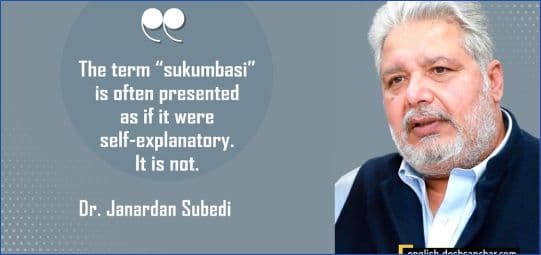
The term “sukumbasi” is often presented as if it were self-explanatory. It is not.
So, the question must be asked again, this time more slowly.
Who is a sukumbasi?
Is it the family displaced by conflict decades ago, carrying history like an unpaid debt?
Is it the household displaced by earthquakes, where “home” became a temporary geological rumor?
Is it the rural migrant who arrived in Kathmandu because survival moves faster than planning does?
Or is it something more fluid than any of these?
In practice, the category no longer behaves like a fixed identity. It behaves like a contested one, which can help the audience empathize with the fluidity and complexity of identities.
In social media discourse and among public commentators, a strong narrative has emerged suggesting that the category of “sukumbasi” is not internally uniform. According to this view, while there are clearly genuine displaced populations shaped by historical violence, natural disasters, and structural exclusion, there are also layers of residents whose relationship to informal settlements is shaped by migration decisions, economic adaptation, and, in some cases, strategic alignment with political networks and local intermediaries.
At the same time, this interpretation is strongly contested. Other voices emphasize historical injustice, chronic urban exclusion, and the state’s long failure to provide equitable housing. Both narratives circulate simultaneously, each selecting different fragments of the same reality.
And it is precisely in that overlap that contradictions become apparent.
I once encountered a couple who identified themselves as Sukumbasi. Their presentation was composed and deliberate, and their narrative aligned with the language of displacement and structural hardship. Yet as the conversation unfolded, another layer emerged quietly beneath their identity.
They were earning a substantial monthly income by renting informal housing to seasonal laborers. Their economic reality was not mere survival but active circulation, a small informal housing economy operating within the language of deprivation.
And then came the second contradiction.
They were planning to send their only son abroad for higher education, where annual costs would exceed what most middle-income households in Kathmandu consider feasible. When the figures were mentioned, there was no shock, only calculation, as if economic mobility and identity narrative belonged to separate categories of reasoning.
This is not an exception. It is a structure.
In contemporary urban systems, identity does not always collapse under contradiction. It adapts around it. Multiple realities coexist without canceling each other: economic adaptation, political identity, and historical grievance can occupy the same space simultaneously.
And this is where the category “sukumbasi” shifts from a description to a negotiation.
Now enter the state.
A figure like Balendra Shah, now serving as Prime Minister with a strong mandate, enters this landscape not as a symbolic disruptor but as an administrator of accumulated ambiguity.
Governance at this level is not about creating clarity. It is about enforcing boundaries around uncertainty.
For years, urban life in Kathmandu operated on an informal assumption: presence gradually becomes permission. Stay long enough, and questions soften. Occupy long enough, and legitimacy stabilizes.
But enforcement interrupts that process, which might make the audience feel the tension and uncertainty that accompany destabilizing societal norms. And interruption is always experienced as a rupture.
People resist not only policy but also the collapse of narratives that made their position feel stable.
And this is where the whirlpool returns.
Because the same sentence reappears, albeit in a different form:
“I am here; therefore, I belong.”
It is the same grammar whether spoken in a sauna or embedded in a settlement.
In one case, the body becomes the claim.
In the other, land becomes the claim.
In both cases, presence is mistaken for permission.
And when presence becomes permission, negotiation becomes endless.
Every boundary becomes offensive. Every correction feels personal. Every rule becomes optional.
A society cannot operate indefinitely under those conditions, not because people are irrational but because systems require limits that are collectively recognized, even when they are individually inconvenient.
Yet the difficulty remains real.
Behind every category lie layered realities. Historical displacement. Economic necessity. Political mediation. Urban failure. Adaptive survival strategies. And institutional delay.
This means this is never a clean moral equation. It is a layered negotiation among memory, necessity, opportunity, and structure.
That is precisely why it is so difficult to resolve.
As reality becomes more complex, simple identities become increasingly attractive.
“Sukumbasi.”
“Occupant.”
“Victim.”
“Authority.”
“Enforcer.”
Each one is clean, and each one is incomplete.
Step back again.
The man in the whirlpool believed he was asserting confidence. But what he was actually asserting was the irrelevance of shared space.
Some public commentators portray segments of informal settlement identity as purely dispossessed. Others portray them as partially adaptive, partially strategic, and partially embedded in political and economic networks. Both readings circulate simultaneously in public discourse, each selecting different fragments of the same reality.
The settlement occupant believes they are asserting survival. The state believes it is asserting order. The commentator believes they are asserting truth.
Different actors. Same grammar.
And beneath it all lies a quiet cultural assumption:
If I am present, I am entitled.
If I remain, I am legitimate.
If I occupy, I define.
This is where modern societies begin to strain, not because of disagreement but because of the overextension of meaning.
Everything becomes symbolic. Everything becomes contested. Everything becomes exposed.
And civilization, in the end, is nothing more than a negotiated agreement that exposure must be limited.
Not everything visible needs to be asserted.
Not everything present needs to become permanent.
Not everything claimed needs to become structured.
When I think back to the whirlpool, I no longer remember a naked man.
I remember a system rehearsing itself on a miniature scale.
When I think of Kathmandu, I do not see any policy conflicts.
I see the same rehearsal repeated at scale.
Different actors. Same script.
And somewhere between the sauna and the city, between the body and the state, the only question that remains is:
How long can a society survive when everyone believes that merely being there is enough to define what “their” means?
Because eventually, someone will disagree.
Sometimes quietly.
Sometimes forcefully.
And sometimes, with the calm certainty of a towel being handed across a boundary that was never as stable as it seemed.
Author Subedi is a Professor of Medical Sociology at Miami University, USA
@Desh Sanchar