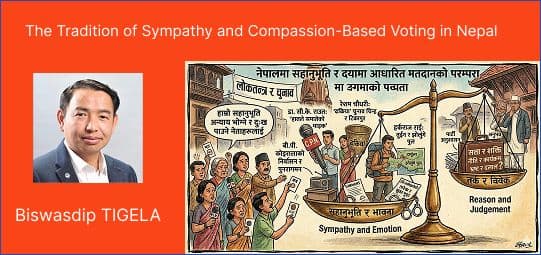
Democracy is not merely a process of vote counting and government formation; it is a system deeply connected with the emotions, sense of justice, and moral consciousness of the people. When citizens perceive that an individual or leader has been subjected to injustice, their support tends to grow emotionally, and this can influence election outcomes. This phenomenon is referred to as “sympathy and compassion voting.” It is not only seen in Nepal but is also a significant political reality worldwide.
The philosophical foundation of this idea was explained by Adam Smith in his work The Theory of Moral Sentiments. According to him, humans are not solely self-interested beings; they possess the capacity to empathize with the suffering of others, which influences their decisions. When this sentiment enters political decision-making, sympathy-based voting begins.
A notable example in Nepalese history is Bishweshwar Prasad (B.P.) Koirala. Forced into exile in India for a long time during the Panchayat era, he returned to Nepal and received overwhelming popular support. The public viewed him not merely as a leader but as a victim of injustice, which facilitated his political comeback.
Similarly, Dr. Chandrakant (C.K.) Raut repeatedly faced state action and arrests, particularly around 2075 BS, when cases were filed against him for actions against the state. However, when he participated in the 2079 BS elections, the public supported him under the election symbol “Handheld Microphone,” and he won six direct seats. This was not just an electoral victory but an expression of public sympathy.
The case of Resham Chaudhary is even more striking. Accused of instigating and participating in the Tikapur incident of 2072 BS, he was arrested in 2074 BS. Even while in jail, he won elections, and in the 2079 BS elections, his party, the Nagarik Unmukta Party, won seven seats (four direct and three proportional). The public viewed him not only as innocent but also as a victim of injustice. They voted for his party under the election symbol “Dhakiya” and supported him wholeheartedly.
Recently, the Rastriya Swatantra Party, led by Ravi Lamichhane, achieved remarkable success despite controversies and legal cases. By fielding candidates even while in jail, the party won a spectacular victory, securing 125 direct seats and 57 proportional seats, totaling 182 seats. After witnessing how Ravi was portrayed as a major criminal with both true and false allegations, the public voted for him out of sympathy, while old, corrupt, and entrenched leaders faced voters’ resentment.
Furthermore, after the tragic deaths of 19 young students and 57 police personnel during the Janajati Movement of 2082 BS, the public voted for the Rastriya Swatantra Party as an expression of sympathy and protest.
This trend is also observed internationally. In India, George Fernandes won the Lok Sabha election from Muzaffarpur in 1977 while in jail during the Voda Dynamite case. In the United Kingdom, Bobby Sands won a by-election in 1981 while imprisoned in Northern Ireland, though he later died in jail during a hunger strike. Similarly, Countess Markievicz won an election in 1918 while in jail but did not attend parliament.
In Pakistan, Asif Ali Zardari was imprisoned for a long time but became president after his release. Though not an election won from jail, it is a strong example of sympathy and political comeback.
The most inspiring example globally is Nelson Mandela. After spending 27 years in prison, he was released and elected president by the people. He once said, “Resentment in leadership is like drinking poison and expecting your enemies to die.” This illustrates that empathy, forgiveness, and a sense of justice form the foundation of long-term leadership. Ordinary citizens, however, raise their voices against injustice and express themselves through voting.
Mahatma Gandhi said, “You can shake the world even by gentle means.” Sometimes, even after seeming defeat, one can succeed, and the public must be aware of this. Martin Luther King said, “Where there is injustice, it exerts pressure for justice everywhere.” These ideas demonstrate that empathy and justice are fundamental values in human society.
However, sympathy-based voting is not always positive. Emotions can sometimes overshadow facts, and even the wrong individuals may gain sympathy. Therefore, while empathy is essential in democracy, it must be balanced with reason, evidence, and justice.
After the formation of Nepal’s new government, former Prime Minister Khadga Prasad Oli was arrested. This has not generated sympathy votes for his party, Nepal Communist Party (Unified Marxist-Leninist). Meanwhile, the presence of Harkraj Rai, chairman of the Shram Sanskriti Party and a former independent mayor, has attracted attention in Parliament. By constructing hanging bridges and expanding local infrastructure in Darchula, he has gained public admiration. If he faces political persecution before upcoming elections, his party could achieve unprecedented results.
Sympathy-driven politics transcends caste, religion, gender, and class. Hence, the public impact of causing suffering to someone must be carefully considered.
During the recent general elections, had Resham Chaudhary been imprisoned, Dr. C.K. Raut remained in jail, Harkraj Rai lacked a history of struggle, Ravi Lamichhane faced no imprisonment or false cases, or if the Janajati Movement had not involved the death of innocent children, the election outcomes would have been significantly different. This time, Chaudhary and Raut did not receive public sympathy, and their parties were absent in Parliament.
Sympathy can also be cruel and blind. The focus of the public is on the victim’s right to liberation and justice, not necessarily on their competence to assume responsibility.
Ultimately, the beauty of democracy lies in citizens’ ability to decide based on their experiences and emotions. Examples from Nepal and around the world show that when people perceive injustice, they respond through voting. Sympathy is not just an emotion; it is a transformative force capable of altering political currents. Viewed this way, compassion and sympathy are not merely emotional but also direct the course of politics, society, and the economy. When paired with reason, they can help build a strong and just society. While sympathy may not be the sole factor in voting, it is certainly one of many important reasons.
biswasdip@ymail.com
16 April 2026, Ashford