Nepal’s latest controversy over the appointment of Chief Justice Manoj Kumar Sharma, PhD, reveals a deeper issue: constitutional morality is often treated as a preference rather than a principle, thereby shaping Nepal’s political culture and influencing public life.
The Judicial Council recommended six qualified candidates, including Acting Chief Justice Sapana Pradhan Malla and Dr. Sharma. Under Nepal’s constitutional framework, the appointing authority retains discretion to select any one of the recommended names. This is not a rupture of constitutional order. It is the constitutional order. One may debate seniority, convention, and institutional predictability, but none of these is identical to constitutional compulsion.
That distinction should have structured the debate, but it became the first casualty. Because Nepal does not make institutional decisions primarily through law, it does so through emotional expectations, which threaten constitutional stability and make citizens wary.
The reaction from segments of mainstream media and political commentary opposing the Balendra-aligned administration and RSP’s parliamentary strength followed a familiar script. Seniority was declared violated, institutional ethics endangered, judicial independence compromised, and democratic morality in distress. The language escalated quickly, not because the legal framework collapsed, but because a preferred outcome did not materialize.
Then came the most symbolically charged intervention.
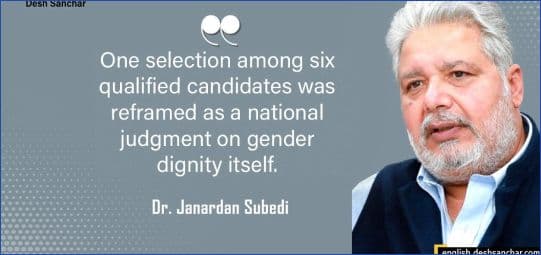
Former Chief Justice and interim Prime Minister Sushila Karki argued that bypassing Sapana Pradhan Malla was an insult to women in Nepal. At that moment, a procedural appointment ceased to be a constitutional question and became a moral imperative. One selection among six qualified candidates was reframed as a national judgment on gender dignity itself.
This is where Nepal’s political discourse reveals its most persistent flaw: elevating symbolism to the point that it blocks clear, proportional reasoning about real issues. Representation matters. Gender equality matters. Institutional history matters. But procedural legitimacy is essential to trust in democracy, not just symbolism.
Nepal has entered a phase in which constitutional disagreement is no longer seen as such. It is seen as an existential threat.
When somebody loses influence, democracy is declared endangered. When somebody is not appointed, morality is declared violated. When somebody is transferred, constitutionalism is declared to be collapsing. Political language has become so inflated that ordinary institutional decisions now require emergency moral interpretation.
Meanwhile, citizens navigate inflation, migration, administrative inefficiency, and structural uncertainty, while elite discourse engages in constitutional theater in increasingly dramatic tones. The irony becomes sharper when viewed in the context of Nepal’s recent political evolution.
The current Balendra government and RSP’s strong parliamentary position are widely associated with a Gen-Z political wave that emerged from deep frustration with legacy parties, institutional stagnation, and a political culture that repeatedly promised transformation while reproducing familiar cycles of dysfunction.
That same Gen-Z wave elevated Sushila Karki to a symbolic moral figure during Nepal’s transitional moment. She was not merely respected as a jurist. She was elevated to a symbolic repository of constitutional resistance and ethical clarity. In that moment, she functioned as what political sociology would call a legitimizing symbol of rupture.
But symbols behave differently when political conditions change.
The same Gen-Z political energy that once amplified symbolic authority now operates through institutional agency. That shift creates tension when symbolic authority encounters independent political decision-making.
The current contradiction is precisely this: the symbolic figure of institutional morality is now publicly contesting the institutional decisions of the political generation that helped elevate that symbolism in the first place.
In simpler terms, the revolutionary symbols are now responding to the autonomy of the revolution they helped inspire. This is not unusual in post-transition societies. It is structurally predictable.
Revolutions often create symbolic moral anchors. But once institutional power decentralizes, those anchors experience displacement anxiety. What was once moral authority becomes interpretive authority, and interpretive authority resists dilution.
The controversy over judicial appointments thus becomes less about selecting one individual and more about who retains the right to define constitutional morality in a changing political landscape. Nepal’s constitutional history intensifies this tension.
The current constitutional structure is designed to maintain separation between judicial and executive authority. The logic is straightforward: judicial legitimacy depends on insulation from political ambition. Yet Nepal’s transitional political history has included extraordinary arrangements in which the boundaries between constitutional roles have been interpreted flexibly during periods of instability.
Madam Karki herself exercised executive authority during a transitional arrangement that, while defended by supporters as politically necessary, remains constitutionally debated regarding strict institutional separation.
This history shows that Nepal’s constitutional flexibility is always shaped by specific circumstances rather than fixed rules, making consistency in interpretation crucial.
That is precisely why consistency is politically significant.
One cannot celebrate constitutional elasticity when it enables transition and condemn constitutional discretion when it produces disagreement. If constitutional interpretation is situational, its moral authority must likewise be consistently situational.
Nepal’s elite discourse, however, often reverses this logic. It treats flexibility as legitimate when it aligns with preferred outcomes and illegitimate when it does not. This is not constitutional theory. It is selective institutional memory.
Selective memory is a poor foundation for democratic maturity.
The seniority debate itself warrants careful consideration. Seniority systems provide predictability and reduce internal competition within institutions. They are not inherently undemocratic. However, they are conventions, not constitutional absolutes. Their strength lies in stability, not in legal compulsion.
Confusing convention with command is one of the most persistent analytical errors in Nepal’s public discourse.
What recurs in this controversy is not merely a disagreement over a judicial appointment. It is a deeper struggle over interpretive authority: who gets to define what counts as constitutional morality and whether that definition remains stable when the political context changes.
This is where Nepal’s public discourse is structurally fragile. Increasingly, constitutional interpretation is not treated as a process of legal reasoning. It is treated as a moral performance arena. Competing actors do not merely argue what the Constitution permits. They argue about what the Constitution should emotionally signify.
Once law becomes symbolic performance, every disagreement becomes identity-based, every outcome becomes a moral judgment, and every institutional decision becomes emotionally charged beyond its procedural significance.
At that point, constitutional systems cease functioning as stabilizing frameworks and become arenas of permanent moral contestation.
This is not unique to Nepal. Many post-transition democracies experience similar tensions. But Nepal’s intensity is heightened by a political culture in which institutional trust remains uneven and elite narratives still exert disproportionate influence over public interpretation.
The result is a recurring pattern: legal discretion is interpreted as moral betrayal when it disrupts expectations, and institutional criticism is framed as moral righteousness when it aligns with expectations.
Democracy, however, does not require emotional agreement. It requires procedural legitimacy, which often produces outcomes that various actors will dislike.
That discomfort is not a constitutional crisis. It is the normal state of constitutional governance.
The bigger risk for Nepal is not disagreement itself. It is the gradual erosion of the ability to distinguish between disagreement and illegitimacy.
Once that boundary collapses, every institutional decision becomes reversible through moral escalation. And once every decision becomes reversible, institutions cease to function as stabilizing systems and become continuous arenas of symbolic conflict.
In that environment, constitutional morality does not disappear. Instead, it becomes unstable, contingent, and strategically deployed.
That is the real issue underlying this controversy.
Not who became Chief Justice.
But whether constitutional interpretation in Nepal can survive without being permanently subordinated to emotional preference.
If every institutional outcome must first receive moral approval before being accepted as legitimate, then constitutionalism does not guide politics.
Politics begins to redefine constitutionalism.
Author Subedi is a Professor of Medical Sociology at Miami University, USA
@DeshSanchar