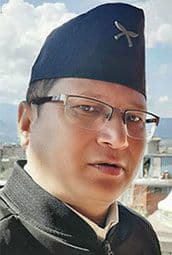
Prem Sagar Poudel------
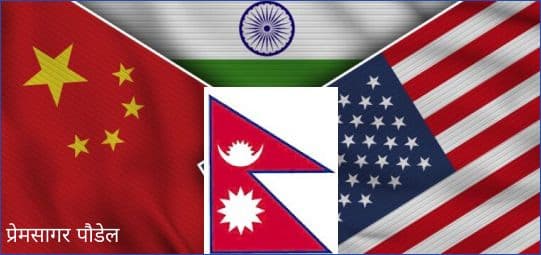
The central question of Nepal’s foreign policy has always remained the same: how can the country maintain sovereign balance between two giant neighbors? In recent years, however, this question has become even more complex. Nepal is now confronted not merely with the challenge of balancing between two powers, but with defining its position within the triangular power contest involving India, China, and the United States. How the new government led by Balen Shah is managing this trilateral dynamic, and what course Nepal should pursue in the future, forms the central subject of this analysis.
Nepal’s geopolitical position is unique. It shares a 1,414-kilometer border with China to the north and an open 1,850-kilometer border with India to the south, east, and west. This geographical reality cannot be altered, but it can be transformed into an opportunity through intelligent diplomacy. Meanwhile, the United States has also been expanding its presence in Nepal through the Indo-Pacific Strategy and the Millennium Challenge Corporation (MCC) project. Consequently, Nepal has emerged as a focal point of interest and competition among three major powers. The dynamics of relations among these powers directly shape Nepal’s foreign policy. Therefore, it is essential to analyze Nepal’s relationship with each power separately.
Nepal’s relationship with India is old, deep, and at the same time the most complex. Despite open borders, cultural affinity, economic interdependence, and close people-to-people ties, a crisis of trust continues to persist between the two countries. The 1950 Treaty of Peace and Friendship has long raised questions regarding Nepal’s sovereignty. Likewise, the secret agreement of 1965, which placed the Nepali Army under the supervision of an Indian military mission, exposed the unequal nature of the bilateral relationship. Border disputes have repeatedly strained Nepal–India relations. In recent years, tensions have further intensified due to India’s unilateral construction of roads, embankments, and infrastructure in border areas, the inundation of Nepali territory, and the inclusion of Kalapani, Lipulekh, and Limpiyadhura within Indian maps. The 2015 blockade left a profound scar on the Nepali psyche, one that remains vivid even today. The five-month-long blockade paralyzed Nepal’s economy and exposed the dangers of excessive dependence on India. It was in the aftermath of this crisis that Nepal pursued a policy of seeking alternative transit routes through agreements with China.
Nevertheless, India remains Nepal’s largest trading partner. Approximately 64 percent of Nepal’s total foreign trade is conducted with India. A significant number of Nepali youths travel to India for employment. Under the 1947 Tripartite Agreement, Gurkha soldiers continue to serve in the Indian Army, contributing substantially to Nepal’s remittance economy. Cooperation in the energy sector has also been expanding. Following the Power Trade Agreement (PTA) signed between Nepal and India in 2014, and the long-term electricity trade agreement concluded in 2024, Nepal gained a pathway to export electricity to India. Nepal has set a target of exporting 10,000 megawatts of electricity to India over the next decade, a development that could fundamentally transform the country’s economy.
Beyond this, India has also supported Nepal in sectors such as railways, roads, irrigation, and healthcare. The Jaynagar–Janakpur–Bardibas railway is already operational, while numerous roads and bridges across the Terai region have been built with Indian assistance. However, these projects have also faced criticism due to implementation delays and escalating costs. The new government must redefine Nepal’s relationship with India. Unequal treaties should be reviewed. The 1950 Treaty of Peace and Friendship must be modernized in accordance with contemporary realities. Diplomatic solutions should be pursued regarding border disputes. The report of the Nepal–India Boundary Working Group should be implemented. Likewise, the report of the Eminent Persons Group (EPG), which recommended the review of bilateral treaties and agreements, should be made public and implemented. Economic cooperation must be transformed into a framework of mutual benefit. Indian investment and assistance in Nepal should be made transparent and competitive. Nepali products should receive easier access to Indian markets, and non-tariff barriers should be removed. India must demonstrate full respect for Nepal’s sovereignty and independence and reflect its commitment to non-interference in Nepal’s internal affairs through practical conduct.
Nepal’s relationship with China has expanded remarkably over the past decade. Since Nepal signed onto the Belt and Road Initiative (BRI) in 2017, Chinese investment and infrastructure projects have grown significantly. Through projects involving roads, hydropower, transmission lines, cross-border railways, and dry ports, China has emerged as a major development partner for Nepal. The greatest achievement of Nepal’s relationship with China lies in its role as an alternative to Nepal’s excessive dependence on India. Following the 2015 blockade, Nepal signed transit and transportation agreements with China, thereby opening alternative routes for trade with third countries. After the operation of the Kerung–Rasuwagadhi border point in 2016, Nepal’s northern trade corridor began to gain momentum. The upgrading and operation of border points such as Korala, Kimathanka, Yari, and Tatopani have increased the possibility of transforming Nepal from a “landlocked” nation into a “land-linked” state. Cooperation with China has injected new momentum into Nepal’s infrastructure development. Projects such as Upper Tamakoshi, the Tatopani border road, Pokhara International Airport, and the feasibility study for the Kerung–Kathmandu railway have advanced with Chinese assistance. Following President Xi Jinping’s visit to Nepal in 2019, bilateral relations were elevated to the level of a “strategic partnership.”
However, Nepal’s relationship with China is not without challenges. Delays in project implementation, concerns over long-term debt burdens, and questions regarding transparency have generated criticism. The inability to effectively initiate BRI implementation has also led to complaints that expected benefits have not materialized. Chinese contractors have at times been accused of failing to employ local workers and compromising on quality standards. Nonetheless, China has consistently adhered to a policy of respecting Nepal’s sovereignty and non-interference in its internal affairs, which remains a positive aspect for Nepal. Beijing has never publicly commented on Nepal’s political matters and has consistently respected Nepal’s internal decisions. The new government must therefore advance relations with China in a more balanced, transparent, and mutually beneficial framework. BRI projects should be accelerated while ensuring transparency and quality. Careful assessments must be conducted regarding debt burdens and repayment capacity. Cooperation with China should not remain limited to infrastructure alone, but should also expand into technology transfer, agriculture, tourism, and human resource development.
The United States is a comparatively newer yet highly influential actor in Nepal’s foreign policy landscape. Nepal established diplomatic relations with the United States in 1947. Since then, the United States has contributed to the strengthening of Nepal’s democratic institutions, governance, healthcare, education, and humanitarian assistance. The signing of the MCC agreement in 2017 and its parliamentary ratification in 2022 introduced a new dimension to Nepal–U.S. relations. The $500 million MCC grant is focused on electricity transmission and road upgrades. However, the MCC generated intense political polarization within Nepal. It was viewed by some as part of the Indo-Pacific Strategy and suspected of targeting China. Nevertheless, the United States has repeatedly clarified that the MCC is purely a development project with no military dimension.
Through the United States Agency for International Development, Nepal has continued to receive significant support in healthcare, education, and agriculture. Volunteers from the Peace Corps have contributed to Nepal’s rural development. The United States also assisted Nepal in post-earthquake reconstruction efforts. However, recent developments - including increased American activity in the Everest region, drone flights, and the reconstruction of Pangboche Monastery - have raised questions regarding Washington’s strategic interests. Within a week of the reconstruction of Pangboche Monastery by the United States, American drones were reportedly flown near Everest Base Camp, blurring the distinction between development assistance and strategic interests. The new government must therefore conduct relations with the United States within a framework of transparency and national interest. MCC projects should be implemented transparently and on time. American assistance and activities must not conflict with Nepal’s sovereignty and national interests.
Prime Minister Balen Shah’s government has not yet published a clear foreign policy document. However, several early signals help illuminate its orientation. First, immediately after assuming office, the government intensified efforts to remove informal settlements, conveying a message of non-interference in internal affairs. Yet, the incident in which the Prime Minister reportedly walked out during the President’s address in Parliament raised questions about his understanding of parliamentary decorum and diplomatic culture. Second, although he has emphasized balanced relations with both India and China, some imbalance has appeared in practice. The postponement of the Indian Foreign Secretary’s visit reportedly due to the Prime Minister’s unavailability created tension in Nepal–India relations. On the other hand, no major high-level engagements or agreements have yet taken place with China either. In contrast, progress appears to have been made regarding MCC implementation with the United States. This suggests that the new government’s foreign policy has yet to assume a clearly defined shape.
For Nepal’s long-term interests, a balanced, independent, and sovereign foreign policy is indispensable. The first principle must be maintaining equal-distance relations with all powers. Nepal must not become anyone’s sphere of influence. Relations with India, China, and the United States should all be conducted on the basis of mutual respect, equality, and national interest. The BRI and MCC can be advanced as complementary rather than contradictory projects. One is focused on physical infrastructure, while the other concentrates on energy transmission; both are necessary for Nepal’s development. China is investing in roads, railways, and hydropower, whereas the United States is providing grants for electricity transmission and road upgrades. These initiatives are not inherently opposed to one another. Yet some actors continue to portray Nepal’s geopolitics as a zero-sum choice between “either China or America.” This misconception must be challenged.
The second principle is prioritizing economic diplomacy. Nepal should not remain dependent solely on foreign aid and loans, but should strengthen economic relations through trade, investment, tourism, and hydropower exports. Nepal must adopt policies aimed at exporting electricity to both China and India, promoting tourism with both neighbors, and attracting investment from both. Relations with the United States should likewise focus on trade and technology transfer. Nepal can utilize its hydropower potential as a form of diplomatic capital. With more than 42,000 megawatts of hydropower potential, Nepal can establish itself as a major supplier within the regional energy market. Electricity trade agreements have already been signed with India and Bangladesh, while plans are underway for cross-border transmission lines with China. This could transform Nepal’s economy and strengthen its foreign policy position.
The third principle is active engagement in multilateral forums. Nepal should strengthen its presence in institutions such as the United Nations, the South Asian Association for Regional Cooperation, the Bay of Bengal Initiative for Multi-Sectoral Technical and Economic Cooperation, and the Shanghai Cooperation Organisation. Such forums help smaller nations resist pressure from larger powers while amplifying their own voices. In particular, Nepal can use its contributions to United Nations peacekeeping missions as diplomatic capital. Nepal is among the world’s leading contributors of peacekeeping troops, earning international respect and influence. Nepal’s chairmanship roles in SAARC and membership in BIMSTEC also provide opportunities for a more active regional diplomatic role.
The fourth and most important principle is internal political consensus. Foreign policy must rise above partisan interests and become a matter of national consensus. Extreme polarization over issues such as the MCC and BRI has weakened Nepal’s diplomatic capacity. The new government should engage major opposition forces and stakeholders to build national consensus. Serious parliamentary debate on foreign policy is essential. The institutional capacity of the Ministry of Foreign Affairs must be strengthened. Diplomatic missions should not become centers of political patronage but should instead remain professional and effective. Nepal must invest in training diplomats and developing research capacity in international relations.
In conclusion, the greatest strength of Nepal’s foreign policy lies in its sovereignty and independence - principles that must never be compromised. Nepal must not become the “puppet” or “sphere of influence” of any power. Geography has placed Nepal between two giant neighbors, but diplomacy has also provided the country with the opportunity to maintain dignified relations with all three powers. The foreign policy of the Balen Shah government remains in its formative stage. It must define its course through a clear vision, mature diplomacy, and national consensus. Only time will determine whether this government succeeds in preserving sovereign balance within the “triangle of three powers.” Yet one reality remains unmistakably clear: Nepal’s future will depend greatly on the direction its foreign policy ultimately takes.
The purpose of this article is not to advocate for any government or political party, but merely to share lessons learned through four decades of experience in the hope that they may contribute to shaping the future of Nepal’s foreign policy. This is the world- and Nepal’s place within it- as I have observed it from the lap of the Himalayas.