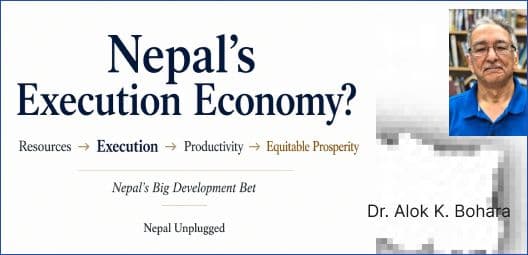
Preamble: This article is Part 2 of a three-part series examining Nepal’s FY 2083/84 budget through a systems-policy lens.
Part 1 examined the budget’s goals, assumptions, and potential fault lines. It argued that the budget rests on three E’s—Enhanced Administrative Efficiency, Enabling Business Environment, and Effective Enforcement—and identified both the opportunities and risks embedded in that approach.
Part 2 asks a different question: What economic logic lies underneath the budget? Rather than viewing it solely through the familiar Keynesian-versus-market debate, I explore whether the budget represents an emerging execution-oriented development strategy—what I call an “Execution Economy.”
Part 3 will move from logic to reality. It will examine whether this execution-oriented model can overcome Nepal’s longstanding constraints of debt, institutional capacity, political incentives, and weak export competitiveness.
In Part 1, I argued that the new government’s budget rests on three E’s:
• Enhanced Administrative Efficiency
• Enabling Business Environment
• Effective Enforcement
The budget pursues three goals: growth through productive investment, stronger state capacity (the government’s ability to carry out its own decisions), and greater private, diaspora, and foreign investment. It also raises three concerns: debt sustainability, whether growth reaches those at the bottom, and whether administrative and technological fixes can overcome deeper institutional constraints. And it rests on three big assumptions: execution will improve, growth will exceed the cost of borrowing, and the gains will spread broadly through society.
The question now is: what economic model lies underneath these assumptions?
The budget debate has quickly polarized into familiar camps. Supporters praise the investment climate reforms, AI initiatives, tax simplification, infrastructure spending, and governance reforms. Critics see a pro-business, donor-friendly budget that places too much faith in technology, markets, and administrative solutions while shifting burdens onto ordinary consumers.
Yet neither label fully captures what appears to be the budget’s underlying logic.
A Brief Detour: Where Does This Budget Fit in Economic Thinking?
Most economic development strategies tend to emphasize one of three broad approaches.
The Keynesian Approach: Stimulate Demand
Named after economist John Maynard Keynes, this approach argues that when economic activity is weak, government spending can stimulate demand and revive growth.
Typical tools include:
• Public infrastructure spending
• Government employment
• Income support
• Tax relief for households
Examples include Roosevelt’s New Deal during the Great Depression and the large fiscal stimulus packages adopted by many countries after the 2008 global financial crisis.
The logic is straightforward:
When households and businesses are not spending enough, government steps in.
Elements of Nepal’s budget carry a Keynesian flavor (stimulating demand through spending).
Examples include:
• Approximately NPR 286 billion allocated to roads and urban infrastructure
• NPR 86 billion allocated to energy
• NPR 218 billion allocated to education
• NPR 102 billion allocated to health
• NPR 120 billion allocated to social security
• Roughly 21% increase in take-home compensation for civil servants through salary and performance incentives
• Doubling of the personal income tax exemption threshold to NPR 1 million
In short, the government is trying to put more spending power into households, public services, and infrastructure in the hope that stronger demand will support growth.
The government’s 7% growth target reflects this optimism.
The Supply-Side Approach: Grow the Economy First
Supply-side economics starts from a different premise. Growth comes primarily from increasing production, investment, entrepreneurship, and productivity.
Typical tools include:
• Lower taxes on investment
• Deregulation
• Easier business formation
• Investment incentives
• Trade liberalization
Recent reforms in Argentina under Javier Milei represent one contemporary example, although far more radical than what Nepal is attempting.
The core idea is simple:
Grow the economy first and the benefits will eventually spread more broadly through society.
Many features of the budget fit this tradition:
• Customs duties reduced on 273 categories of industrial raw materials
• Customs structure simplified from 11 tiers to 7 tiers
• Excise duties abolished on 360 categories of goods
• 50% income tax exemption for IT export earnings
• Startup, venture capital, private equity, and LLP reforms
• One-stop Investment Express approval system
• FDI facilitation and streamlined approvals
• Capital market reforms and financial-sector liberalization
In short, the government is attempting to lower the cost of investment, production, and entrepreneurship so that businesses expand and create jobs.
Critics view these as pro-business measures. Supporters view them as pro-growth measures.
The Development-State Approach: Build Productive Capacity
Countries such as South Korea, Singapore, Taiwan, and later Vietnam combined public investment, industrial policy, export promotion, and strong state coordination.
Their governments did not simply spend more money or reduce taxes.
They actively coordinated development.
The emphasis was on:
• Execution
• Exports
• Infrastructure
• Industrial upgrading
• Bureaucratic discipline
None of these models fully captures what the government appears to be attempting. They simply provide a vocabulary for understanding the ingredients being combined in the current budget.
Nepal’s Emerging Hybrid: The Execution Economy?
What makes the current budget interesting is that it borrows elements from all three traditions.
From Keynes, it borrows demand support through spending and tax relief.
From supply-side economics, it borrows investment incentives, business facilitation, and regulatory reform.
From the developmental-state approach, it borrows the emphasis on implementation, coordination, and state capability.
The distinguishing feature, however, appears to be its emphasis on the idea that Nepal’s biggest bottleneck may not be a shortage of money or ideas, but the ability to implement them.
That is why the budget repeatedly returns to digitization, one-stop approvals, project completion, compliance, performance incentives, and administrative reform.
In that sense, the budget can be read as an execution-oriented development strategy—one that assumes better governance, stronger implementation, and improved compliance can unlock growth from resources already present within the system. For convenience, I refer to this perspective as an “Execution Economy.”
The Three E’s
When Finance Minister Swarnim Wagle defended the budget in his lengthy press conference, he repeatedly returned to a theme: execution.
Viewed through that lens, the budget appears to rest on three pillars:
• Enhanced Administrative Efficiency
• Enabling Business Environment
• Effective Enforcement
The budget is therefore not primarily about spending more money.
Rather, it rests on the assumption that better governance, stronger execution, and improved compliance can generate enough growth and revenue to make the numbers work.
Beyond Revenue: The Execution Problem
Wagle repeatedly emphasized a problem that economic models often treat only indirectly: the gap between plans and implementation.
Standard economic models often assume that once a policy is enacted or a budget is allocated, the economy will respond automatically.
In Nepal, that assumption frequently breaks down.
Infrastructure money sits idle in treasury accounts. Procurement disputes drag on for years. Projects remain stalled by land acquisition delays, litigation, contractor failures, bureaucratic risk aversion, and poor coordination among government agencies.
For years, Nepal’s biggest economic embarrassment has not simply been inadequate budgets but the inability to spend development budgets effectively.
In many years, actual capital expenditure has fallen well below planned allocations, sometimes hovering near or below 50 percent of the approved budget.
In that sense, the budget appears to assume that economic growth can be unlocked not merely by injecting more money into the system or by offering better incentives to investors, but by improving the state’s ability to turn policies into results.
Digitization, one-stop approvals, performance incentives, streamlined procedures, stronger compliance, restructuring of public entities, and project discipline are all intended to reduce the gap between policy intent and policy outcomes.
This is what I mean by the idea of an Execution Economy.
From Wealth-Pump Economy to Better Execution
This is where the budget becomes particularly interesting.
For decades Nepal’s economy has depended heavily on remittances, aid, transfers, and various forms of redistribution, while struggling to expand productive capacity at the same pace. In many ways, the economy became better at moving resources around than creating new productive capacity.
The new budget appears to be attempting something different.
Its underlying premise is that Nepal already possesses considerable resources: remittances, foreign exchange reserves, hydropower potential, entrepreneurial talent, public revenues, and access to capital.
The binding constraint is not necessarily the lack of resources. This includes not only administrative and institutional bottlenecks but also the fiscal capacity to finance projects as they move from approval to implementation.
The binding constraint is the inability to coordinate, execute, and deliver.
Thus the proposed transition:
Resources ? Better Execution ? Higher Productivity ? Higher Growth
Whether this sequence actually holds is, of course, the central question facing the budget.
Who Pays? Who Benefits?
This transition, however, is not costless.
The budget simultaneously provides:
• Income tax relief to middle-income earners
• Customs reductions on industrial inputs
• Excise removal on 360 categories of goods
• IT-sector tax incentives
• Startup and venture-capital incentives
• Investment facilitation reforms
• Capital-market reforms
• AI and technology investments
At the same time, it relies heavily on:
• VAT and consumption taxes
• Electricity-related charges and fees
• Broader tax compliance measures
• Indirect taxes ultimately borne by consumers
This creates the political economy debate now visible across Nepal.
Critics argue that poorer households are being asked to bear today’s burden while investors, businesses, and higher-income groups receive many of the immediate incentives.
Supporters counter that without investment, entrepreneurship, productivity growth, and job creation, there will be little future income to distribute in the first place.
This is the central trade-off embedded in the budget.
The Real Gamble
The budget’s success therefore does not depend primarily on whether it is Keynesian or supply-side.
Nor does it depend solely on how much it borrows.
Its success depends on whether Nepal can successfully improve execution and convert resources into productive outcomes.
That transition is not merely administrative. It is a wager that improved execution can transform public spending into productive assets, infrastructure into economic activity, and incentives into investment and employment.
Yet execution itself should not be confused with development.
A state can become better at implementing policy, but it must still answer a larger question:
Execution toward what end?
Youth retention, entrepreneurship, productive employment, regional integration, export capacity, and long-term economic transformation ultimately remain the true tests of success.
The budget therefore represents a double gamble: first, that the state can execute better; and second, that better execution is being directed toward the right developmental destination.
In that sense, the most important question raised by this budget may not be whether it is pro-business or pro-poor, donor-driven or market-driven, Keynesian or supply-side.
The deeper question is whether Nepal has finally identified its true bottleneck.
If Nepal’s main constraint is indeed its ability to implement decisions (state capability), then the Three E’s may prove more important than any individual tax measure or spending allocation.
If not, what I have called the Execution Economy may simply become a more technologically sophisticated version of old habits.
The answer, as always, will lie not in the budget speech but in what happens after it.
The challenge is no longer writing plans.
The challenge is execution.
Execution, however, must ultimately serve a larger purpose: transforming better governance into productivity, productivity into opportunity, and opportunity into a more prosperous and inclusive Nepal.
If Nepal’s Fourth Century vision is to become more than a slogan, execution must evolve into productive capacity, innovation, and regional connectivity. The ultimate test is whether Nepal can move beyond dependence on remittances, transfers, and redistribution and emerge as a capable bridge economy between India and China—creating value not merely through geography, but through coordination, production, and exchange.
Execution is the means. Transformation is their hope.
This is, at least, what the new government is banking on.
But execution does not happen on paper. It must confront the realities of debt, administrative capacity, political incentives, and an economy still searching for stronger engines of productivity and exports. If this Part 2 explored the logic behind the budget, Part 3 will examine the reality: can this execution-oriented model overcome the constraints that have repeatedly limited Nepal’s development ambitions?
As one veteran journalist, while remaining noncommittal, remarked recently: only time will tell.
Dr. Alok K. Bohara, Emeritus Professor of Economics at the University of New Mexico, writes as an independent observer of Nepal’s democratic evolution through the lens of complexity and emergence science. His systems-policy essays on Nepal’s socio-economic and political landscape appear on Nepal Unplugged.