I once asked Time what my greatest fault was.
Not a clock, not a calendar, but Time itself, that quiet auditor of human illusion.
It answered without hesitation.
“Your greatest fault is that you believed everyone who came into your life belonged to you.”
It became a critique of how societies confuse connection with ownership, authority with entitlement, and alignment with belonging, emphasizing the importance of understanding internal and external influences on Nepal’s political culture.
Because in Nepal, this is not merely a private mistake. It is often a public instinct.
Too often, we do not simply cooperate; we personalize. We do not merely recognize authority; we elevate it emotionally. We do not simply engage institutions; we attach ourselves to personalities. And when reality refuses to honor these invisible expectations, we call it betrayal.
Time, unsurprisingly, calls it ignorance.
This illusion begins in small, familiar moments. Consider a scene repeated across the country. A newly elected parliamentarian visits a public school in his constituency. What should be a routine institutional interaction quietly becomes something else. Recognition is expected. Deference is anticipated. The office is unconsciously translated into status. When the headmaster treats the visitor not as a patron but as another public servant with a different responsibility, irritation sometimes follows.
Time would smile at this confusion.
A parliamentarian is not a feudal lord entering inherited land. A school is not a royal court. A headmaster is not a subordinate in a personal hierarchy. All are parts of the same civic architecture, differentiated by function rather than dignity.
Yet the emotional residue of hierarchy persists inside democratic structures like a ghost that never signed the constitution but refuses to leave the building.
This is not about one individual. It is about a political culture that frequently mistakes authority for ownership and visibility for superiority. Democracy, under such conditions, becomes theatrical rather than institutional. The roles exist. The scripts are written. But the emotions behind them belong to another era.
The same psychology extends into party politics.
Nepali political parties have rarely functioned as purely ideological organizations. They often operate as relational ecosystems. Coalition partners denounce one another during elections, only to share cabinet tables months later. Leadership struggles are narrated as questions of loyalty rather than debates over policy. Alliances emerge and dissolve with remarkable speed.
Each transition is interpreted as a betrayal.
But betrayal requires permanence. And permanence was never part of the system.
Time has witnessed countless leaders mistake proximity for permanence, only to discover that politics remembers interests long after it forgets affection.
Even voters participate in this illusion. Too often, representatives become extensions of our emotional identity rather than temporary custodians of delegated authority. “Our leader” becomes part of who we are. When that leader negotiates, recalibrates, or changes course, it feels less like politics and more like personal loss.
But democracy was never designed to provide emotional permanence. It was designed to manage disagreement through institutions.
Nepal’s modern history offers repeated reminders of this lesson. Democratic transitions have inspired enormous hope. Revolutionary promises have generated profound faith. Leaders have periodically been elevated into embodiments of national destiny. Yet personalities have repeatedly disappointed, not because disappointment is inevitable, but because institutions were expected to perform the work of devotion.
Time has consistently delivered the same verdict: personalities pass; institutions endure.
This confusion becomes even more consequential when projected beyond our borders.
Nepal’s relationship with India is often framed in emotional terms. At times, it is described as civilizational intimacy; at others, as domination and grievance. Friendship and resentment coexist uneasily in the same conversation.
But both interpretations risk misunderstanding the nature of the relationship.
India is not a personality. It is geography translated into power, and recognizing this can help us be more respectful of the intricate realities that shape our external relationships.
A country that influences transit routes, trade access, labor mobility, and energy connectivity does not require malicious intent to create asymmetry. Structure alone is sufficient. Yet Nepal often interprets this structural reality through the language of expectation—what India should do, how India should behave, what India owes.
States, however, do not operate on “should.” They operate on interests constrained by capabilities.
Expectation applied to structure produces disappointment disguised as analysis.
If the southern relationship is burdened by expectation, the northern one is often burdened by projection.
China is frequently imagined as a strategic balance, an alternative opportunity, or a geopolitical relief. Infrastructure promises and connectivity projects are interpreted as signs of directional change in Nepal’s favor.
But China is not participating in Nepal’s balancing strategy. It is pursuing its own regional and economic interests.
Investment is not alignment.
Connectivity is not a substitute.
Influence is not reassurance.
Time, indifferent to flags and slogans, has never confused geography with friendship.
Complicating this landscape further is the United States. Unlike Nepal’s immediate neighbors, the United States operates less through geography and more through institutions, development assistance, governance initiatives, and broader strategic frameworks.
Yet Nepal often interprets American engagement through emotional extremes—either enthusiasm or suspicion, depending upon the political mood of the day.
But the United States is not participating in Nepal’s internal narrative. It is pursuing interests within a global framework that includes Nepal but does not make it central.
Thus, Nepal’s view of India as an emotional grievance, China as a projected alternative, and the US as an ideological symbol risk overshadowing the structural realities that shape these relationships, encouraging a more realistic understanding.
It is tempting to externalize blame-seeing India constraining, China competing, or America complicating-yet adopting a structural perspective reveals that Nepal’s challenges stem from internal weaknesses more than external influences.
It is tempting to externalize blame. India constrains. China competes. America complicates.
But such explanations remain incomplete.
Because external power becomes overwhelming primarily when internal capacity is weak.
Many small states navigate asymmetry successfully. Their strength lies not in size but in coherence. Predictable institutions, policy consistency, administrative competence, and economic resilience allow them to negotiate rather than merely react.
Nepal’s greatest vulnerability is not its small size.
It is that Nepal’s internal systems are too often fragmented, inconsistent, and vulnerable to short-term interests, which should motivate us to feel a collective responsibility for strengthening our institutions.
Corruption, policy instability, and weak institutional discipline do more than delay development. They distort perception itself. They magnify every external pressure and transform every negotiation into a perceived threat.
Weakness inside amplifies power outside.
Geography matters. Economic dependence matters. Institutions matter.
Yet structures do not interpret themselves.
Human beings do.
The deepest challenge, therefore, is not merely geopolitical. It is psychological. It lies in how we understand and respond to the realities surrounding us.
Across our personal lives, political culture, and foreign relations, the same pattern reappears.
We expect permanence in a world organized by movement, loyalty in systems governed by interest, and possession in a world where only participation exists. When reality refuses these assumptions, disappointment acquires the language of betrayal.
Time offers a simpler lesson.
Nothing stays.
Not people.
Not power.
Not partnerships.
Everything aligns for a time and then realigns.
The implication is not cynicism. It is clarity.
Nepal’s task is not to detach emotionally from the world, but to interpret it more accurately.
That requires three corrections.
First, authority must be understood as a function rather than ownership.
Second, domestic reform must be recognized as a geopolitical capacity rather than an administrative preference.
Third, external actors must be understood as interest-driven systems rather than emotional participants in Nepal’s expectations.
Perhaps Time’s greatest lesson is also its gentlest correction.
You suffer not because things change, but because you believed they were yours to begin with.
For Nepal, this is not philosophy alone.
It is statecraft.
Because nations do not stay.
They align.
And those who mistake alignment for attachment do not merely become disappointed.
They become structurally outmaneuvered.
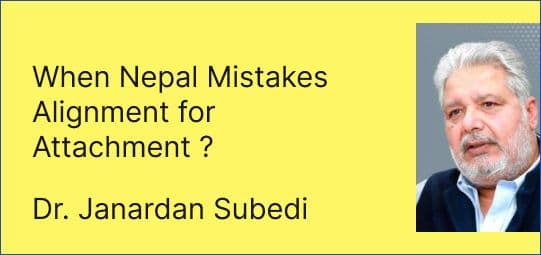
Author Subedi is a Professor of Medical Sociology at Miami University, USA
@DS