Prelude
Now that the largest party, the RSP, has also embraced Social Democracy as its guiding philosophy—joining virtually every other major political party in Nepal—I thought it was an appropriate time to reflect on what social democracy should, and should not, mean in Nepal’s current context.
In my view, social democracy should not be a class struggle project. It should be a class coalition project—a partnership between workers and the middle class to expand opportunity, mobility, and prosperity for all. Indeed, the measure of social democracy is not the permanence of class divisions, but the strength of the bridges that connect them.
The central argument of this essay, together with a gentle cautionary nudge, is summarized below.
Nepal need not choose between two familiar extremes:
* The traditional left: Redistribute first through subsidies, pensions, and state protection.
* The neoliberal supply-side sequencing narrative: Grow first, share later through trickle-down prosperity.
* An alternative: Build a class coalition through mobility pathways that enable workers, farmers, entrepreneurs, and the middle class to create and share prosperity together.
The experience of successful countries suggests that labels alone do not guarantee progress or prosperity. Institutions, incentives, and “well-designed ladders” of opportunity that enable citizens to move from the working class into the middle class do.
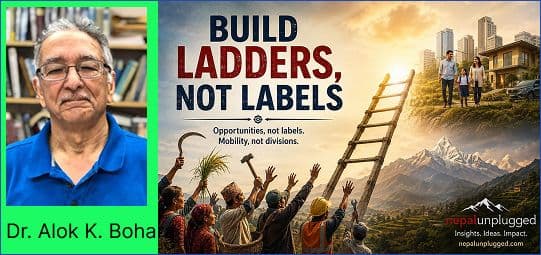
Social democracy should be judged by the ladders it builds, not merely by the benefits it distributes. Build coalition, not sequencing.
Introduction
Few words are used more frequently in Nepal’s political discourse than “socialism.”
Virtually every major political force claims some connection to it. Nepal’s Constitution embraces a socialism-oriented state. The traditional communist parties have long defined themselves through socialist ideals. Even newer reform-oriented parties such as the Rastriya Swatantra Party (RSP) have articulated their philosophy in terms of social democracy.
Yet despite its widespread use, the meaning of socialism often remains surprisingly unclear.
For some, socialism means guaranteeing basic needs such as education, health care, housing, employment, and social protection. For others, it implies redistribution, subsidies, pensions, and state support for disadvantaged groups. Still others associate it with economic equality, social justice, or a stronger role for government in regulating markets.
The Constitution itself reflects many of these aspirations, promising citizens a wide range of social and economic rights.
But an important question remains:
What does socialism—or social democracy—actually mean in the context of a modern developing economy such as Nepal?
More importantly, how should it be explained to citizens who increasingly aspire not only to basic security, but also to opportunity, mobility, entrepreneurship, and participation in a growing economy?
This essay attempts to shed some light on that question.
Rather than viewing social democracy primarily through the traditional lens of class conflict or redistribution, it explores an alternative perspective: social democracy as a project of building a durable class coalition between workers and the middle class through pathways of mobility, opportunity, and shared advancement.
What Is in a Name?
This essay’s timing is motivated by the recent adoption of social democracy as the guiding philosophy of the Rastriya Swatantra Party (RSP), the newest major entrant into Nepal’s political landscape. The announcement raises an interesting question: what exactly does social democracy mean in Nepal’s current context? More broadly, what is the relationship between the labels political parties adopt and the institutions, incentives, and policies that ultimately shape citizens’ lives?
There is, of course, nothing wrong with a society aspiring toward social justice, fairness, and protection of the vulnerable. These are worthy goals. Indeed, Nepal’s Constitution itself embraces many of these aspirations through its commitment to a socialism-oriented state and a broad range of social and economic rights. Yet Nepal’s own development experience also reminds us that constitutional aspirations and political labels, by themselves, do not automatically translate into outcomes.
History offers an interesting perspective. Countries such as Vietnam, China, India, South Korea and Malaysia began their modern development journeys from relatively modest economic circumstances. What transformed their trajectories was not necessarily the ideological labels they adopted, but the institutions, incentives, investments, and policy frameworks they put in place. Vietnam retained its communist identity while opening itself to trade, investment, and export-oriented production. China combined socialist rhetoric with extensive market reforms and industrial expansion. India accelerated growth not by debating constitutional terminology, but through liberalization, entrepreneurship, and integration with the global economy. South Korea and Singapore had a similar story.
The lesson is not that labels are irrelevant. Ideas matter. Values matter. Political philosophies matter. But names alone do not create prosperity. Ultimately, citizens judge systems by outcomes: whether they create opportunity, mobility, dignity, and a better future.
Likewise, the real challenge is not choosing between markets and social justice, but designing institutions that allow productive growth and social justice to reinforce one another.
For Nepal, therefore, the more important question is not whether a party or constitution uses the word socialism. The question is whether the country can build the institutions, incentives, productivity, and mobility pathways that allow workers, farmers, entrepreneurs, and the middle class to advance together.
Social democracy should not be judged by its label alone. It should be judged by whether it creates bridges between classes, expands opportunity, protects dignity, and builds a productive economy capable of sustaining social justice.
Nepal’s Evolving Understanding of Socialism
Nepal’s understanding of socialism has evolved over time.
BP Koirala’s democratic socialism emerged in a poor agrarian society and focused primarily on ensuring basic human dignity—food, clothing, shelter, education, and health. The objective was not class conflict but the fulfillment of basic needs in a newly democratizing society.
Later, Nepal’s communist and socialist movements increasingly framed politics through the lens of economic inequality. The dominant narrative became one of workers and the poor confronting feudal elites, landlords, aristocrats, and privileged classes. Policies often emphasized redistribution, subsidies, pensions, guaranteed employment, and various forms of state support and quotas for disadvantaged groups.
These ideas emerged from specific historical circumstances and addressed real social inequities. However, Nepal today faces a different challenge.
The central question is no longer simply how to redistribute existing resources. It is how to create a larger productive economy while ensuring that more citizens participate in and benefit from it.
A Lesson from the American Experience
As an economist and having had studied various economic systems, including the United States for nearly four decades, I have observed both the strengths and the emerging weaknesses of one of the world’s largest middle-class societies.
The success of postwar America was not built solely on markets or welfare programs. It rested on institutions that connected workers and lower-income households to the middle class:
* public schools,
* vocational education,
* community colleges,
* apprenticeship programs,
* universities,
* housing opportunities,
* Social Security,
* Medicare and Medicaid,
* student aid,
* food assistance programs,
* and support for minority-owned, women-owned, and small businesses.
These institutions functioned as mobility pathways. In that, a worker’s child could realistically aspire to become a teacher, nurse, engineer, entrepreneur, or professional. People were not merely receiving benefits; they were participating in a broader story of upward mobility.
Today, many of these pathways or ladders are under strain. Political debates increasingly focus on cultural and ideological conflicts—immigrants versus natives, welfare recipients versus taxpayers, elites versus workers, urban versus rural populations. Universities have become ideological battlegrounds. Health and social programs are increasingly viewed through partisan lenses. Economic frustrations are often expressed through identity-based conflicts.
As these divisions deepen, the institutions that once connected workers and the middle class receive less attention.
The result is a weakening of the social compact or you can even call — a social contract.
Interestingly, some of the newer political voices in the United States are increasingly attempting to reconnect with workers’ concerns around wages, affordability, health care, housing, and economic security. Whether one agrees with their policy prescriptions or not, there appears to be a growing recognition that a durable democratic system requires rebuilding the connection between workers and the broader middle class.
So, has Nepal built a social contract or a ladder economy, not just the rhetorics of socialism?
Nepal’s Challenge: The Missing Bridge
Nepal faces a somewhat different problem.
The challenge is not simply that the bridge between workers and the middle class is weakening. In many respects, that bridge was never fully built.
Large numbers of poorer households attend under-resourced public schools and eventually migrate to the Gulf or Malaysia.
Much of the middle class relies on private education and increasingly sends its children to Australia, Europe, North America, or other destinations.
Over time, these groups begin to inhabit different educational systems, labor markets, migration pathways, social networks, and aspirations. They no longer experience themselves as participants in the same “national journey.” This creates fertile ground for resentment, populism, and grievance politics. We are quite familiar with all of that as evidenced by the periodic collapses of our systems.
From Class Struggle to Class Coalition
I am proposing a different way of understanding social democracy.
Rather than organizing politics around perpetual conflict between classes, social democracy can be understood as a project of building a durable coalition between workers and the middle class. The objective is not to erase differences. The objective is to create institutions that allow both groups to see their futures as connected — through the carefully designed laddered opportunities across these classes.
Farmers need markets.
Workers need productive jobs.
Entrepreneurs need skilled workers.
Teachers need quality schools.
The middle class needs economic stability and opportunity.
Poorer households need credible pathways upward.
Their interests are often complementary rather than conflicting.
In fact, one of the important shifts in Swedish social democracy after the Second World War was precisely this movement away from defining politics primarily through class conflict. The emphasis increasingly became building a productive economy in which workers, professionals, entrepreneurs, and the middle class could participate in a shared project of advancement. The durability of the model came less from redistribution alone and more from creating a broad coalition around opportunity, productivity, and social mobility.
Mobility Pathways
In brief, a class coalition is sustained through mobility pathways.
These pathways may include:
* quality public education,
* technical and vocational training,
* apprenticeships,
* community colleges,
* entrepreneurship support,
* infrastructure,
* health access,
* affordable finance,
* agricultural modernization,
* manufacturing expansion,
* and pathways from informal work into productive employment.
These pathways must also remain genuinely accessible across caste, ethnicity, gender, geography, and income so that opportunity is not determined by birth but by capability and effort. These institutions become bridges connecting workers and the middle class.
When the bridges are strong, growth and inclusion reinforce one another. When they weaken, politics becomes increasingly organized around competing grievances.
A class coalition is therefore not merely a political alliance. It is a system of institutions that allows workers and the middle class to see themselves as participants in the same national story.
This —class coalition— does not imply that differences of interest disappear; rather, it argues that durable institutions should seek to align those interests around shared productivity and upward mobility.
A Different Narrative for Social Democracy
This perspective may also help address concerns often voiced from poorer regions of Nepal.
Many citizens do not oppose growth, entrepreneurship, or investment. Rather, they fear being excluded from the pathways through which growth occurs.
The answer is not to pit workers against the middle class. Nor is it to promise that growth today will eventually benefit others tomorrow. Instead, the message becomes one of shared advancement.
Workers, farmers, entrepreneurs, professionals, and the middle class are participants in the same development project from the beginning.
Thus, a useful formulation may be:
Social democracy is not a class struggle project. It is a class coalition project—a partnership between workers and the middle class to expand opportunity, mobility, and prosperity for all.
Conclusion
The task of social democracy is therefore not merely to redistribute resources. It is to build and strengthen the institutions that allow workers and the middle class to advance together. In the long run, the strength of a democratic society depends less on the conflict between classes than on the bridges that connect them.
Perhaps that is the next evolution of Nepal’s socialist tradition: from a politics of redistribution toward a politics of mobility; from class struggle toward class coalition; and from competing grievances toward a shared national journey of opportunity, productivity, and prosperity.
Such a coalition ultimately depends on a productive economy capable of generating the opportunities through which mobility becomes possible. Productive capacity and mobility pathways are therefore complements rather than substitutes; one creates the opportunities, the other enables citizens to participate in them.
At the same time, this framework invites a broader policy imagination for Nepal’s new government. Moving beyond narrow aspirations of becoming an AI or IT hub, the real challenge is to think in terms of economic geography—how different regions can align people, skills, and industries based on their comparative advantages. Instead of focusing solely on safety nets that provide basic survival toolkits for the working poor, the government must articulate an economic mechanism that connects local populations to productive sectors in agriculture, tourism, manufacturing, services, and emerging industries.
In closing, if this interpretation has any merit, perhaps future debates on social democracy in Nepal may spend a little less time debating labels and a little more time debating the institutions and mobility pathways that enable citizens to move upward together.
Dr. Alok K. Bohara, Emeritus Professor of Economics at the University of New Mexico, writes as an independent observer of Nepal’s democratic evolution through the lens of complexity and emergence science. His systems-policy essays on Nepal’s socio-economic and political landscape appear on Nepal Unplugged.