In politics, history is often less forgiving of squandered opportunities than of outright failures. Failure can emerge from unfavorable conditions, structural constraints, or historical timing. A squandered opportunity, however, is the consequence of choices made when alternatives were still available. Nations recover more easily from defeat than from the slow erosion of public hope.
Few political movements in contemporary Nepal generated as much anticipation as the Rastriya Swatantra Party (RSP). Its emergence signaled more than the birth of another party in an already crowded political landscape. It represented a collective exhaustion with decades of entrenched corruption, patronage networks, dynastic dominance, and institutional stagnation. For millions of Nepalis, particularly younger voters, it embodied the possibility that politics could be redefined, competence over ideology, merit over nepotism, and institutions over personalities.
That promise now appears increasingly fragile, not because the external environment has changed, but because the party has failed to address specific internal challenges-such as leadership cohesion, decision-making transparency, and institutional capacity-that hinder the crucial shift from movement to institution.
This distinction is not rhetorical. It is structural.
Movements are powered by moral clarity, urgency, and opposition to an existing order. Rules, procedures, internal deliberation, and predictable decision-making sustain institutions. Movements survive on enthusiasm; institutions survive on discipline. One mobilizes emotion, the other organizes power.
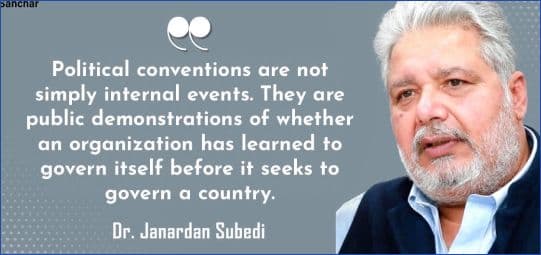
The recent national convention exposed the unresolved tension between these two logics. Instead of demonstrating institutional consolidation, it revealed procedural uncertainty, informal coordination, and contested authority. Political conventions are not simply internal events. They are public demonstrations of whether an organization has learned to govern itself before it seeks to govern a country.
In this case, the demonstration was uneven.
The most visible illustration of this tension was Manish Jha’s defeat.
Beyond individual preference, Jha represents a rare type in Nepali politics, a leader who combines intellectual discipline with parliamentary seriousness. His interventions reflect preparation, policy awareness, and deliberative reasoning rather than performative rhetoric. His relevance is not symbolic but substantive. He represents the possibility of a political culture grounded in argument rather than spectacle.
His defeat therefore cannot be read only as a personal outcome. It raises a deeper institutional question: what kinds of qualities are being rewarded within the organization, and what kinds are being sidelined?
Political organizations reveal their true priorities not only through their manifestos but also through internal selection processes that often expose underlying weaknesses in transparency, meritocracy, and institutional integrity.
When internal alignment dynamics consistently overshadow competence, the logic of organization begins to shift. Loyalty becomes more valuable than capability. Informal influence becomes more decisive than formal merit. At that point, institutional drift is no longer speculative; it becomes observable.
This drift is not abstract. It is visible in how the party functions internally.
Decisions that shape strategy and organization are widely perceived to emerge from a narrow circle of leadership rather than from structured, transparent deliberation across institutional layers. Consultations, when they occur, often appear episodic rather than systematic, and outcomes are frequently communicated as finalized positions rather than collectively reasoned conclusions.
This perception is reinforced when decisions that shape strategy and organization emerge from informal influence and concentrated authority rather than structured, transparent deliberation, raising questions about the potential for meaningful political reform within the party.
Clarifying decision-making processes and communicating reasons behind key choices can rebuild trust, reassuring the audience about the party’s integrity.
In such environments, what is not explained becomes more politically significant than what is announced.
This is also reflected in the growing number of former members and organizers who have stepped away from the party while articulating remarkably similar concerns. While their personal experiences differ, their structural diagnosis converges: centralization of authority, weak internal consultation, limited institutional feedback mechanisms, and a widening gap between public rhetoric and internal practice.
When such patterns repeat across independent actors, they cease to be individual grievances. They become institutional signals.
All political parties experience dissent. What distinguishes resilient organizations from fragile ones is not the absence of criticism, but their ability to absorb, evaluate, and institutionalize it. When criticism becomes structurally recurring across actors who are not acting in coordination, it indicates not disagreement but organizational patterning.
Here, political sociology offers a critical lens. Max Weber argued that charismatic authority is inherently unstable because it depends on personal legitimacy rather than institutional rules. Over time, such authority must undergo what he called the routinization of charisma, the transformation of personal influence into stable, rule-based systems.
Without this transformation, movements remain dependent on individuals rather than institutions. That dependence gradually produces informal power structures, procedural inconsistency, and internal competition that is not governed by transparent rules.
Strengthening institutional boundaries and reducing personalization can help the party establish a stable foundation and encourage confidence in its future.
This is not unique to Nepal.
Comparative experience shows similar trajectories elsewhere. The Aam Aadmi Party in India, the Five Star Movement in Italy, and Podemos in Spain all emerged as anti-establishment movements promising to replace old political cultures with transparency and participatory governance. Each encountered the same structural challenge, converting protest legitimacy into governing competence. Each discovered that dismantling an old order is easier than constructing a durable institutional alternative.
The pattern is consistent: anti-establishment energy does not automatically produce institutional maturity.
Politics, unlike activism or journalism, is defined not by exposure or mobilization, but by the slow construction of governing capacity. Journalism reveals problems. Activism amplifies grievances. Politics must resolve them through negotiation, compromise, procedural discipline, and institutional continuity.
This is why the transition from movement to institution is the most difficult stage in political development. Many movements succeed in opposition precisely because opposition allows moral clarity without administrative burden. Governance, by contrast, forces ambiguity, compromise, and accountability under conditions of constraint.
The RSP’s current trajectory suggests difficulty in making this transition. Instead of consolidating internal democracy into predictable structures, it appears to be drifting toward informal coordination, concentrated decision-making, and competing centers of influence that operate alongside formal institutions rather than through them.
Institutional theory in political science emphasizes that organizations rarely collapse suddenly. They erode gradually through the normalization of informal practices that slowly displace formal rules. Over time, what is unofficial becomes routine, and what is formal becomes symbolic.
This has consequences beyond organizational survival. When reform-oriented parties begin to resemble the systems they once criticized, public perception shifts. Citizens begin to see political alternatives not as genuine choices, but as variations of the same underlying structure. Electoral competition then becomes rotation without renewal.
Nepal is especially vulnerable to this dynamic. The country continues to face structural pressures, economic stagnation, weak institutional capacity, fragmented governance, and sustained youth outmigration. Public trust in institutions remains fragile, and political instability discourages long-term planning. In such a context, political organizations are not judged only by electoral success, but by their ability to generate trust.
Trust is not produced by rhetoric. It is produced by consistency between promise and practice over time.
No individual leader can compensate for weak institutional systems. Successful democracies are not built on exceptional personalities, but on organizations capable of reproducing competent leadership across generations. That requires internal democracy, transparent procedures, merit-based advancement, and intellectual openness.
The central question facing the RSP is therefore no longer whether it can win elections.
It is whether it can become an institution that outlives its founding moment.
That distinction is decisive.
Elections produce governments. Institutions produce political systems that endure beyond the individuals who create them.
History does not reward rhetorical transformation unless it is matched by structural change. Political actors are ultimately judged not by what they promised in moments of emergence, but by whether they built systems capable of sustaining those promises under pressure.
For the RSP, the trajectory remains open. Institutional correction is still possible, especially in early-stage organizations where norms are forming, and pathways are not yet fully locked in.
But political time is never neutral. It either consolidates institutional discipline or exposes structural fragility.
History, as always, is watching, but it is no longer waiting.
The RSP now stands at a decisive crossroads, and its internal dynamics increasingly reflect that reality. One path leads toward institutional consolidation, transparent decision-making, structured internal deliberation, merit-based leadership selection, and the gradual subordination of personality to process. This path is demanding, slow, and often politically inconvenient, but it is the only route that produces long-term credibility in democratic politics.
The alternative trajectory is already familiar in the political history of South Asia. It leads to the personalization of authority, reliance on informal networks of influence, the weakening of internal deliberative structures, and eventual absorption into the same political culture it once sought to transcend. This path offers short-term cohesion and tactical advantage, but it carries a predictable long-term outcome: institutional dilution, declining legitimacy, and eventual political exhaustion.
The most dangerous illusion in reformist politics is not failure, but partial success, the belief that early achievements guarantee institutional permanence. Once that illusion takes hold, organizations begin to mistake visibility for stability and momentum for structure.
Whether the RSP can avoid that trajectory will depend not on its capacity to mobilize public sentiment, but on its willingness to discipline itself internally. Movements win attention; institutions endure only through restraint.
In the end, the defining question is not whether the RSP can displace Nepal’s old political forces. The real question is whether it can avoid becoming another expression of them. The answer to that question will determine not only the fate of a party, but the credibility of political renewal in Nepal itself.
Author Subedi is a Professor of Medical Sociology at Miami University, USA
@DS