A mountain collapses. Rock, snow, and debris roar down. Water joins the destruction. Roads disappear, homes are damaged, people are killed or go missing, and families begin searching for loved ones.
Then the pandits arrive.
They appear on television, on Facebook, on YouTube, on podcasts, in newspapers, and on international news programs, armed with graphs, theories, explanations, and remarkable certainty. One explains geology, another climate change, another glaciers and hydrology. Others explain infrastructure, government failure, geopolitics, China, India, or global warming. Within hours, Nepal seems to have produced an entire intellectual army to explain what has already happened.
The dead, meanwhile, offer no commentary.
The missing ones have no microphones.
Their families are left waiting.
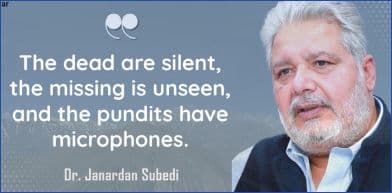
The dead are silent, the missing is unseen, and the pundits have microphones.
That contrast is more than a clever observation. It reveals something important about Nepal’s disaster culture: we often become most intellectually energetic after a catastrophe, when what we need most is proactive, institutionalized action grounded in knowledge that should have been implemented beforehand.
This is not an argument against expertise. Nepal needs genuine expertise more than ever. It needs scientists, engineers, geologists, hydrologists, environmental researchers, and disaster specialists who understand the Himalayas’ extraordinary complexity. The problem is not that experts speak. The problem is that expertise often becomes most visible after the event, when the consequences are already painfully clear.
This is where the word pandit becomes useful. I use it here not to describe a scientist or scholar who has devoted years to studying a particular subject, but as a sociological type: the person who acquires public authority after a catastrophe because society suddenly needs someone to explain it. The pandit may possess genuine knowledge or the confidence to sound knowledgeable. Either way, catastrophe creates an audience.
Nepal is generous with its audiences. Give a person a microphone, a disaster, and ten minutes, and suddenly the entire Himalayan system may be explained. The television presenter asks, “What happened?”
The pandit explains.
Soon, the geology has been explained, climate change has been explained, government failure has been explained, and, before the program ends, perhaps civilization itself has been found responsible. Tomorrow, another pandit will arrive with another explanation.
Nepal has therefore developed a peculiar intellectual industry: retrospective expertise. Its raw material is catastrophe, its product is explanation, and its deadline is usually yesterday.
There is something almost comic about this, except that the consequences are not funny at all. The core issue is failing to turn knowledge into action before disasters happen, which urges society to act proactively.
Nepal is not a knowledge desert. It has universities, government agencies, engineers, scientists, environmental organizations, international research institutions, and generations of people who have studied the Himalayas. Institutions such as the International Center for Integrated Mountain Development (ICIMOD) have spent decades producing research on mountain environments, climate change, glaciers, water systems, and human vulnerability.
So, the uncomfortable question is not whether Nepal has knowledge.
A warning in a report is knowledge. But without institutional memory, that knowledge goes unused, and Nepal risks repeating the same mistakes instead of learning from them.
A warning in a report is knowledge.
A warning, translated into policy, infrastructure, land-use planning, early warning systems, and evacuation procedures, becomes preventive power.
Disasters depend heavily on how society organizes around hazards, making societal choices crucial in vulnerability and resilience.
Nature creates hazards. Society distributes vulnerability.
Who lives in the danger zone? Who builds the road? Who approves the hydropower project? Who maintains the bridge? Who monitors the slope? Who receives the warning? Who has the authority to order an evacuation? Who has the resources to evacuate? Who decides that the risk is acceptable?
These are sociological questions.
And they are often more important than another television discussion about what happened afterward.
The sociology of disaster is therefore also the sociology of visibility.
The catastrophe is visible. The helicopter is visible. The destroyed road is visible. The grieving family is visible, at least briefly. The television camera is visible. The pandit is visible.
Prevention is almost invisible yet essential. Building resilient infrastructure and systems before disaster strikes creates a safer society, yet it often goes unrecognized compared with the visible destruction.
If a dangerous settlement is relocated before a disaster, no one reports the relocation as breaking news. If a bridge is reinforced before it collapses, there is no dramatic footage. If an early warning system successfully evacuates a village and no one dies, the success may generate little public excitement.
Nothing happened.
That is precisely the point.
Modern societies often reward reaction more visibly than prevention. Politicians attract attention by visiting disaster zones. Media organizations attract audiences by showing destruction. Experts receive invitations because the public seeks explanations. Committees are formed. Reports are commissioned. Statements are issued.
Then time passes.
The cameras leave.
The reports go into drawers, files, and forgotten websites.
The next crisis arrives.
And the pandits return.
This creates a familiar cycle: warning, neglect, catastrophe, explanation, committee, report, forgetting, and repetition.
Every cycle risks creating the illusion of learning without building lasting institutional memory, which is vital to real progress.
Nepal does not need more people explaining yesterday with extraordinary confidence. It needs institutions that can remember yesterday while making decisions for tomorrow.
That requires a different relationship between knowledge and power.
Experts cannot simply publish findings and assume society will act. Governments cannot cite experts only when television cameras are present. Universities cannot be content with producing knowledge that never reaches the people who make decisions. Media organizations should not confuse visibility with expertise or confidence with evidence.
And politicians should understand that listening to experts before a disaster is not a sign of weakness. It is one of the most basic responsibilities of governance.
There is another uncomfortable matter.
After a disaster, everyone suddenly becomes interested in causes. Climate change, Himalayan geology, glacial dynamics, infrastructure, and land-use policy all become important.
Where was that urgency yesterday?
Perhaps the most revealing question after a catastrophe is not simply, “What caused this?”
It is:
Who knew? Who warned? Who listened? Who had the authority to act? Who had the resources to act? And who decided that waiting was acceptable?
Those questions move us from geology to sociology and from explanation to accountability.
They also highlight the difference between expertise and expert performance. Expertise is not merely the ability to explain complexity. It is the capacity to anticipate consequences, communicate risk, inform institutions and help society act before consequences become irreversible.
The true expert may therefore be less visible than the pandit is.
The scientist quietly working on a dataset may never appear on television. The engineer inspecting a dangerous structure may never become famous. The hydrologist monitoring a watershed may never attract a thousand social-media reactions. The researcher who spends years documenting risk may receive little attention compared with the person who appears after the disaster and explains it in five confident minutes.
That is not merely a media problem. It is a social valuation issue.
We have created a culture in which the person who explains the disaster can become more visible than the person who tried to prevent it.
And perhaps that is why the pandit keeps rising.
The mountain falls, and the pandit rises.
The village disappears, and the television studio becomes crowded.
The missing remains missing, while explanations multiply.
But explanations cannot bring the dead back.
They cannot make a missing person suddenly walk through the door.
They cannot return a destroyed home to a grieving family.
They can, however, serve a useful purpose if we allow them to: they can mark the beginning of institutional learning rather than the end of public attention.
That is the challenge.
Nepal does not need to silence its pandits. It needs to ask more of them. It needs to ask governments, universities, and the media more. Most importantly, it needs to ask itself whether knowledge will remain something we discuss after a disaster or become something we use before a disaster.
The ultimate test of expertise is not whether someone can explain why the mountain fell.
It is whether society listened while the mountain was still standing.
The next time a pandit appears on television and says, “We knew this could happen,” perhaps the most important question is not “What do you see coming?”
It is:
“What did you do when you saw it coming?”
And for those who hold political and institutional power, the question is even simpler:
“What are you going to do about it?”
Because the dead are silent.
The missing are invisible.
The pandits have microphones.
And somewhere beyond the cameras, the mountains are still standing.
Author Janardan Subedi is Professor Emeritus of Sociology at Miami University, Ohio, USA.
@desh sanchar