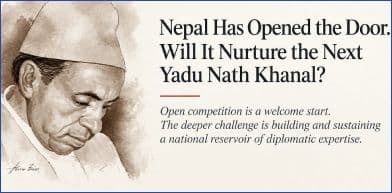
Open competition is a welcome start. The deeper challenge is building and sustaining a national reservoir of diplomatic expertise.-----------------Dr. Alok K. Bohara----------
Sep 20-----
The Experiment
Earlier this year, Nepal did something it had never done before.
The Ministry of Foreign Affairs publicly invited qualified Nepalis to apply—or be recommended—for ambassadorial appointments. It accompanied the call with a detailed Terms of Reference laying out eligibility, responsibilities, preferred qualifications, tenure and accountability. The response was remarkable: more than 4,400 applications and recommendations arrived. After duplicates and incomplete submissions were removed, roughly 2,700 remained for consideration. The government has now recommended the first 13 ambassadors from that process.
The experiment naturally generated debate. Some veteran diplomats and commentators questioned whether an ambassadorship should be treated like an ordinary competitive position, whether diplomatic experience might be undervalued, and how thousands of applicants could be meaningfully screened. Those are legitimate questions.
Yet I find myself starting from a somewhat more optimistic place.
For a young government trying to change Nepal’s long-established culture of public appointments, simply opening this door is not trivial. For a country accustomed to hearing bhāgbandā whenever important positions are distributed, shifting the starting question from “Whose turn is it?” toward “Who is qualified?” is itself a meaningful change in trajectory.
The first results also provide some encouraging signs. The published profiles of the 13 recommendations show people drawn from foreign policy, security, academia, development, banking and other professional backgrounds. There also appears to have been some effort to match expertise to particular missions. Granted, CVs alone cannot tell us how anyone will perform as an ambassador, but that apparent attention to qualifications and mission fit deserves recognition.
I was also struck by an observation I had heard from veteran diplomat Professor Jaya Raj Acharya, former UN Ambassador. He welcomed the open-call idea but wondered whether some highly capable people might simply shy away from applying.
I partly agree.
To me, that is less an argument against open competition than an argument for being flexible. Open the door widely—but retain the ability to go looking for exceptional expertise among those who might not apply. It is understandable that such questions arise with an experiment so new in Nepal’s history.
And this took me back nearly forty years, to my graduate-student days at the University of Colorado.
Knowing Where Expertise Resides
Professor Keith Maskus taught us international economics. I remember him mentioning one day that he had to go to Washington for a government meeting. As a young graduate student, I found that rather fascinating. Washington seemed very far away from our economics department in Boulder. Yet here was one of our young professors whose specialized knowledge could be tapped when the country needed it.
I understood the significance of that much better later.
Professor Maskus went on to spend a career studying international trade, intellectual property and the global economy while periodically moving between scholarship and public policy. He served at the U.S. State Department, became a Lead Economist at the World Bank, advised international institutions, and decades later returned to Washington as Chief Economist of the State Department. His scholarship continued in between.
What stayed with me was not any particular position he held. It was the system around him that fascinated me.
A university professor could spend decades accumulating specialized knowledge while the government knew that expertise existed and could draw upon it when needed.
There was another little detail that stayed with me. My impression from those graduate-school days was that Professor Maskus leaned Democratic, at least as I recall from our conversations. Yet here he was being tapped for his expertise during a Republican administration—President Reagan, to be precise.
What was interesting for me, having grown up in a highly politicized society, was that expertise did not necessarily have to come from within the governing political circle.
Years later, Democratic President Obama provided a much more prominent example when he asked Robert Gates to remain as Secretary of Defense after Gates had been appointed to that position by Republican President George W. Bush.
There is a useful principle here for Nepal.
An open competition does something valuable before anyone is even selected: it signals that the formal door is open. A scholar, economist, diplomat, security specialist or public intellectual need not first belong to the governing political circle to put a name forward. Political affiliation need not be a litmus test for expertise. That is the basic idea of open competition, which was recently applied in the selection of Vice Chancellor positions at several universities. It may not have been a perfect process, but it was certainly a refreshing idea.
Back to Dr. Acharya’s observation: open competition alone may not capture everyone. Sometimes the state should also know whom to call, as it did with my professor.
Different Countries, Different Doors
Other countries combine these appointment mechanisms differently.
Canada relies heavily on its professional Foreign Service. Career officers compete for Head of Mission positions, and their skills and experience are matched against the requirements of particular missions. Political leadership ultimately makes appointments while retaining the ability to bring people in from outside the Foreign Service.
India similarly rests heavily on its professional Foreign Service, while its rules explicitly allow the government to appoint either members of the service or “other persons” as Heads of Mission.
The United Kingdom has a strong professional Diplomatic Service. Head of Mission positions are normally filled through competitive government processes based on merit and fair and open competition, while exceptional appointments from outside the normal system remain possible.
The United States uses a different model. The president nominates ambassadors and the Senate provides advice and consent, allowing career Foreign Service officers and people drawn from outside the diplomatic service to coexist.
None offers a perfect template for Nepal. But its hybrid mechanism is a welcome and promising starting point. Indeed, a relatively small country with a large global diaspora and considerable expertise scattered around the world may have good reason to develop its own hybrid. A country with nearly one third of its population living abroad must define its boundaries beyond its geographic demarcation. Many countries have found ways to tap their diaspora resource pool for national benefit.
Back to the case at hand—the selection of diplomatic heads—I see three salient features:
1. The professional Foreign Service provides continuity, diplomatic craft and institutional memory.
2. Open competition creates a contestable pathway for expertise accumulated elsewhere.
3. Targeted search allows the state to reach exceptional people who may never apply.
Importantly, the question is not simply, “Who is most qualified?”
It is:
Qualified for which mission?
I am sure that as the government gains experience with the mechanism, it will refine the process along the way.
Beyond the Applicant Pool
When the open announcement and the TOR came out, people had a hard time putting their arms around it. Praise and criticism followed swiftly. As an academic who is used to such open competitions at various stages of my academic career, I was optimistically waiting for it to unfold.
But there was one deeper question for me: where does that expertise come from in the first place, especially in a field like diplomacy? Many commentators in Nepal had similar reservations.
My reaction was: a nation needs more than a good applicant pool. It needs a “deep” pool.
This was my thinking: diplomatic judgment accumulates slowly. It grows through years of studying countries and institutions, learning languages, negotiating, watching crises unfold, building relationships, making mistakes and acquiring institutional memory.
That is one reason Nepal’s professional Foreign Service matters. To its credit, the ruling party does mention in its manifesto a target of drawing at least 50 percent from that pool.
Many countries follow this model.
Imagine a young Foreign Service officer deciding whether to devote years to mastering Mandarin, studying Chinese history and institutions, accepting difficult assignments and becoming a genuine Nepal-China specialist. That person is making a human-capital investment.
The expected return to that investment matters.
Career ladders do more than reward the people who eventually reach the top. They influence the investment decisions of people twenty years below them. After all, we look up to the success of those above us and try to emulate them.
Open competition should therefore complement the professional Foreign Service, not hollow it out. But the deep pool need not reside only inside the Ministry.
Countries accumulate expertise in universities, think tanks, international institutions, business, security establishments and among their citizens working around the world.
Henry Kissinger provides a striking, if controversial, illustration. Whatever one’s judgment of his policies, his foreign-policy expertise did not suddenly appear when Richard Nixon appointed him National Security Adviser. Kissinger had spent years at Harvard studying international affairs and advising different parts of the U.S. government before entering the White House.
The institutional point is simpler than the man I am using as an example.
When government needed foreign-policy expertise, there already existed people who had spent much of their professional lives developing it.
That is a national reservoir of intellectual capital. This open competition mechanism should not discourage the incentive for those who genuinely devote their intellect to this area. I know of a few such scholars in Kathmandu’s intellectual circle who possess deep foreign-affairs credentials and who may or may not have submitted applications. I remain cautiously concerned that we may be missing out on their service.
But let me turn to a specific towering example.
The Yadu Nath Khanal Aspiration
Professor Yadu Nath Khanal did not begin as a conventional career diplomat. He began in scholarship and teaching. His diplomatic journey included serving as Member Secretary of Nepal’s delegation to the historic Bandung Conference in 1955. He subsequently served twice as Foreign Secretary and became the only Nepali ambassador to represent the country in India, China and the United States. Nepal’s own Ministry of Foreign Affairs describes him as one of the principal architects of modern Nepalese foreign policy and credits him with helping to intellectualize foreign policy and strengthen a professional, specialized Foreign Service.
But the offices he occupied are not what make Khanal especially interesting for this discussion.
His knowledge compounded. Scholarship fed diplomacy. Diplomacy deepened his understanding of India, China and the wider world. Successive responsibilities added institutional knowledge, negotiating experience and geopolitical judgment. His writings and experience then became part of the intellectual inheritance available to those who came after him.
Khanal himself described diplomacy as requiring “special discipline” and historical and contemporary insight. It was, he warned, “more than adhocism.”
That seems particularly relevant to the experiment Nepal has just begun.
The interesting question is no longer whether an open application system would have found Yadu Nath Khanal.
Perhaps it would have.
The harder and more useful question is:
Can Nepal create the institutional environment in which the next Yadu Nath Khanal can emerge?
Government cannot manufacture such a person. But institutions and the mechanisms they adopt can affect the “soil” in which expertise grows.
A strong professional Foreign Service can give young diplomats reason to invest decades in their craft. Universities and research institutions can cultivate serious country and policy expertise. An open competition can tell people outside government that there is a credible pathway into national service. Targeted search can allow government to reach exceptional people who never apply.
Seen this way, Nepal’s new open call may have an effect far beyond these first 13 appointments.
A young scholar may decide to spend fifteen years understanding China. Someone else may develop deep expertise in migration and the Gulf. Another may specialize in trade negotiations, climate diplomacy, international law or multilateral institutions.
Not because an ambassadorship is guaranteed. But because expertise has a visible pathway toward national service.
Nepal has opened the door. That is a good start, and it deserves recognition.
Concluding Thoughts & Looking Ahead
The mechanism will undoubtedly reveal things that can be improved. Greater transparency about how such a large applicant pool was narrowed could strengthen public confidence and also send clearer signals about the expertise the country values. Experience may also suggest refinements in balancing career diplomats and outside candidates, seeking out exceptional people, and matching expertise to particular missions.
That should be expected of an experiment this new.
The ultimate measure of this reform may therefore not be only the ambassadors Nepal appoints today.
It may be the people who begin preparing themselves today because they can imagine serving Nepal tomorrow.
We cannot manufacture the next Yadu Nath Khanal. But perhaps we can help nurture the conditions from which one can emerge.
And when Nepal faces its next difficult diplomatic moment, perhaps there will once again be someone worth calling.
Dr. Alok K. Bohara, Emeritus Professor of Economics at the University of New Mexico, writes as an independent observer of Nepal’s democratic evolution through the lens of complexity and emergence science. His systems-policy essays on Nepal’s socio-economic and political landscape appear on Nepal Unplugged.