A grieving mother whose child was killed during the September 8/9, 2025, Gen-Z massacre has now entered Parliament as a member of the political establishment that emerged from that upheaval. Her question is devastatingly simple: When will all the children who were killed that day receive justice? This should evoke empathy and a shared desire for accountability among the audience.
The irony is almost unbearable. The present government led by Balendra Shah rose to power from a political transformation whose legitimacy was deeply shaped by the deaths of young Nepalis on those September days. Their blood became part of the moral narrative of a new political order. Now the mother of one of those victims sits in Parliament, carrying the question that order has yet to answer.
The mother has entered Parliament. Her child cannot.
That single contrast captures something profound about contemporary Nepal.
September 2025, however, was not the beginning of Nepal’s problem. Throughout modern Nepali history, people have been killed during political upheavals, protests, movements and conflicts. Some were political participants; others were simply in the wrong place at the wrong time. Some had nothing whatsoever to do with politics.
Yet the ritual has remained remarkably consistent. The dead are declared martyrs, political victims, or a matter to be settled; compensation is announced for the grieving family; condolences are offered; perhaps a committee is formed; and eventually the file disappears into the machinery of the state.
Money is offered where accountability should be.
A memorial replaces an investigation. Compensation becomes a substitute for justice. Families may receive financial assistance, but they are rarely given the answer that matters most: Who was responsible, and why has that person not been held accountable?
The failure to hold perpetrators accountable reflects a deeply ingrained political culture of impunity that threatens Nepal’s long-term stability and democratic health.
Kill, compensate, commemorate, close the file.
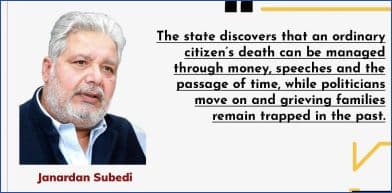
That is the political economy of impunity. The state discovers that an ordinary citizen’s death can be managed through money, speeches and the passage of time, while politicians move on and grieving families remain trapped in the past.
The mother’s question therefore reaches far beyond September 2025. It asks whether Nepal’s republic can finally abandon a political culture in which citizens’ lives are assigned a monetary value while their deaths are denied the full protection of law.
That question leads directly to another: Who is running contemporary Nepal?
A recent investigation by The Grayzone, based on leaked documents, alleges that U.S. funded organizations helped cultivate young Nepali political and civic leaders and identifies figures who later became prominent in Nepal’s new political establishment, including Balendra Shah, Rabi Lamichhane, Sagar Dhakal and Sudan Gurung. These are serious allegations and deserve independent scrutiny, not automatic acceptance or reflexive dismissal.
But the more important question is not whether a foreign country has interests in Nepal. Of course it does.
Nothing unusual, immoral, or surprising about nations pursuing their national interests. The United States does it. China does it. India does it. Russia does it. Great powers pursue strategic, economic, and security interests beyond their borders because that is how international politics works. The international system is not a charity organization.
The United States has interests in Nepal. China has interests in Nepal. India has enormous interests in Nepal. None of that, by itself, constitutes a scandal.
The scandal would be something else entirely: if Nepal’s own political leaders cannot identify, defend and advance Nepal’s national interests.
That is the question Nepalis should be asking.
Nepal’s Constitution itself defines national interest in terms that include sovereignty, territorial integrity, independence, dignity, the rights of Nepali people, border security, economic wellbeing and prosperity. Its stated foreign policy emphasizes an independent approach grounded in sovereign equality, non-alignment, Panchasheel, international law and the overall national interest.
So, the real issue is not whether Washington is working for Washington, Beijing for Beijing, or New Delhi for New Delhi. The real issue is whether Kathmandu is working for Nepal. This should inspire responsibility and hope that leaders can prioritize national interests for a better future.
That distinction is crucial because foreign influence does not operate in a vacuum. Foreign powers cannot run Nepal by themselves. They require Nepali intermediaries, political networks, institutional relationships, and domestic actors willing to translate external interests into domestic political choices. At the same time, it would be intellectually lazy to label every Nepali who studies abroad, receives foreign training, participates in an international program, or maintains relationships with foreign institutions as a foreign agent. International engagement is not treason, and cooperation is not subordination.
The test is conduct.
When an external interest conflicts with Nepal’s national interest, which side does a Nepali leader choose? When personal political survival conflicts with institutional integrity, what does the leader protect? When party interest conflicts with the public interest, who wins?
Those questions matter far more than political labels.
This is where the words snollygoster and quisling become useful, although neither should be thrown around casually. A snollygoster is the political opportunist who treats public office as an instrument of personal advancement. At the same time, a quisling is someone who collaborates with an external power against their own country’s interests. Foreign friendship does not make anyone a quisling, just as foreign education does not make anyone a foreign agent. The distinction must be established through evidence and conduct, not political suspicion.
The deeper problem is that Nepal has spent decades producing political actors whose primary loyalty often appears divided among party, faction, family, patronage network, personal ambition, and, sometimes, external relationships. The tragedy is not that Nepal has foreign friends. The tragedy would be that Nepal lacks leaders confident enough in their own country’s interests to maintain those friendships without becoming dependent on them.
That vulnerability did not begin with today’s young politicians.
For decades, Nepal’s established parties have recycled leaders, alliances, slogans and promises. Young Nepalis were frequently treated as crowds to mobilize rather than citizens to empower. Corruption, unemployment, patronage and institutional frustration created genuine anger long before anyone attempted to organize it. The grievances that produced political upheaval were therefore not imaginary, and reducing the September movement to a foreign conspiracy would insult the very citizens whose suffering gave the movement its force.
Yet genuine grievances can be organized, redirected and converted into political power. A spontaneous uprising can acquire political entrepreneurs, and domestic political ambitions can intersect with international strategic interests. That is not a conspiracy theory; it is a basic sociological observation about how power operates.
The important task, therefore, is neither to romanticize the new political class nor to demonize it. It is to hold it to a higher standard.
Nepal does not need politicians who are permanently pro-American, pro-Indian or pro-Chinese. It needs leaders who are demonstrably pro-Nepal. Nepal can cooperate with Washington without becoming Washington’s client, deepen economic and diplomatic engagement with Beijing without becoming Beijing’s client, and preserve its extraordinary relationship with India without becoming India’s client. A sovereign country should be capable of friendship without dependency and cooperation without surrender.
That is what Nepal First should mean.
But Nepal First cannot stop at foreign policy. It must also mean that the Nepali citizen comes before the politician, that justice comes before political convenience, and that citizens’ blood cannot be converted into political legitimacy and then forgotten once power is secured.
This is why the grieving mother in Parliament is more than a symbol of September 2025. She is a test of the republic itself.
She is not asking whether Nepal should lean toward Washington, Beijing, or New Delhi. She is not asking which political faction deserves credit for the transformation that brought new leaders to power. She is asking when her child, and all those children, will receive justice.
If the families of those killed on September 8 and 9 are still waiting for accountability while politicians who emerged from that transformation occupy positions of power, Nepal faces a problem deeper than a change of government. It raises the possibility that the country has changed its politicians without changing its political culture.
The old establishment was condemned for corruption, patronage, opportunism and dependence. If a new generation reproduces the same habits beneath younger faces, sharper slogans and more sophisticated social media, then Nepal has not transformed its politics. It has merely updated the software.
Foreign powers will continue pursuing their interests, and they should. Nepal’s responsibility is to ensure that its leaders pursue Nepal’s interests with equal determination.
Let Washington be Washington.
Let Beijing be Beijing.
Let New Delhi be New Delhi.
But let Kathmandu be Nepal.
And let the mother in Parliament continue asking the question that no political slogan, foreign relationship or electoral victory can silence: When will our children receive justice?
Until Nepal can answer that question, the republic remains unfinished. And until Nepali leaders demonstrate through their conduct that Nepal comes before personal ambition, party patronage and external influence, the country will continue to confront the most uncomfortable question of all:
Who is really running contemporary Nepal?
Author Janardan Subedi is Professor Emeritus of Sociology at Miami University, Ohio, USA.
@deshsanchar