The Constitution of Nepal, (2015), envisions a robust framework of commissions and constitutional bodies to safeguard governance, transparency, and accountability. Key institutions include the Commission for the Investigation of Abuse of Authority (CIAA), the Office of the Auditor General, the Public Service Commission, the Election Commission, the National Human Rights Commission, the National Women's Commission, the National Natural Resources and Fiscal Commission, and several other commissions under Part 27. While commissions under Parts 21 to 26 are indispensable to the functioning of the state, many bodies under Part 27 often serve as convenient postings for political appointees. The machinery of government runs smoothly even when many of these positions remain vacant, raising troubling questions about why taxpayers should finance officials whose contribution is negligible or nonexistent.
The performance record of these political appointees is deeply concerning. Many commissions have failed to deliver meaningful or productive work, yet their members continue to draw hefty salaries, perks, and state privileges without accountability. Around the world, politically appointed officials of outgoing governments voluntarily step down to preserve institutional neutrality and public trust. In Nepal, however, the culture of clinging to office, no matter how undeserved, has become normalized. The same moral standard applies to ambassadors recalled by the new government. Diplomats represent the Nepali state, not the interests of political parties. Politically appointed ambassadors who refuse to step aside undermine Nepal’s credibility abroad and weaken the principle of impartial diplomacy. Their reluctance to resign reflects a disregard for democratic norms and institutional integrity.
Nepal’s persistent political instability has further strained governance. The House of Representatives, constitutionally mandated until 2084 BS, was dissolved following the Gen–Z Movement, and elections for the Federal Parliament are now scheduled for March 5. The aftermath of the movement, which resulted in widespread destruction of public property and infrastructure, demands massive reconstruction funds. The government has been forced to cut budgets for development projects and adopt austerity measures to ensure resources for rebuilding and conducting elections.
In this context, the moral and political legitimacy of individuals occupying partisan-appointed positions is indefensible. Many of these appointments reflect nothing more than political patronage, offering rewards to loyalists rather than selecting individuals based on expertise, merit, or service to the nation. Adding to the irony, many of these appointees are enjoying state-provided luxury that they had never experienced before. Expensive vehicles, full maintenance and fuel costs, generous allowances, and multiple security personnel—without any credible security threats—have become symbols of entitlement rather than responsibility. Some behave like royalty, refusing even to open the doors of their own cars, and treating security personnel as if they were private servants assigned to their personal comfort. This misuse of state resources is a national embarrassment and an insult to the dignity of the security forces. These personnel must be recalled immediately so they can serve the nation where they are genuinely required, not wasted protecting individuals whose authority is rooted solely in political favoritism.
Clinging to luxury and undeserved privilege at a time when the government is struggling to fund essential reconstruction and development is not just unethical; it is shameful. Nepal cannot afford such extravagance while cutting down project budgets and enforcing austerity. To make matters worse, Nepal’s governance continues to be influenced heavily by foreign powers. India, China, and the United States remain particularly active in Kathmandu’s political and diplomatic landscape, often shaping outcomes that should be guided by Nepal’s own priorities. A government accountable to its people must prioritize domestic needs, ensure efficient service delivery, uphold institutional discipline, and respond promptly to public concerns. Yet, despite constitutional mechanisms such as parliamentary oversight and ministerial responsibility, essential services fail to reach many citizens, particularly marginalized communities. Corruption, clientelism, and the dominance of powerful individuals continue to undermine the system, allowing public resources to be used at personal whim rather than according to law and institutional norms.
Nepal stands at a decisive turning point. Political appointees in Part 27 commissions and recalled ambassadors must recognize that public office is not a personal privilege. It is a responsibility grounded in ethics and accountability. Voluntary resignation is not merely a symbolic gesture; it is a moral obligation. It is the least they can offer a country struggling to rebuild its infrastructure and prepare for crucial national elections. If Nepal is to restore public trust, strengthen institutions, and preserve democratic values, these morally compromised officials must step aside. Their unwillingness to do so exposes their true motivations—not service or duty, but entitlement and personal gain.
The time has come for Nepal to reject the culture of privilege and demand integrity from all who occupy public office. The Nepali people deserve better, and the state must be protected from those who treat it as a reward for political loyalty rather than a sacred responsibility.
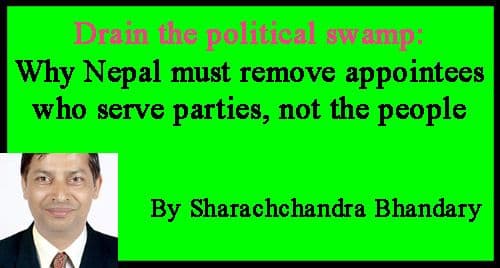
Bhandary is the Executive Editor at the National News Agency (RSS)