
# Prem Sagar Poudel -----------------
The essence of democracy lies not merely in the process of changing governments, but in the continuous presence of justice. The basis on which a state considers itself civilized and accountable is the equal application of the law to all. But when those in power themselves begin to manipulate judicial processes, when priority is given not to the law but to individuals who stand above it, democracy becomes confined to formal structures and hollowed out from within. The political practices currently on display point precisely toward this dangerous turn.
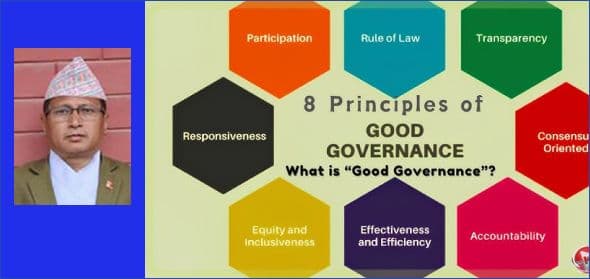
Freeing thousands of accused involved in serious crimes from the prison system in order to protect a single individual, or withdrawing hundreds of cases related to economic crimes at the initiative of the state itself to grant immunity to one figure, cannot be dismissed as ordinary administrative decisions. This represents an extreme distortion of the relationship between power and justice, where the state arrogates to itself the authority to choose which criminals deserve protection and turns justice into an object of bargaining. To label such practices as good governance is not merely a linguistic deception; it is an open acknowledgment of the moral decline of the state itself.
A glance at world political history shows that weakening justice to preserve power is nothing new. Yet it has always produced grave consequences. In many Latin American countries, “amnesty laws” were enacted to shield military rulers or those in power. In Argentina, Chile, and Brazil, serious allegations of human rights violations were suppressed for decades. As a result, these countries gained not political stability but long-term social divisions and deep institutional distrust. Eventually, those laws were repealed, but justice came too late, and the wounds never fully healed.
Similar patterns have appeared across the African continent. In countries such as Kenya, Uganda, and Zimbabwe, corruption and violent crimes committed by individuals close to power were ignored in the name of “political stability.” But when the law is weakened, power itself cannot remain secure in the long run. Institutional decay ultimately pushed these countries toward economic crisis, social unrest, and international isolation.
In Eastern Europe, after the collapse of communist regimes, some countries chose to turn a blind eye to past crimes in the name of “political reconciliation.” While this appeared to bring short-term calm, it weakened public trust in justice over the long term. The democratic backsliding visible today in Poland, Hungary, and Romania is rooted in that very culture of impunity, where power was deemed greater than the law.
The South Asian context is even more troubling. Here, democracy is often confined to elections, while the justice system falls under the shadow of power. In Pakistan, cases have repeatedly been withdrawn in the name of “national interest.” In Sri Lanka, crimes committed during the civil war were turned into tools of political bargaining. In India, serious questions continue to be raised about the tendency to delay or weaken cases involving individuals close to power for years. All these examples show that when a state administers justice not by the nature of the crime but by the status of the criminal, democracy is reduced to a mere game of numbers.
The greatest irony is that those who make such decisions are often the loudest preachers of morality. Words like good governance, transparency, and the rule of law are repeated so frequently that they begin to feel empty. This deep gap between rhetoric and practice is the most dangerous signal for any democracy. When citizens stop believing in words and begin to judge solely by decisions, the silent social contract between the state and society breaks down.
In such circumstances, intolerance of criticism grows. Those who raise questions are defamed, those who reveal the truth are systematically attacked, and a culture of sycophancy flourishes around power. History shows that this is a shared characteristic of every declining regime: praise of power becomes mandatory, while truth becomes punishable.
The impact of such decisions is not immediately visible. But in the long run, the cost is extraordinarily high. When law-abiding citizens begin to feel foolish, when crime becomes a matter of power and access, when justice is presented as something that can be bought, the moral foundation of the state begins to collapse. World history makes it clear that states fall not because of external aggression, but because of internal impunity.
From the fall of the Roman Empire to the crises of modern African and Latin American nations, a single common pattern emerges: power standing above the law. When a state violates its own rules, it loses the moral authority to demand that citizens obey them. From that very moment, anarchy begins- no matter how carefully it may be wrapped in the formal language of good governance.
The questions raised in this context are not insults; they are warnings. Criticism is not incivility; it is an essential condition of democracy. If justice continues to be used as a tool to protect power, there will soon be no institutions left capable of protecting that power itself. History does not remain silent. It does not record speeches; it records decisions.
The true test of good governance lies not in slogans, but in difficult choices. Power cannot be strengthened by weakening the law. On the contrary, power becomes sustainable only when the law is strong. Until this truth is understood, democracy in any country will remain merely a showpiece structure- decaying quietly from within.