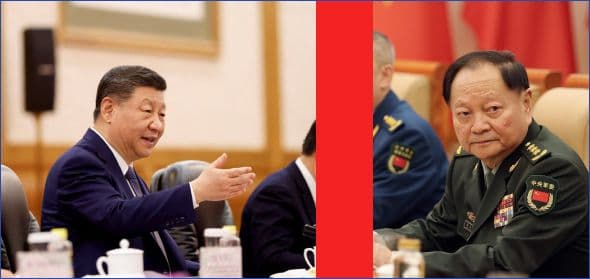
Dozens of generals have been toppled in President Xi Jinping’s unrelenting campaign against perceived corruption and disloyalty over the past three years. But this weekend’s downfall of Gen. Zhang Youxia, who had been the Chinese president’s chief deputy in the military, was of a different order of magnitude.
Xi’s decision to oust Zhang and another top general means the Central Military Commission, the small committee that commands China’s armed forces, has only two members left: Xi himself and the officer he has used to oversee the purges.
This move “represents the total annihilation of the high command,” said Christopher K. Johnson, a former C.I.A. analyst who follows Chinese elite politics.
At 75, Zhang was old enough that Xi could have ushered him into retirement. Instead, Xi made him a public pariah.
China’s defense ministry announced that he was under investigation for unspecified breaches of laws and political discipline. An editorial in the military’s official newspaper, the People’s Liberation Army Daily on Sunday hinted that Zhang was being accused of corruption, and, perhaps more important, of disloyalty to Xi.
What prompted Xi to finally turn against Zhang is now a topic of fevered speculation in Beijing and beyond. Some believe Xi may have come to see him as too powerful, after the general’s own rivals were toppled in previous purges. Others believe Xi concluded that systemic corruption was so deep that he needed drastic surgery to clear the way for a new generation of commanders.
Still other allegations are more serious: The Wall Street Journal reported on Sunday, citing anonymous sources, that Zhang had been accused of leaking nuclear secrets to the United States.
President Xi Jinping, seated at a conference table, gestures with his right arm while speaking.
President Xi Jinping in Beijing this month. Carlos Osorio/Reuters
What does seem clear is that Zhang’s purge — the most dramatic in a wave of military purges that has unfolded since 2023 — has raised questions about China’s strategy toward Taiwan, at a time when China’s military has been severely diminished by Xi’s anti-corruption campaign.
Investigations and disappearances
After Xi became China’s leader in 2012, he moved quickly to shake up the military, which was rife with corruption and organizationally stuck in the past. Zhang was one of the commanders Xi picked to help lead this overhaul.
But after a decade in charge, Xi seemed to conclude that some of his own handpicked protégés had been infected by the military’s corruption, and a new cycle of investigations and purges began.
Since 2023, waves of top commanders and officers in the Chinese military, and executives for arms manufacturers, have been removed from office and placed under investigation — or, in some cases, have disappeared from view without explanation. Investigations have taken down admirals, regional military commanders and members of the Central Military Commission.
The investigations’ toll on the military was visible at a meeting last year of the Communist Party’s Central Committee, a council of top officials. Of the 44 uniformed officers appointed to the committee in 2022, 29 — roughly two-thirds — had been purged or were missing.
Zhang had long seemed to be spared scrutiny. Xi kept him in office past retirement age, and made him his top vice chairman of the Central Military Commission — Xi’s eyes and ears in running the People’s Liberation Army’s forces day to day.
Zhang Shengmin and Liu Zhenli, dressed in uniform, are seated at a table with papers and porcelain teacups in front of them.
Gen. Zhang Shengmin, left, who has overseen Xi’s purges, and Gen. Liu Zhenli, who was also ousted this weekend, in March. Florence Lo/Reuters
A lack of operational experience
Zhang being pushed out is especially significant because he was a celebrated war veteran, in a nation where few active commanders have experienced real combat. Zhang fought in China’s last war, a border conflict with Vietnam that began in 1979 and lasted years.
Xi seems to have calculated that in the longer term, his shake-up will make the military less corrupt, more loyal and more effective in pursuing his goals. But the disruptions caused by the purges could leave Xi less confident that his commanders are ready for combat, analysts say.
“There’s no one right now at the highest level who has operational experience or who is in charge of training and exercises,” said Shanshan Mei, a political scientist who studies China’s armed forces. “This is going to cut very deep.”
But it’s also not clear that the changes will lead to more restraint. Another former U.S. government official shared his worries about the potential consequences of purging one of the people who could speak candidly to Xi.
Zhang “could assess U.S. and Taiwan military capabilities objectively and explain to Xi Jinping what the military risks and costs of an operation to take Taiwan would be,” Drew Thompson, a former Pentagon official, wrote on Substack. “I worry about the consequences of someone other than Zhang Youxia providing Xi Jinping with military advice.”
@The NewyorkTimes