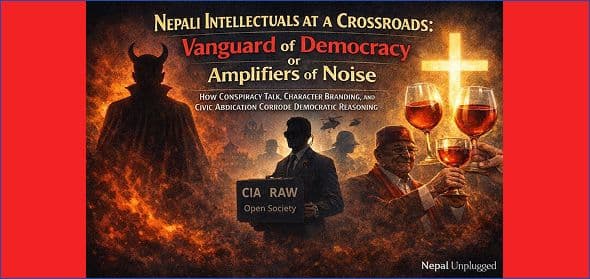
How Conspiracy Talk, Character Branding, and Civic Abdication Corrode Democratic Reasoning
Dr. Alok K. Bohara
When global power games—garnished with colorful metaphors—are invoked to explain away domestic accountability, intellectual discourse slips from civic clarification into “political witchcraft”—a subtle, elite-driven practice distinct from the overt “political witch hunts” waged by partisan actors. The urgency of this issue in the public mind demands immediate attention as Nepal’s election temperature continues to rise.
“As our island of knowledge grows, so does the shore of our ignorance.” — John Archibald Wheeler (1911–2008), theoretical physicist
Signal, Noise, and the Missing Vanguard
One of the most frustrating things about democracy is the blurry line between signal and noise, between facts and fictions. This surfaces most glaringly during election cycles—and just look at what is unfolding in the current election in Nepal.
This essay is not about the fanfare.
What it is about is the role of an important segment of society in the development of democracy: the intellectuals.
Nothing illustrates this more vividly than the between-the-lines and subtle partisan push we can see in many—though certainly not all—of the debates and writings involving our intellectuals. In many cases, instead of playing the role of a vanguard—vetting candidates and their policies through clear, non-partisan scrutiny—they themselves have become amplifiers of Nepal’s familiar pastimes: conspiracies, “foreign hands” metaphors, and even damaging caricatures with little bearing on ideas, vision, or candidates’ calibre.
The election cycle has never been a dull event in Nepal. This time is no different. Long motorcades, candidates’ faces buried in garlands, the drama of helping housewives with their chores, and politicians dodging nosy journalists and uncomfortable questions are all familiar scenes.
But setting this election campaign ritual aside, a pertinent question for me is this: are Nepal’s intellectuals fulfilling their role as a vanguard of candidate scrutiny and translators of policy for the broader public? Are they helping citizens understand candidates’ policy positions? Or are they, instead, contributing—actively or passively—to misinformation and conspiracy chatter?
Sadly, the answer appears to be the latter.
This essay draws a few lessons—and makes a humble request—for Nepal’s intellectuals, especially during this election season and beyond, to exercise greater restraint, humility, and analytical care. More importantly, it lays out the reasoning that this tenuous role—and the prolonged complacence surrounding it—may well be a central reason behind Nepal’s liberal democratic fragility and its periodic collapse. My challenge is grounded in a simple notion: a strong democracy, and its survival, requires intellectuals to act as independent brokers rather than partisan amplifiers.
From Foreign Hands to Moral Caricatures
Nepal has long had a habit—sometimes understandable—of reaching for conspiratorial explanations when politics becomes messy. Yes, India, China, and lately the U.S. do “meddle,” often through informal channels. But external influence becomes intrusive only when internal institutions are already weakened and compromised.
What is equally concerning, however, is how this habit has evolved inward—toward the branding of individuals as conspiratorial agents themselves. A hyper-active social media ecosystem finds such labels ready fodder and amplifies them beyond repair.
In essence, what worries me just as much is the drift in our public discourse—foreign conspiracy chatter on the one hand, and the branding of political actors on the other. Taken together, these labels become political focal points, draining oxygen from the harder work of policy differentiation and substantive debate.
In Nepal, politicians are casually branded as foreign agents—CIA assets, Indian dalals, George Soros’s agents, or increasingly through symbolic caricatures invoking religion and imagery, including “holy wine” and “Hindutva” metaphors. These labels travel faster than evidence and linger longer than facts. Like most misinformation, the damage—real or perceived—is done early, dulling the seriousness with which a candidate’s ideas and arguments are received, especially when such branding is echoed directly or tacitly by intellectual voices.
Political figures, of course, invite scrutiny—and they must. Their temperament, language, and indulgences matter. Provocation, theatricality, and moments of excess—whether in rhetoric, social media conduct, or enforcement—deserve serious criticism and debate. But there is a difference between analytical critique and moral branding.
Even veteran television journalists and intellectual commentators have, more often than not, slid into speculative territory, often accompanied by a dash of mockery.
When critique on high-profile platforms drifts into apocalyptic labeling, it leaves the public not better informed but unsettled—confused about facts, motives, and consequences. This is precisely where an independent intelligentsia ought to exercise restraint, yet increasingly does not.
This becomes especially troubling when highly regarded intellectuals casually deploy moral caricatures—branding political actors as sinister demons, saviors, foreign agents, or religiously manipulated figures. Such language does not elevate debate; it corrodes it. Character assassination may win applause, but it contributes little to democratic reasoning.
Yes, politicians will insult each other. YouTubers will sensationalize. That comes with the terrain. But intellectuals occupy a different space. Their words shape norms, not just narratives. In a fragile democracy, restraint, precision, and analytical humility matter as much as critique itself.
If we are serious about democratic renewal, we must resist both easy conspiracies and rhetorical excess—and return to the harder work of institutional diagnosis, accountability, and civic discipline.
This tension between analysis and speculative theater is not new; it sits at the center of enduring debates about the power—and responsibility—of intellectuals in democratic societies. I turn next to two philosophers who offer enduring cautionary lessons for all of us.
A Higher Civic Obligation: Intellectuals in a Free Society
This moment calls for reflection, especially from those who shape public reasoning.
Friedrich A. Hayek warned explicitly about the power—and responsibility—of intellectuals in a free society. In The Intellectuals and Socialism (1949), he noted that intellectuals play a decisive role in determining which ideas circulate, which facts are highlighted, and how public understanding is shaped. His warning was structural, not partisan: when intellectuals drift from analysis into moral theater or factional branding, they distort the informational environment. Consequently, citizens struggle to exercise judgment.
The cumulative effect is a heavier cognitive burden on citizens. Confused and bewildered, they must sift through speculative jargon and moral labeling before they can engage with policy arguments at all.
This is particularly important for Nepal, where public awareness about the difference between manifesto rhetoric and implementable policy mechanisms remains limited. Intellectuals are not compelling politicians to answer in substance rather than rhetoric, nor are they consistently translating accountability or policies into a language the public can evaluate and follow.
If Hayek’s concern was the distortion of understanding, Berlin’s was the hardening of belief. Nepal’s intellectual space suffers from both.
Isaiah Berlin, writing from a different tradition, issued a parallel caution. In The Crooked Timber of Humanity, he warned against intellectuals who come to believe they possess the sole moral truth. Such certainty, Berlin argued, often slides into rigidity, because once one truth is treated as absolute, dissent becomes error—worthy not of engagement but dismissal. Berlin calls it an erosion of pluralism and warns of its damaging effect on liberty itself.
Listening to some of our intellectuals in televised discussions—often alongside journalists who appear more in awe than in interrogation, and with very little pushback—offers a clear illustration of the very tendency Berlin cautioned against. Such moments are then consumed by the public largely unfiltered and insufficiently vetted, especially when delivered with the aura of confidence by our intellectuals.
To be clear, not all intellectuals or journalists fall into this pattern. Some do press, probe, and challenge with rigor. But the visibility of “unexamined certainty” delivered on prominent platforms remains troubling because of its reach and influence in the public.
Together, Hayek and Berlin point to a simple lesson for Nepal: democracy depends on a restrained, plural, and independent intellectual space. When intellectuals become partisan amplifiers, moral enforcers, or worse, referees of moral judgment, the middle corridor of democracy—the space between power and populism—narrows.
Preserving that space requires pause, discipline, and humility. Without it, citizens are left navigating noise rather than knowledge—and democracy itself becomes easier to manipulate, even reopening the door to the much-dreaded specter of “foreign hands.”
When Critique Turns into Political Witchcraft
In conclusion, the current landscape that many Nepali intellectuals now occupy appears increasingly critical but less analytical. Add to this the endless circulation of conspiracies and character caricatures, and public discourse begins to resemble a form of “political witchcraft.”
Political anthropologists have long used witchcraft not to describe belief in the occult, but to explain systems of accusation that redistribute anxiety and blame without resolving underlying institutional failure or uncertainty (Evans-Pritchard; Comaroff & Comaroff; Geschiere). When similar logics enter democratic discourse—often through bombastic geopolitical metaphors and moralized symbolism—civic clarification gives way to suspicion and insinuation.
Applied here, it captures a troubling shift. Instead of clarifying policy choices and institutional stakes for the general public in a non-partisan manner, intellectuals leverage their influence to seed suspicion, amplify labels, and raise doubts.
Economists have described analogous behavior as a cost-raising strategy—where influential actors, rather than clarifying issues for public evaluation, introduce accusations and symbolic frames that force others into defensive postures, thereby increasing cognitive and reputational transaction costs without advancing substantive understanding.
In modern democratic settings, “political witchcraft” emerges when reputable elites seed suspicion and symbolic accusation—often unfounded and dazzling. Beyond shaping public doubt, these actions impose reputational and cognitive costs on those targeted—civic and political figures alike. Such deliberative accusations divert all of us from engaging in substantive debate, the very task intellectuals are burdened to carry forward in a healthy democracy.
The result is predictable: muddying the water, deflecting real issues, and raising the transaction costs for those being accused—while the public is left further removed from policy substance and democratic accountability.
Thus, Nepal’s democracy will only hold a firm middle corridor if its intellectuals refrain from practicing political witchcraft and return to the harder work of civic clarity.
A fort falls when the commander flees. A democracy collapses when its intellectuals abandon their post.
Dr. Alok K. Bohara, Emeritus Professor of Economics at the University of New Mexico, writes as an independent observer of Nepal’s democratic evolution through the lens of complexity and emergence science. His systems-policy essays on Nepal’s socio-economic and political landscape appear on Nepal Unplugged.
References
The concept of “political witchcraft” is used here analytically, drawing on political anthropology, political economy, and intellectual history to describe systems of accusation that displace accountability, amplify moral suspicion, and raise cognitive and reputational transaction costs under conditions of institutional weakness.
Evans-Pritchard, E. E. (1937).
Witchcraft, Oracles and Magic among the Azande.
Oxford: Clarendon Press.
Comaroff, Jean, & Comaroff, John L. (1999).
“Occult Economies and the Violence of Abstraction: Notes from the South African Postcolony.”
American Ethnologist, 26(2), 279–303.
Geschiere, Peter. (1997/2013).
The Modernity of Witchcraft: Politics and the Occult in Postcolonial Africa.
Charlottesville: University of Virginia Press.
Faria, João Ricardo. (1998).
“The Economics of Witchcraft and the Big Eye Effect.”
Kyklos, 51(4), 537–544.
Hayek, Friedrich A. (1949).
“The Intellectuals and Socialism.”
University of Chicago Law Review, 16(3), 417–433.
Berlin, Isaiah. (1990).
The Crooked Timber of Humanity: Chapters in the History of Ideas.
London: John Murray.