By Dr Janardan Subedi--------------
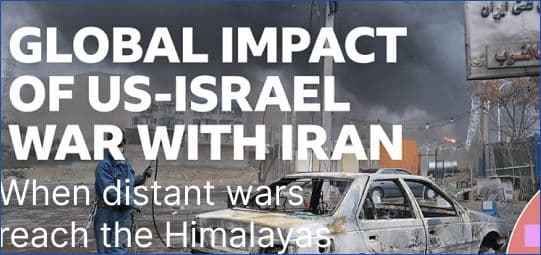
Shambhu stared at his empty phone, counting the days since his brother sent money from Doha. Although the Gulf was thousands of miles away, every tremor there echoed across his village. For decades, remittances had been invisible scaffolding things like the masubhat on his table, school fees paid, and medicine on the shelf. Now, the scaffolding wobbled. Somewhere far beyond mountains and deserts, generals and diplomats were moving pieces on a board, and Shambhu’s life depended on their mistakes or their mercy.
Nepal had never sent soldiers to that distant land, yet it was closely linked to its fortunes. Hundreds of thousands of Nepalese worked on construction sites, in service industries, and in skyscrapers abroad. Their earnings flowed home like lifeblood into households, villages, and even national accounts. Now, with conflict threatening mass evacuations, Shambhu pictured his brother at a crowded airport, passport in hand, uncertain if the remittance wire would go through, whether the family could survive, or if anything would feel normal again.
The recent election had shocked the country. The Rastriya Swatantra Party, barely a few years old, surged to a two-thirds majority. The old parties, which had long treated democracy like a performance, were decisively rejected. Villagers like Shambhu’s family celebrated a mandate for change, but the reality was stark: untested institutions, bureaucracies stretched thin, and an economy dependent on the distant whims of foreign powers. The victory was electrifying, but it carried a weight heavier than any ballot box could bear.
Energy vulnerability was another critical issue. Nearly a fifth of global oil passes through the Strait of Hormuz. A single flare-up or blocked shipment could cause prices to spike. Nepal imports refined petroleum via India, which means Shambhu now recalculates every rupee, bus fare, masubhat, and cooking gas. He traces the chain reaction in his mind: bombs in deserts, shipment delays, multiplied costs. If supply stopped altogether, empty shelves, silent pumps, and stoves that wouldn’t light would become a reality.
The threat of evacuation hung heavy. Thousands could flood airports at once. Remittances might collapse. Households would struggle. Returning migrants would compete for housing, jobs, and social services. The new government, armed with a popular mandate, would face a stress test unlike anything in its short history: strategic competence under pressure, domestic unity under strain, survival on the line.
Nepal sits between China and India, both of which are alert to tremors in the West Asia. China monitors energy corridors and Iranian partnerships. India balances Israel, the U.S., and regional initiatives. Nepal’s stance of non-alignment, once simple, now calls for near-superhuman diplomacy. Weakness or improvisation could turn a principle into vulnerability. Minor diplomatic slips could echo across time and space. Shambhu feels it in the whispered anxieties of neighbors, the tense glances at headlines, the silent question in every masubhat: will we survive?
Daily life becomes a series of micro-decisions. Rising bus fares mean children walk farther to school. Masubhat budgets tighten. Shops struggle to adapt. Evacuations would exacerbate these challenges, including housing shortages, labor disputes, and emotional stress. Policy debates in Kathmandu collide with everyday realities in households across the city. Shambhu understands that global strategy is not just an abstract concept but a calculation of survival.
Nepal’s economic dependencies deepen with each shock. Oil price surges hit transportation and energy. Dips in remittance flows strain households, slow domestic spending, and increase social tensions. Political instability reduces the country’s ability to adapt. Each ripple from abroad could trigger a local tsunami. Yet, these vulnerabilities also offer pathways for decisive action. The very constraints that threaten lives can inform better policy, smarter planning, and more resilient institutions.
Shambhu’s resilience mirrors that of the nation. Geography offers some protection, but only partially. The Himalayas can shield against armies, perhaps, but not against empty wallets, delayed tuition, or the threat of evacuation. Every price increase, every late remittance, every returning worker underscores how deeply global events are tied to daily survival.
Within crises lie opportunities. The RSP government, holding a two-thirds majority, could turn constraints into strategy. Economic diversification might reduce reliance on foreign labor. Strategic energy reserves and alternative supply chains could buffer shocks. Proactive diplomacy could defend autonomy and manage pressures from India, China, and international powers. Weaknesses could be transformed into strengths, vulnerability into a blueprint for long-term resilience.
Global conflicts serve as stress tests, exposing flaws but also opening doors for strong leadership. Effective governance could boost credibility, strengthen institutions, and deepen regional ties. Failure, however, could destabilize domestic life, magnify economic shocks, and invite external pressures. For Shambhu, each missed remittance, rising bus fare, or postponed tuition fee is a reminder: survival depends on clarity, courage, and foresight.
Public discourse brims with tension. Wars, alliances, and global rhetoric influence conversations in classrooms, tea shops, and villages. Competing narratives—Western influence versus emerging Asian alternatives shape perceptions before tangible shocks even arrive. The government must navigate perception, policy, and social consequences simultaneously.
Shambhu’s household reflects the larger challenges. The empty phone screen, rising bus fares, delayed tuition, and threat of evacuation are measures of geopolitical instability. The Himalayas offer sanctuary but no longer isolation. Every decision, delay, and mistake carries weight.
Even in adversity, agency exists. The government can turn threats into opportunities, transforming dependency into strategy, fragility into resilience. Shambhu, like the country, watches and calculates. The invisible threads linking Gulf conflicts to masubhat and tuition are signals of resilience, insight, and adaptability.
Global shocks, policy failures, and economic reliance are no longer just vulnerabilities; they are opportunities to demonstrate competence, reinforce unity, and translate electoral mandates into lasting action. Nepal’s survival hinges on understanding the complex interplay between global crises and local realities, and on acting decisively. The mountains still watch silently, but it’s the choices of people, institutions, and leaders that will determine if life remains secure, stable, and hopeful.
In Shambhu’s village, the distant rumble of war is a tangible reality, a flicker of uncertainty, a tightening of budgets, and quiet worry about his brother’s safety. Across valleys, rivers, and winding roads, the impacts of decisions made far away arrive daily. The RSP government’s ability to navigate these intertwined political, economic, and social currents will shape a generation. Strategic foresight, resilient institutions, and good governance are no longer ideals but essential tools for survival.
Shambhu’s worries carry the weight of systemic fragility. Each day brings the distant sound of war, not as an abstract policy but as a direct threat to survival. Empty phones, rising fares, and delayed tuition are the real markers of geopolitical instability. Nepal’s survival now depends on strategic foresight, strong institutions, and leadership capable of turning a two-thirds majority into effective action. No longer can geography be the sole shield.
Even in hardship, there is room for agency. The government can turn threats into opportunities, turning constraints into strategies, and fragility into a plan for resilience. For Shambhu, every masubhat, each rupee spent or saved, and every anxious thought about his brother abroad becomes a lesson in how deeply personal and geopolitical worlds are intertwined. Ultimately, resilience is not just enduring but also recognizing, tracing, and acting on these invisible threads before they break.
Global conflicts echo beyond mountains, and the Himalayas no longer offer the illusion of distance. Survival, stability, and hope now depend on the decisions of living people, the strength of institutions, and the ability to convert vulnerabilities into leverage. For Shambhu, the stakes are immediate, real, and critical. For Nepal, they are existential.
@PReview