Nepal’s Fourth Liberation: The Electoral Revolt Against a Broken System
Ending a Century of Revolutions and Opening Nepal’s Fourth-Century Renaissance —Peace • Progress • Prosperity
Dr. Alok K. Bohara-------------
Nepal’s citizens have given a new generation of leaders something rare in politics: a clean slate. What is written on it now will shape the nation’s fourth century.
Preamble
Nepal may be witnessing a rare political moment.
The sweeping electoral rise of a new political force reflects deep public frustration with corruption, patronage politics, and decades of governance failures. Yet the scale and geographic spread of the electoral shift suggest something larger than a routine change of government.
This essay places the current political moment within a longer historical arc. Over the past three centuries, Nepal’s political evolution has moved through distinct governing orders—militocracy, aristocracy, and democracy—each shaped by upheaval and reform. Within the democratic century that began in 1950, the country experienced a series of “revolutions” expanding the promise of freedom and inclusion.
The current electoral upheaval may represent a fourth moment of liberation—not from a ruler or regime, but from the broken political system itself. If so, Nepal may be closing a century defined by revolutions and opening the possibility of something different: a fourth-century renaissance grounded in peace, progress, and prosperity.
Achieving that future will require what might be called adaptive governance—a political culture capable of learning, correcting mistakes, and turning new challenges into opportunities. It will also require a new geopolitical imagination: seeing Nepal not as a buffer trapped between two competing giants, but as a bridge linking India and China in a trilateral opportunity for cooperation and development.
The Puzzle of the Electoral Sweep
How did a relatively new political party manage to sweep across Nepal’s political landscape—gaining support across regions, classes, and communities, and even elevating a youth and former mayor of Kathmandu and engineer of Madhesi ethnic background to the prime ministership?
At one level, the answer is clear. Years of corruption, mismanagement, elite collusion, and political stagnation created deep frustration among citizens. Voters simply used the ballot box to punish the old parties and try something new.
But this explanation tells only part of the story. Nepal’s recent electoral upheaval also fits into a much longer historical rhythm—one that becomes clearer when we step back and look at the country’s evolution over three centuries.
Three Centuries, Three Governing Orders: Militocracy, Aristocracy, Democracy
Viewed through this longer lens, Nepal’s political history can be understood through three governing orders: militocracy, aristocracy, and democracy.
The first century began with Prithvi Narayan Shah’s military consolidation of Nepal in the eighteenth century. The country emerged from a fragmented landscape of small warring kingdoms known as the Baise and Chaubise states. Through a series of military campaigns and conflicts, Shah unified much of the region and laid the foundation of the Nepali state. This was a turbulent period, but it created the geographic and political birth of modern Nepal. In this sense, Nepal’s first century was an era of militocracy—state creation through military consolidation.
The second century began after the Kot massacre of 1846, when Jung Bahadur Rana and his clan captured the state and established a hereditary oligarchy that ruled Nepal for roughly a hundred years. This period represented an era of aristocracy, where a small ruling elite controlled political power. Despite its excesses and exclusionary nature, the Rana system brought administrative consolidation and relative political calm. Through pragmatic relations with British India, the regime preserved Nepal’s sovereignty in a volatile regional environment. (See Reference: Nepal’s Historical Cycle: Three Centuries of Disintegration, Integration, & Disintegration)
The third century began with the democratic revolution of 1950, led by democratic forces including B.P. Koirala and other freedom fighters, with King Tribhuvan aligning with the anti-Rana movement. This moment carried the promise of liberty and representative governance.
Yet democracy arrived during what appears, in cliodynamical terms, to be another upheaval phase in Nepal’s long historical rhythm. In simple terms, Nepal’s history over the past three centuries seems to have followed a pattern of upheaval, calm, and upheaval.
The first century, beginning with Prithvi Narayan Shah, involved intense conflict and state formation as small kingdoms were brought together into a single polity. The second century, under the Rana regime, brought administrative consolidation and relative calm. The third century, beginning with the democratic revolution of 1950, has once again been marked by turbulence.
In this sense, Nepal’s democratic century has been less a settled democratic order than a continued search for one.
Revolutions as Constructive Resets
Yet these upheavals were not purely destructive. Each movement was also a form of constructive disruption—what the economist Joseph Schumpeter famously described as a process of “creative destruction.” In political life, such disruptions can function as resets, moments when societies attempt to replace exhausted institutions and renew their political order.
Nepal’s democratic century has been a century of liberations.
Four Revolutions, Four Expansions of Freedom
1950 — Liberation from Aristocratic Oligarchy
The revolution of 1950 liberated the country from hereditary oligarchy and opened the door to political freedom.
1990 — Liberation from Autocratic Rule
The people’s movement of 1990 ended the Panchayat autocracy and restored multiparty democracy and civil liberties.
2006 — Liberation Toward Social Inclusion
The uprising of 2006 ended the monarchy’s political role and ushered in the republican era, expanding the national agenda toward minority rights and broader social inclusion.
2020s — Electoral Liberation from the System
The recent electoral upheaval represents a new kind of revolution—one directed not at a ruler but at the political system itself. Voters rejected entrenched patronage networks, elite cartels, ideological rigidity, and the politicization of society through party-controlled organizations at every level.
From Liberation from Rulers to Liberation from Systems
Unlike earlier revolutions aimed at rulers, the current moment appears to be directed at something deeper: the political system itself—a system of party cartels, patronage networks, and institutional stagnation that many citizens felt had become incapable of reform.
In that sense, Nepal’s democratic evolution may now be entering a new phase:
from liberation from rulers to liberation from systems.
Seen in this historical light, the sweeping electoral mandate delivered in the recent election may represent what could be called Nepal’s Fourth Liberation.
But this liberation must also carry a new message:
no more revolutions.
The Fourth Century: Peace, Progress, and Prosperity
Nepal has experienced enough upheavals. The country now needs stability, institution-building, and long-term policy coherence.
If the lessons of the past three centuries are taken seriously, the fourth century of Nepal’s history should become a century of peace, progress, and prosperity.
Encouragingly, a new generation appears ready to carry this responsibility. The emerging leadership includes young, educated citizens—dozens with doctoral degrees, many more with master’s and bachelor’s training—bringing new energy and new perspectives into public life. This generation has the capacity to think beyond the politics of patronage and confrontation that shaped the past.
The opportunity before Nepal is therefore larger than a simple electoral victory. It is an opportunity to lay the institutional foundation for the fourth century.
A New Geopolitical Mindset
Part of that vision requires a new geopolitical mindset. Nepal’s two giant neighbors—India and China—have often been treated as liabilities in domestic political competition, with parties using them as tools in internal political battles. The future requires a different approach: viewing both neighbors as strategic assets for economic development and regional cooperation.
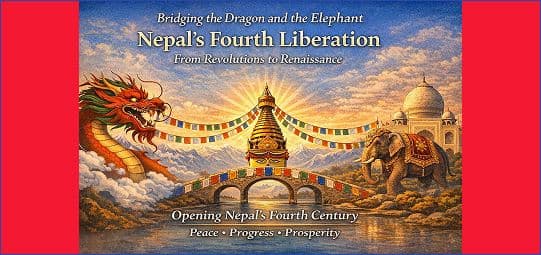
One symbolic step toward such a vision could be the convening of a China–Nepal–India summit, focused on regional connectivity, trade, and shared prosperity. Such an initiative would signal Nepal’s intention to enter its fourth century not as a battleground of competing influences, but as a bridge between two major civilizations. (See Reference: win-win-win, THECA)
Renewal Instead of Revolution
The recent electoral upheaval therefore represents more than a political shift. It may mark the beginning of a new chapter in Nepal’s long historical journey.
The country has moved through militocracy, aristocracy, and democracy.
The challenge now is to ensure that democracy finally delivers what citizens have long hoped for: peace, progress, and prosperity.
If this moment is used wisely, Nepal’s fourth century may not be remembered for revolution—but for renewal.
Nepal’s citizens have given a new generation of leaders something rare in politics: a clean slate. Mistakes will inevitably be made, as they are in every democratic experiment. What will matter most is the willingness to acknowledge those mistakes, correct them with humility, and remain faithful to the aspirations of the citizens who placed their trust in this new beginning. If that spirit prevails, Nepal’s fourth century may finally become what generations have long hoped for—a nation defined not by upheaval, but by peace, progress, and prosperity.
Dr. Alok K. Bohara, Emeritus Professor of Economics at the University of New Mexico, writes as an independent observer of Nepal’s democratic evolution through the lens of complexity and emergence science. His systems-policy essays on Nepal’s socio-economic and political landscape appear on Nepal Unplugged.
References:
Bohara, Alok. April 18, 2025. “Nepal’s Historical Cycle: Three Centuries of Disintegration, Integration, & Disintegration,” Nepal Unplugged