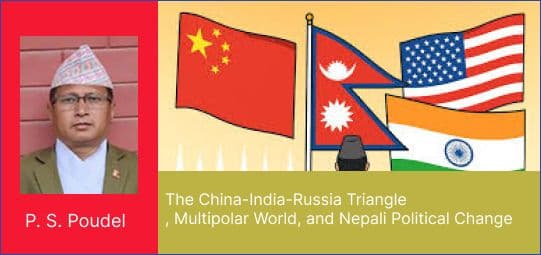
Situated in the heart of South Asia, Nepal, though geographically small, is an extremely sensitive country from a geo-strategic perspective. Nestled in the lap of the Himalayas, this nation shares its border with the vast emerging power China to the north and with South Asia's largest power, India, to the south, east, and west. This geographical location makes Nepal not just a sovereign nation but a sensitive point in the Asian power balance.
Throughout history, Nepal has often been interpreted as a "buffer state"—a security cushion between two powers. However, in changing global politics, the perception of Nepal as a "bridge state"—an economic and strategic link between two powers—is also gaining strength. This dual identity, caught between being a "buffer and a bridge," continuously influences Nepal's internal politics, economic potential, and international relations.
Recently, the emergence of new political forces in Nepal and the change in power have brought this geo-strategic equation back into discussion. The rise of new political forces like the Rastriya Swatantra Party (RSP) expresses the Nepali people's frustration with traditional parties and their aspiration for change. This change not only affects Nepal's domestic politics but may also have subtle yet significant impacts on regional power balance and international diplomatic equations. Particularly in the context of the complex strategic relationships among major regional and global powers like China, India, and Russia, Nepal's political direction and stability become even more important.
At the center of China's foreign policy lie the concepts of "peaceful development" and "stable neighborhood." According to Beijing's strategic thinking, instability, political conflict, or power vacuums in neighboring regions can create long-term security challenges. Especially for China, Nepal, which shares a border with Tibet, is not just a neighboring country but a strategic area directly connected to a sensitive border region. For this reason, China appears to prioritize stability, economic development, and political stability in Nepal. In China's view, Nepal's stability is not merely a matter of bilateral relations but is connected to the security of western China, the stability of Tibet, and the strategic balance of the entire Himalayan region.
China's policy towards Nepal has traditionally been based on "non-interference" and "respect for sovereignty." China has not been publicly seen directly supporting any particular political force in Nepal. However, it has always seemed to desire a government that respects the One-China policy, does not allow its land to become a base for separatist activities related to Tibet, and maintains friendly and practical relations with China. For China, more important than whether Nepal's government is pro-Western, pro-Indian, or pro-Chinese is that the relationship be based on stability and mutual respect.
Since the establishment of diplomatic relations between China and Nepal in 1955, bilateral relations have passed through various ups and downs, crossing new phases of development. Particularly after the second decade of the 21st century, this relationship has gained new dimensions. Following the devastating earthquake of 2015, China provided humanitarian and economic assistance to Nepal, which strengthened bilateral trust. That same year, when Nepal faced a severe economic crisis due to the border blockade with India, the need for alternative trade routes and partnerships in Nepal became even clearer. This incident forced Nepal to reassess its traditional economic dependency and created an environment to view relations with China as a new opportunity for economic and infrastructure development.
China's Belt and Road Initiative (BRI) has given Nepal-China relations a new strategic dimension. Connecting the Himalayan region to new economic routes through infrastructure development, cross-border transportation, energy transmission, and expansion of trade links is a major goal of the BRI. The construction of Pokhara International Airport, the concept of cross-border transmission lines, and possibilities for expanding road and rail links show the potential to establish Nepal as a regional connectivity hub.
However, increasing cooperation with China brings both opportunities and challenges for Nepal. On one hand, it opens possibilities for economic development and infrastructure expansion; on the other, it creates a sensitive balance of regional power competition. If these projects are effectively implemented, Nepal could become not just a buffer between two powers but an economic bridge between China and South Asia.
Historical Relations with India: At the Crossroads of Tradition and Change
India has historically viewed Nepal as its natural sphere of influence. Open borders, deep cultural ties, religious connections, and economic dependency are fundamental elements of Nepal-India relations. Millions of Nepali citizens go to India for employment, and Nepal's major trade routes operate through Indian ports. This binds Nepal in deep economic and social relations with India.
The 1950 Nepal-India Peace and Friendship Treaty provided an institutional basis for relations between the two countries. But in recent decades, especially after the 2015 border blockade, a more critical perspective towards India has strengthened in Nepal. Many Nepalis interpreted that incident as indirect pressure on their sovereignty. This strengthened the debate in Nepal about seeking alternative diplomatic and economic partners. China's growing presence began to be seen as a result of this.
However, Nepal does not have the option to completely ignore India. Geographical, economic, and social realities make relations with India Nepal's lifeline. For India too, Nepal is not just a neighboring country. It is an important strategic area connected to the security of the Himalayan region, the water resources of the Ganga river system, and northern border security. In the context of growing competition between China and India, Nepal has become a sensitive area for both powers.
Russia's Role: Limited but Significant Presence
Although Russia's direct political influence in Nepal is limited, Nepal-Russia relations have historically been friendly. Some military equipment of the Nepali Army is of Russian origin, and technical and educational cooperation between the two countries has existed since the Cold War era. In 2014, Russia provided a helicopter to Nepal as military assistance, revealing one aspect of bilateral relations.
After the Ukraine war, Russia has faced serious tension in relations with Western nations. In this situation, Russia has attempted to expand its diplomatic and economic relations in Asia, including deepening cooperation with China. Energy trade, military cooperation, and a shared vision of a multipolar world are developing the China-Russia relationship as a strategic axis. Analysts suggest that Russia may adopt a strategy to re-expand its influence in South Asia, which could offer new opportunities for Nepal-Russia relations in the future.
The China-Russia-India Triangle: A Complex Equation
In world politics, multipolarity is gradually becoming clearer. The unipolar American dominance seen for a long time after the Cold War is now entering a phase of transformation with the emergence of various rising powers. China's economic and military expansion, Russia's strategic resurgence, India's emergence, and the activism of middle powers in Europe and Asia are leading world politics toward a new power balance. Within this changing structure, the China-Russia strategic partnership is strengthening.
India appears to adopt a policy of balance in this equation. On one hand, India participates in the QUAD structure with America, Japan, and Australia; on the other hand, its historical defense relationship with Russia continues. Although India's trade relations with China are substantial, border disputes maintain distrust and suspicion between the two countries. In the midst of this complex triangular relationship (China, India, and Russia), a medium-sized nation like Nepal must chart its diplomatic course.
Meanwhile, Western powers have also increased their strategic activism in South Asia. The Indo-Pacific strategy advanced by America and its allies is seen as an attempt to maintain power balance in the Asia-Pacific region. In this context, Himalayan nations like Nepal also risk indirectly becoming arenas of strategic competition. The political debate in Nepal over the Millennium Challenge Corporation (MCC) agreement also exposed this type of strategic sensitivity.
Multipolar World and Nepal's Strategic Position
Nepal's geopolitical location is not just a security question; it can also create economic opportunities. China and India are the world's two largest emerging economies. If Nepal can improve its infrastructure, policy environment, and political stability, it holds the potential to become a transit route between two vast markets, an energy trade center, and a regional connectivity hub. The Himalayan region's water resources, energy production capacity, and tourism potential can also give Nepal an important place in the regional economic structure.
Nepal has continued its tradition of maintaining a non-aligned policy without participating in any military alliance, which can remain its diplomatic foundation in the future. Nepal participated in the 1955 Bandung Conference, expressing its commitment to the principles of Panchsheel. Since then, Nepal's foreign policy has been guided by these principles. The first principle of Panchsheel—'non-interference in others' internal affairs,' second—'mutual respect,' third—'mutual benefit,' fourth—'peaceful coexistence,' and fifth—'non-aggression'—form the cornerstone of Nepal's foreign policy.
The Rise of New Political Forces: RSP and Potential Foreign Policy
The recent change in power in Nepal and the emergence of new political forces like the Rastriya Swatantra Party (RSP) show the potential for change not only in Nepal's internal politics but also in its foreign policy. Public frustration with traditional parties and anger against corruption have provided opportunity to new forces. This change marks the beginning of a new era in Nepali politics, expected to prioritize good governance, transparency, and development.
Clarity on what the new government's foreign policy will be is yet to emerge. But looking at RSP's election manifesto and leadership expressions, it appears to prioritize national pride, economic diplomacy, and balanced relations. The new government is likely to maintain friendly relations with both China and India while expanding economic and technical cooperation with third countries as well. Continuing Nepal's traditional non-aligned policy, it may embrace multi-dimensional diplomacy.
The new government is expected to adopt a practical approach in international relations, keeping Nepal's national interest at the center. However, as a new political force, it may take time to develop experience in governance and diplomatic capacity. For this, the skilled manpower in the Ministry of Foreign Affairs and Nepali embassies can provide guidance.
Diplomatic Strategy for Nepal: The Rationale for a Multi-Vector Policy
The most practical diplomatic strategy for Nepal could be a multi-vector foreign policy. According to this concept, instead of depending on any one power center, balanced relations are developed with various regional and global powers. Maintaining balanced relations with China and India while expanding economic and technical cooperation with Russia, Japan, South Korea, the European Union, America, and other partners could be beneficial for Nepal in the long term.
There is deep harmony between the multi-vector policy and the principles of Panchsheel. The principles of 'mutual respect' and 'mutual benefit' in Panchsheel provide a strong foundation for the multi-vector policy. Considering Nepal's geographical location, historical perspective, and economic needs, a Panchsheel-based multi-vector policy appears extremely suitable for Nepal.
However, implementing a multi-vector policy will require Nepal to face some challenges. First, maintaining power balance is always challenging. Second, relations with one power may discomfort another. Third, a multi-vector policy can also lead to internal political polarization. This requires high diplomatic capacity, visionary leadership, and national consensus.
Nepal's Future: Opportunities and Challenges
Nepal's future does not depend solely on the strategic calculations of external powers. Nepal's development, stability, and sovereignty ultimately depend on the political maturity of the Nepali people, the far-sightedness of leadership, and the capacity for national unity. For this, attention must be paid to the following aspects:
First, clear definition of national interest: Nepal must clearly define its national interest, and all diplomatic efforts should be centered on that. Second, diplomatic capacity development: Skilled manpower management in the Ministry of Foreign Affairs and Nepali embassies must be ensured, with regular training provided to diplomats. Third, internal political consensus: Foreign policy must rise above partisan interests and be conducted based on national consensus. Fourth, economic diplomacy: Diplomacy must be conducted focusing on trade, investment, tourism, and technology transfer. Fifth, multilateral relations: Nepal's presence in international organizations like the United Nations, SAARC, and BIMSTEC must be strengthened. Sixth, balanced relations: A policy of maintaining balanced and friendly relations with both China and India while cooperating with other powers should be adopted. Seventh, internal stability: Internal political stability must be maintained for long-term policy formulation and development.
Conclusion: Nepal at the Dawn of a New Era
Nepal is a medium-sized country. But its strategic importance is immense. The complex equations and regional competition among China, India, and Russia continue to affect Nepal. The recent change in power will affect not only Nepal's internal politics but also its international relations. China's policy is clear: stability, peace, and development in Nepal. China wishes to advance its strategic interests while respecting Nepal's sovereignty. India also desires stability in Nepal but wants to maintain its traditional influence. Russia's interest, though limited, cannot be ignored.
Nepal can use its geographical location as an opportunity rather than a curse. For this, it needs to be internally strong, economically prosperous, and diplomatically astute. The RSP-led government must pay attention to aspects such as balanced diplomacy, prioritizing national interest, economic diplomacy, military balance, internal stability, and multilateral relations.
Nepal's future is in the hands of the Nepali people. Regional powers can provide guidance and assistance, but Nepal must make its own decisions. Let us trust that the new RSP-led government understands this responsibility and will move forward keeping national pride at the center. If Nepal can utilize its geographical location well, this Himalayan nation need not be a victim of regional power competition but can become a center of Asian connectivity and cooperation. For this, what is needed is balanced diplomacy, strategic autonomy, economic transformation, and far-sighted leadership that keeps national interest at the core.
May Nepal's sovereignty, national unity, and territorial integrity remain intact. May regional stability prevail, and may Nepal progress on the path of development. This should be the wish of all of us Nepalis.