The Nepalese government is allegedly preparing to designate a 30-square-kilometer area in Lo Manthang, Upper Mustang, as the “Mustang Special Zone” to grant the U.S. and Australia exclusive rights for uranium processing under the “Pax Silica” coalition. Despite denials from former Prime Minister Sushila Karki and Finance Minister Rameshwor Khanal regarding the agreement, confidential documents suggest an in-principle consent was granted in March 2026 to link MCC project energy with new AI data centers and secure data sovereignty, while other potential uranium sites include Makwanpur and Sindhuli.
- Mahesh Bajgai
Multipolar Press is a reader-supported publication. To receive new posts and support our work, consider becoming a free or paid subscriber.
The government is preparing to hand over the responsibility of processing uranium found in Mustang to the United States. Preparations are underway to jointly entrust a technical team from the U.S. and Australia with the processing of uranium, reported to be located in Lo Manthang, Upper Mustang—under the coordination of the Nepalese Army.
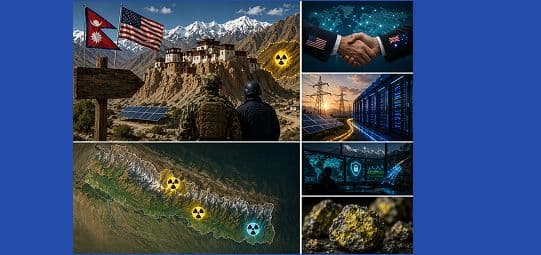
The government intends to declare a 30-square-kilometer area in Lo Manthang, Upper Mustang, where uranium deposits are said to exist, as the Mustang Special Zone (MSZ). According to the proposal, this sector will be advanced as a high-security research zone, granting exclusive access to the Nepalese Army and the Australian-U.S. technical team.
Sources claim that the Ministry of Communication and Information Technology gave “in-principle” approval to this matter prior to the elections held on March 4 (Phagun 21). To counter Chinese dominance in Rare Earth and Critical Minerals (including uranium), a coalition named “Pax Silica” has been formed under U.S. leadership. Sources suggest that preparations are being made to extract uranium and other rare earth minerals in Mustang through this organization.
However, the Prime Minister of the then-government, Sushila Karki, stated that her administration has made no such decision. “I haven’t heard the term ‘Pax Silica.’ I haven’t been to Singha Durbar since the March 4 elections, and I haven’t heard or discussed anything regarding this matter,” Karki told Singha Durbar.
High-level sources claim that on March 8, 2026, just three days after the electionan agreement was signed to participate in Pax Silica, granting in-principle consent. When Journalistinquired with the then-Finance Minister, Rameshwor Khanal, regarding this agreement, he denied any knowledge of it. He told, “To my knowledge, this subject was never mentioned while I was in government.”
Despite the denials from the then-Prime Minister and Finance Minister, a confidential document mentions that in-principle consent was indeed given to join Pax Silica.
The document further specifies that the electricity required for uranium extraction in Mustang will be sourced from the MCC project. It claims this will directly link the transmission lines built under MCC with the energy requirements of new Edge AI data centers to be constructed in the hilly regions.
The alleged agreement with Nepal was reportedly made under the “Himalayan Resource and Digital Security Annex.” On February 20, 2026, India joined Pax Silica during the Global AI Impact Summit held in New Delhi. The agreement claims that India’s participation has paved the way for Nepal to join the regional “Silicon Stack.”
Sources claim that on the night of the election (March 5, 2026), as results began favoring the Rastriya Swatantra Party (RSP), a preliminary agreement was reached between the Ministry of Communication and technical advisors of Pax Silica to secure “Digital Hashes.”
The agreement also reportedly addresses the sensitive issue of Data Sovereignty Transfer.
Mustang Special Zone (MSZ): The 30-square-kilometer uranium reserve in Lo Manthang is declared a “High-Security Research Zone,” granting exclusive access to the Nepalese Army and the Australian-American technical team.
“Glass Box” AI Security: Implementation of security protocols that will monitor fiber-optic traffic along the borders to heighten security alerts.
Energy Integration: The MCC project is directly linked to the power requirements of the newly proposed data centers.
Various locations across Nepal are claimed to hold uranium deposits. According to studies, the following areas have been identified:
Makwanpur: The Tinbhangale-Kalopani area of Dhiyal (estimated to have the highest level of radiation).
Mustang: Lo Manthang and surrounding areas.
Sindhuli: Buka Khola and adjacent regions.
(@ https://www.multipolarpress.com/p/nepal-government-prepared-to-grant?triedRedirect=true)