
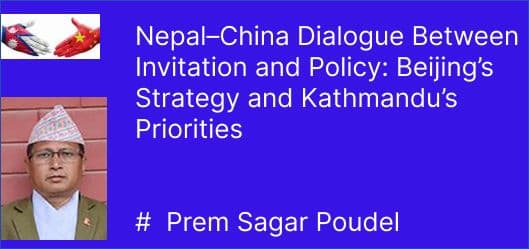
Nepal’s Minister for Foreign Affairs, Shishir Khanal, is currently on a four-day official visit to China. If this visit, extended at the invitation of his Chinese counterpart, is viewed merely as a matter of routine diplomatic courtesy, there is a risk of underestimating both its gravity and its potential. This visit is taking place at a time when global politics is simultaneously undergoing polarization and restructuring. On one hand, the 55-minute telephone conversation between Russian President Vladimir Putin and U.S. President Donald Trump has opened a new window for diplomatic engagement. On the other hand, the recent meeting between Chinese President Xi Jinping and North Korean leader Kim Jong Un has underscored China’s renewed strategic activism in Northeast Asia. Against the backdrop of these wider geopolitical developments, the Nepali foreign minister’s visit to Beijing signals a subtle but significant turn in South Asian diplomacy.
After India, China: A Practice in Balance or a New Departure?
Khanal’s China visit follows immediately after his visit to India. This sequence itself conveys a clear message about Nepal’s foreign policy. Kathmandu is not seeking alignment with any single neighbour, but rather a mature, active, and balanced relationship with both. For a geopolitically sensitive country like Nepal, such balance is not merely a theoretical priority of foreign policy; it is also a prerequisite for survival and development. The question, however, is this: will this visit simply continue the traditional practice of balance, or will it lay the foundation for taking Nepal–China relations into a new phase of institutional transformation? Initial indications suggest that the second possibility is stronger.
Beijing’s Strategy: Redefining Influence in South Asia
China has long regarded Nepal as an important component of its South Asian strategy. In recent years, however, Beijing’s approach appears to have undergone a notable shift. Nepal is no longer seen merely as a “buffer” for Tibet’s security or as a “pawn” in competition with India. Rather, it is increasingly viewed as a potential hub for broader Himalayan connectivity and economic cooperation. China appears keen to institutionalize its relationship with Nepal through infrastructure, energy, trade, and people-to-people networks. This strategy is a coherent extension of the “neighbourhood diplomacy” China has been pursuing from the Korean Peninsula to the Middle East. For Beijing, Foreign Minister Khanal’s visit has become an opportunity to reactivate that strategy in South Asia.
Key Agenda: Redefining Cooperation
The core agenda of this visit is multidimensional. First is the revival of projects under the Belt and Road Initiative (BRI). Nearly a decade has passed since Nepal signed the BRI agreement, yet tangible achievements remain limited. The full-capacity operation of the Rasuwagadhi–Kerung and Tatopani border points, long-term studies on rail and road connectivity, and the expansion of transit facilities are among the key priorities. Second is the reduction of the trade imbalance. Nepal’s trade deficit with China has continued to widen every year. Concrete understandings are expected on easier access for Nepali exports to the Chinese market, the establishment of quality testing laboratories, and the promotion of agricultural exports. Third is energy cooperation. Attracting Chinese investment in Nepal’s hydropower sector and securing access to the regional energy market remain important issues. Fourth is border management and confidence-building. Continuous dialogue is necessary to regulate the movement of border communities, local trade, and cooperation in disaster management.
Kathmandu’s Priority: National Consensus and Transparency
The most important aspect of this visit, however, is how Nepal frames its cooperation with China within the parameters of national consensus, transparency, and economic feasibility. Although numerous agreements have been signed in the past, implementation has remained slow. Project delays, debt sustainability, the interests of local communities, and environmental sensitivities are equally pressing concerns. Nepal must have the courage to raise these issues openly. Diplomatic success should be measured not merely by joint statements, but by agendas, timelines, and outcomes.
Another important dimension is advancing cooperation with China while maintaining trust with India. As Nepal deepens its engagement with China, it must present this relationship not in anti-India or anti-Western terms, but in the language of national development and regional stability. This very balance is the central formula of Nepal’s diplomatic success.
Regional Context: A Lesson for South Asia
Khanal’s visit can send an important message to South Asia. A small or medium-sized country can safeguard its interests amid great-power competition if it has a clear policy, sustained dialogue, and national consensus. Nepal’s effort to maintain active engagement with both China and India can offer a diplomatic model for countries such as Sri Lanka, Bangladesh, and Myanmar.
Conclusion: A Test and an Opportunity
This four-day visit, extended at the invitation of the Chinese counterpart, is an important test of Nepal’s long-term neighbourhood policy. It will define the alignment between Beijing’s growing strategic activism and Kathmandu’s aspiration for balanced development. If Nepal can transform this opportunity into concrete projects, transparent financial management, and national consensus, the visit may prove to be not merely a four-day diplomatic event, but a milestone in the history of Nepal’s international relations. Otherwise, like many previous visits, it will remain confined to yet another chapter of joint statements and goodwill gestures.
This is a moment that will test whether Nepal can turn its geopolitical location into an opportunity. The coming days will provide the answer.
The author, Prem Sagar Poudel, is a senior journalist and international relations analyst from Nepal. He has conducted in-depth studies on Nepal–China relations, Himalayan geopolitics, and Asian security issues.