US-Israel war on Iran was not a simple conflict over territory or economic issues. Part of it stemmed from historical enmity between the Jewish state and broader Islamic world, following creation of Israel in 1948 in a land that had seen changing empires, demography and borders. The conflict was sowed by Britain’s Balfour Declaration of 1917 to create a national home for Jews where about 90 population was non-Jewish, bought by The League of Nations Mandate in 1923, and cemented by The UN Partition Plan in 1947 and Israel’s Declaration in 1948.
Secondly, Israel and the US were decided to stop Iran from developing nuclear weapons. Iran had signed in 1957 a civil nuclear cooperation agreement with the US, and in 1967 the US-supplied nuclear reactor had become operational. Iran signed the NPT in 1967, and signed a safeguards agreement with IAEA in 1974. The US-Iran relations began to sour following the 1979 Islamic revolution in Iran. The new regime was found secretly enriching uranium, negotiation with Britain, France and Germany resulted in Iran’s acceptance to suspend the program. When Iran decided to restart the uranium enrichment, the IAEA took Iran to the UN security Council. After a series of conflicts, sanctions and negotiations, Iran and world powers reached Joint Comprehensive Plan of Action, leading to lifting of economic sanctions on Iran, upon Iran’s acceptance of strict limits on its uranium enrichment activities and to comply with IAEA inspections and verification. However, in course of implementation, rifts arose and the agreements collapsed.
Third important aspect is geopolitics and global economic order. By 1971, the US inflation and trade deficits ended the 1944 Bretton Woods Agreement that ensured dollar-gold convertibility. To shore up the greenback, Washington reached a 1974 accord with Riyadh offering security guarantees in return for dollar-only oil pricing and the recycling of Saudi oil earnings into US government securities. Following the collapse of USSR and the Warsaw Pact, the US became the only superpower. Iran, mainly a Persian Shi’a republic had geopolitical and historical differences with Saudi Arabia, a mainly Sunni Arab kingdom. While none of these two recognize Israel, they have different level of relations with major world powers, including the US, Russia, and China. Utilizing such differences, the US was able to set its military bases in many Gulf countries. Iran considers Israel and US presence in the region as major threats to its stability and regional interests. Russia and China see hope in cooperation with Iran.
US-ISRAEL ATTACK ON IRAN
While the two sides had remained hostile to each other, they had mainly fought proxy wars for decades. It was in June 2025 that Israel suddenly hit targeted Iranian military and nuclear sites, triggering a massive retaliatory response from Iran involving hundreds of drones and ballistic missiles. The US military also joined Israel and bombed three Iranian nuclear facilities. The war officially ended when US President Trump brokered a fragile truce that halted the 12 days of direct bombardment.
In February 2026, the US and Israel launched coordinated, large-scale military operations targeting Iranian assets and leadership. The US assassinated Supreme Leader Ayatollah Ali Khamenei on February 28, hoping a regime change in Iran, with exactly opposite result. Iranians rallied in support of the regime and chose his son Mojtaba Khamenei as the successor.
Iran condemned the killing as a declaration of war, immediately launching an unprecedented retaliatory barrage of ballistic missiles and drones at Israeli cities and regional US military bases. Tehran vowed total resistance, mobilized its regional proxy network. Iran also deployed naval mines, anti-ship missiles, and fast-attack craft to physically block the Strait of Hormuz, shutting down a critical global oil transit choke point.
Global impact was not far.
ENTRY OF PAKISTAN
Pakistan entered the conflict as a mediator on March 23, offering Islamabad for talks. It looks Pakistan also took China and some other stakeholders in confidence in the process. When the US and Iran reached a stalemate, President Trump had issued a severe deadline on April 5, threatening to obliterate Iran’s infrastructure. On April 7, Trump warned that a whole civilization would die that night. Hours before the deadline, Pakistan negotiated a crucial two-week extension. Despite weeks of collapsed talks, intense diplomacy resumed, culminating in an initial framework on June 14. President Trump and President Pezeshkian electronically signed the 14-point agreement on June 17, and the Islamabad MoU officially entered into force on June 18.
The peace-making role has earned Pakistan a global credit. A burning neighbourhood that shares over 900 KM border with it obviously could create problems ranging from influx of refugees, cross-border crimes, supply chain disruptions, to domestic violences. It could make significant impacts on Pakistani economy.
This is not the first time Pakistan has mediated a peace process. During the Cold War, when the US and were at odds, Pakistan hosted Henry Kissinger secretly in Islamabad and arranged his historic visit to Beijing in 1971, which in turn led to Nixon’s visit to China and normalization of US-China relations. Pakistan played active diplomatic role in 1988 Geneva Accords that ultimately made the Soviet Union’s withdrawal from Afghanistan. Islamabad hosted or supported several rounds of 2018–2021 US–Taliban dialogues, contributing to the Doha Agreement process, which and the US withdrawal from Afghanistan. Likewise, Pakistan helped normalize Saudi-Iranian relations.
HOW PAKISTAN SUCCEEDED TO HELP?
As to helping US-China communication, it was relatively easy. The relations of both the US and China with the USSR were low in history. Both were trying to find ways to improve bilateral relations. The USSR was supplying weapons to Pakistan’s rival India. Such geopolitics made Pakistan a choice communication channel.
In cases where the conflicts took place in its neighbouring middle or small-sized Muslim countries,Pakistan’s mediating ability stems from its status as a nuclear power, a leading Muslim nation, a non-aligned tradition, maintenance of diplomatic ties across diverse regions and ideological spectrum, and its strategic spatial location.
The latest US-Israel war on Iran did not move as smoothly as the US had imagined. The best US fighters were brought down. Their hitting of the Shajereh Tayyebeh elementary school in Minab and killing of 175 people, mainly children, earned Trump worldwide condemnations. With the onset of the war, Trump’s domestic approval rate declined, and historical allies including the UK, France and Germany criticized the US actions, many European allies refused to join the military campaign, imposed restrictions to US military access, and expressed skepticism about the strategy. Besides, the war had severe impact on global supply chain, regional peace, and employment. Not only this, as the consequence of the war, many analysts opined that China was winning a war without participating in it. As with the rest of the world, the US should have breathed a relief in the Pakistani proposal to host US-Iran peace talks.
Neither the US nor Iran was in a position to displease Pakistan by reject its call for peace. Such move would have further distanced itself from the rest of the global community. And, more important, everybody knew Pakistani proposal was not guided by self-interest. It has purely humanistic. Trump bought Pakistani proposal halt attacks on Iran for two weeks, which ultimately opened door to further negotiations and opening of Hormuz Straight. We hope the war will end permanently and peace will prevail in the Middle East.
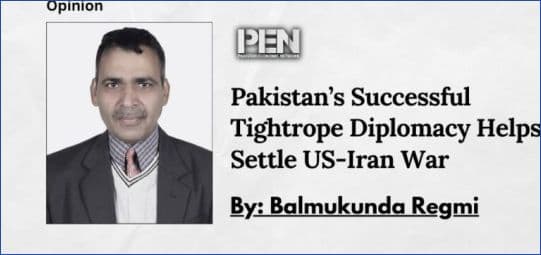
(Regmi is professor at Tribhuvan University and guest professor at Sichuan Normal University, China.)
@PEN