Gratitude is one of humanity’s simplest virtues. It costs nothing and demands little effort, yet it possesses an extraordinary power to inspire, uplift, and transform people. In Europe and America, expressing thanks—whether for a small favor or a significant contribution—is deeply embedded in everyday life. Children learn to say “thank you” at home, and schools, teachers, and social customs reinforce this habit. There, expressing gratitude is not seen as diminishing one’s dignity; rather, it is regarded as a mark of refinement that enhances the dignity of both the giver and the receiver.
The habit of expressing appreciation even for the smallest acts has evolved into a broader culture of promptly recognizing and acknowledging worthwhile contributions to society or the nation. Whether someone writes an insightful article, delivers a thoughtful speech, or renders valuable public service, their efforts are generally recognized with appreciation, praise, and constructive feedback. This culture motivates people to continue serving others. Gratitude functions almost like a cultural engine, driving creativity, innovation, and social progress. Sadly, when I look at Nepal, I cannot help wondering whether this engine has yet to arrive.
We all know that in our society, respect is often determined not by a person’s contribution but by wealth, power, and influence. Many people still seem to believe that expressing gratitude somehow makes them appear smaller. An even more serious weakness exists: praise and recognition in Nepal are frequently based not on merit but on personal relationships and self-interest. People tend to glorify those they like or from whom they expect some benefit. Conversely, they often fail to recognize the genuine achievements of those they dislike. Worse still, some even fabricate faults and smear the reputations of deserving individuals. Such emotional bias overshadows true accomplishment and gradually erodes the moral foundation of society.
In this context, I would like to share a personal experience that has remained vivid in my memory.
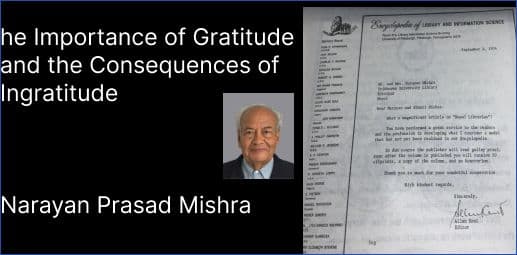
In 1974, my late wife, Shanti Mishra, and I—both librarians by profession—received an invitation from the editor of the internationally renowned Encyclopedia of Library and Information Science, edited at the University of Pittsburgh, to write an article on the libraries of Nepal. The editor sent us a sample article on Chile as a guide. After reviewing it, we found that its format and content did not fully meet our expectations. We therefore decided to write the article in our own format, providing more comprehensive information on some aspects.
Contrary to the editor's instructions, we prepared the article in our own style and with a different structure, believing that it would produce a better result. We also felt that, if the editor rejected our approach, we could always publish the article elsewhere.
Naturally, we were anxious that the editor might reject our submission or ask us to rewrite it because we had departed from the prescribed format. Instead, on September 5, 1974, we received the following letter praising our work and describing it as a "model article." That letter did far more than compliment our writing. It validated our professional judgment, affirmed our independent thinking, and inspired us to produce even better work in the future. It was a deeply encouraging experience that we never forgot.
Frankly, I would hardly expect such a gracious response from many people holding powerful positions in my own country. More likely, they would put you on their block list for being too outspoken and regard you as troublesome. Too often, those in positions of authority seem to think they know everything, as though all wisdom resides exclusively with them. By contrast, in Europe and America, people are generally more willing to acknowledge their own limitations while appreciating the strengths and abilities of others. In my opinion, this attitude is one of the important foundations of their modern development.
Allow me to offer another example.
A few years ago, I sent several of my articles published in People’s Review—including “A Tale of a Missionary Doctor and an Abandoned Child,” “A System of Bhagabanda,” and “Disfigured Democracy and Nepal”—to many foreign friends as well as Nepali acquaintances. From my Nepali friends, however, I did not receive even a single sentence of response—neither praise nor criticism, neither agreement nor disagreement.
My foreign friends, on the other hand—writers, professors, librarians, and social workers—responded almost immediately. Their messages were warm, encouraging, thoughtful, and deeply reflective of a culture of gratitude.
A television presenter in Indiana, USA, wrote, “This story deserves to be made into a film.”
A librarian colleague shared the article with others, calling it “an excellent article.”
An old friend from Pennsylvania wrote emotionally that my beloved wife, Shanti, would have been immensely proud had she still been alive to read it.
From Texas, New York, Indiana, and elsewhere, I received messages filled with encouragement, affection, and thoughtful reflections.
These responses represented far more than simple compliments. They reflected a commendable culture that values, recognizes, and honors even the smallest contributions people make.
Unfortunately, the situation in Nepal has often been very different.
In 1980, I published a small book on Tribhuvan University and wrote numerous articles on education and the National Education System. Over the years, I have felt that many policymakers, teachers, writers, and numerous education commissions established later have drawn extensively upon the ideas presented in that book and in my published articles. Yet I have rarely found my name acknowledged in their reports, bibliographies, or references.
They adopted my ideas but were unwilling to give credit to their source. In Europe or America, such conduct would be almost unthinkable. There, proper acknowledgment is regarded as both an academic discipline and a moral obligation. In Nepal, however, envy, insecurity, and the fear that recognizing another person’s contribution might somehow diminish one’s own status often seem to prevail over fairness.
Our country possesses countless talented individuals in every field—writers, teachers, administrators, artists, political leaders, engineers, doctors, members of the security forces, journalists, and literary figures—who have made significant contributions to nation-building. Yet many of them pass away without being recognized, appreciated, or even remembered by the very institutions they served. What a profound tragedy.
In some cases, even those whose contributions have permanently shaped the course of our history are denied the recognition they deserve. King Prithvi Narayan Shah, King Tribhuvan, and King Mahendra were all historic figures who played decisive roles in shaping Nepal’s identity, creating unified Nepal, advancing democracy, and building its infrastructure. One need not support the monarchy to acknowledge their historical contributions. Recognizing what individuals have accomplished for the nation is simply the hallmark of a civilized society. Sadly, even this basic obligation appears to be fading in our country.
Where gratitude withers, the impulse to serve others also fades.
Where deserving people are not appreciated, talent withers.
Where recognition is absent, progress comes to a halt.
Where power, personal connections, and favoritism replace merit and competence in determining justice, society cannot move forward.
If we continue nurturing a culture of ingratitude instead of gratitude, our nation will lose its talented people. Opportunists and the unscrupulous will continue to dominate public life, and genuine national progress will remain beyond our reach.
Gratitude is not a trivial matter; it is the lifeblood of a civilized society. To honor those who contribute is, in essence, to honor the nation itself. Nepal can rise again—but only if we learn to place merit above favoritism, appreciation above envy, and truth above personal prejudice.
The journey toward national renewal begins with a simple yet timeless virtue: sincerity, respect, and a heartfelt “thank you”—gratitude expressed from the depths of one’s heart.
Nepal’s future may well depend on whether we revive this noble virtue or continue burying it ever deeper beneath indifference and ingratitude.
Email: narayanshanti70@gmail.com
About the Author
Narayan Prasad Mishra is a non-partisan author of several books and numerous articles in both Nepali and English. He is the former Chief of the Office of the Tribhuvan University Service Commission and is now a senior citizen in his mid-eighties.