Dr. Ghulam Nabi Fai--Chairman, World Forum for Peace & Justice--------
New York, New York, July 30, 2026------------
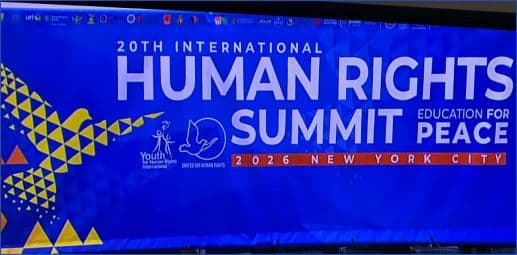
The 20th Annual International Human Rights Summit opened today, on July 30, 2026, at United Nations Headquarters in New York under the timely theme, "Education for Peace – A 25-Year Legacy." Hosted by United for Human Rights and its youth initiative, Youth for Human Rights International, the Summit marks the organization's 25th anniversary and brings together youth leaders, diplomats, educators, civil society organizations, and human rights advocates from more than 70 countries.
The Summit's central message is compelling: education is the foundation of peace. Speaker after speaker underscored that teaching human rights is indispensable to creating more just, tolerant, and inclusive societies.
At the beginning, I would like to extend my sincere appreciation to United for Human Rights, Youth for Human Rights International, the Permanent Mission of Timor-Leste to the United Nations, and all partner organizations for convening the 20th Annual International Human Rights Summit.
My gratitude goes to Dr. Mary Shuttleworth for her inspiring leadership and unwavering commitment to advancing human rights education over the past twenty-five years. I also thank Ambassador Dionisio da Costa Babo Soares, Ambassador Selma Ashipala-Musavyi, the distinguished speakers, youth delegates, civil society representatives, and participants from more than seventy countries whose thoughtful contributions enriched this important gathering.
Special recognition is due to the young leaders, including Ms. Demi, the emcee and the delegates from around the world, whose passion demonstrates that the next generation is prepared to champion peace, dignity, and justice.
Demi, emcee of Houston, recipient of the Human Rights Hero Award, Co-Director of Youth for Human Rights USA, and emcee of the Summit, welcomed delegates by observing that this gathering represents two decades of bringing together youth, Nobel laureates, diplomats, and changemakers from around the world, united by a single document—the Universal Declaration of Human Rights (UDHR). Her observation that the Summit's diverse voices are ultimately united by one purpose—education for peace—captured the spirit of the event.
Dr. Mary Shuttleworth, President of United for Human Rights and Youth for Human Rights International and founder of the movement, reminded participants that the Summit celebrates twenty-five years of a simple but profound conviction: every person should know their human rights and understand that those same rights belong equally to everyone else. She rightly described human rights education as one of humanity's greatest forms of empowerment. Education reaches potential victims, influences potential perpetrators before prejudice hardens into violence, and teaches every child that every human being is born with equal dignity and equal rights.
Her words deserve careful reflection: "Human rights education changes people. Changed people change communities. Changed communities change nations. Changed nations change the world." Equally memorable was her challenge: "The question is not what it would cost to teach human rights, but what it would cost not to." Coming from someone raised under apartheid in South Africa, those words carry exceptional moral authority.
Ambassador Dionisio da Costa Babo Soares, Permanent Representative of Timor-Leste to the United Nations, emphasized that promoting human rights is a collective responsibility and that young people are indispensable partners in building a more peaceful, just, and inclusive world. His reminder that education is the enabling right—without which freedom of expression, democratic participation, equality, and justice cannot fully flourish—highlights why investment in education remains indispensable.
Similarly, Ambassador Selma Ashipala-Musavyi of Namibia emphasized that education is far more than a social service. It is a constitutional obligation, a fundamental human right, and one of the most powerful instruments for peacebuilding because it equips citizens with knowledge, values, and critical thinking necessary to reject discrimination and uphold democratic principles.
A young delegate from Timor-Leste perhaps offered the Summit's most poignant reminder: human rights are not abstract principles written into legal texts; they shape the opportunities people enjoy, the choices they make, and the future they build.
I agree with the recurring message that declarations, treaties, and laws remain little more than aspirations unless faithfully implemented on the ground. Likewise, the Summit's inspiring theme of educating youth for peace will achieve its full promise only if governments genuinely embrace and practice the principles they publicly endorse.
It is important to understand that education for peace is not merely a slogan; it is an investment in humanity's future. If we teach every child to understand not only their own rights but also the equal rights of others, we lay the foundation for societies built on justice rather than fear, dialogue rather than violence, and cooperation rather than conflict.
As President Nelson Mandela taught the world, lasting peace is achieved not through domination but through reconciliation, mutual respect, and courageous leadership. The challenge before our generation is to transform the ideals of the Universal Declaration of Human Rights (UDHR) into everyday reality.
If the UDHR is to remain humanity's moral compass, its principles must be applied consistently and impartially. Human rights cannot depend upon geography, political alliances, or strategic interests. Their universality is precisely what gives them enduring moral authority.
Yet candor requires acknowledging an uncomfortable truth. Human rights education, while indispensable, is not sufficient by itself. Lasting peace also requires political courage, accountability, and consistent international action when grave violations occur.
The greatest tribute to the 20th Annual International Human Rights Summit would not be another declaration, however eloquent. It would be translating the Summit's vision into measurable action. Education must inspire governments as well as citizens. Human rights must be defended consistently rather than selectively. International law must be applied impartially rather than politically. Peace must be pursued through justice rather than expediency.
One unresolved example is frequently cited when the international peace is under discussion and that is Kashmir. The dispute has remained before the international community since 1948, while generations of Kashmiris have endured uncertainty, violence, displacement, and competing political claims. Whatever one's national or political perspective, the protection of the human rights and dignity of the people of Kashmir should remain paramount.
The United Nations has long recognized the importance of achieving a peaceful settlement of the dispute. While governments differ sharply over the legal and political dimensions of Kashmir, there should be no disagreement that civilians must be protected, human rights respected, and dialogue encouraged over confrontation and final settlement explored in accordance with the wishes and aspiration of all, irrespective of their religious background or regional affiliations.
Recent periods of heightened tension between India and Pakistan over Pahalgam massacre in April 2025 have once again demonstrated how easily regional crises can escalate between two nuclear-armed neighbors. This reality underscores the urgency of sustained diplomacy and confidence-building measures that reduce tensions and create conditions conducive to a durable peace.
No lasting solution can succeed unless it commands legitimacy among the people most directly affected. Their aspirations, welfare, and fundamental rights deserve meaningful consideration in any process aimed at securing a peaceful future. Lasting peace is rarely achieved through coercion; it is built through dialogue, mutual respect, reconciliation, and statesmanship.
President Nelson Mandela's legacy offers a timeless lesson. He demonstrated that even the deepest and most painful conflicts can yield to negotiation when leaders possess the courage to place justice and reconciliation above hostility and division. That lesson remains as relevant today in Kashmir as ever.
The 20th Annual International Human Rights Summit has reminded us that this responsibility belongs not only to governments or international organizations, but to each of us. The future of human rights will be determined not simply by the declarations we adopt, but by the values we choose to live. That is the enduring legacy of the Universal Declaration of Human Rights—and the most meaningful legacy this Summit can leave to future generations.
May the deliberations of this Summit strengthen our collective resolve to transform the principles of the Universal Declaration of Human Rights into lived realities for every person, everywhere. Let this gathering serve not only as a celebration of twenty-five years of human rights education but also as a renewed commitment to building a more peaceful, just, and compassionate world.
Dr. Fai can be reached at: WhatsApp: 1-202-607-6435
gnfai2003@yahoo.com