I recently watched a video of a subcommittee under the State Affairs and Good Governance Committee of Nepal’s Parliament questioning Prem Kumar Rai, Chief Commissioner of the Commission for the Investigation of Abuse of Authority (CIAA). I had heard his name many times. I knew he was a seasoned bureaucrat and had served as Secretary of the Ministry of Home Affairs before becoming chief of the country’s principal constitutional institution for fighting corruption. But I had never really heard him speak at length.
After watching the parliamentary proceeding, I was left with an uncomfortable question: How does someone rise through the bureaucratic system and eventually become the head of Nepal’s most important anti-corruption institution when his public explanations can leave a listener searching for a coherent thread?
Let me make one thing clear before the bureaucratic guardians of political correctness arrive with their files. A person does not have to be a great orator to be a great administrator. Some of the finest administrators could probably put an audience to sleep before finishing their second sentence. They read files, examine evidence, understand procedures, make decisions, and leave eloquence to politicians and poets. But there is a difference between being a poor speaker and being unable to communicate a clear thought.
The chief of an anti-corruption institution does not need to speak like Shakespeare. He does, however, need to explain himself clearly to foster public trust. Clearly. Coherently. Logically. Preferably without making the listener wonder whether the answer is still loading.
And that is where the Rai episode becomes larger than Rai himself. The CIAA is not just a bureaucratic body; it is a constitutional institution entrusted with investigating abuse of authority and corruption, making its credibility vital for effective governance. When such a person appears before Parliament, citizens are not watching an ordinary bureaucrat answering an ordinary question. They are watching the person who is supposed to investigate the people who administer the state.
The public therefore has a legitimate right to ask: Does he understand the question? Does he understand the law? Does he understand the evidence? Can he explain an institutional decision in language that ordinary citizens can understand? Because corruption does not become less corrupt because it is explained in bureaucratic language. In fact, bureaucracy may be the most sophisticated camouflage ever invented. A citizen asks, “Who approved this?” The official responds, “The matter was processed according to the prevailing procedural framework.” Wonderful. Nobody answered the question. Ask again. “The decision was taken within the institutional mechanism.” Excellent. Still no answer. Ask a third time, and perhaps you receive a fourteen-page report explaining why nobody can remember who actually made the decision.
This is how accountability dies. When officials respond with vague answers, citizens lose faith and feel powerless to hold institutions accountable. It does not always die dramatically. Sometimes it dies quietly in a conference room, wearing a suit and carrying a government file. Nepal has become remarkably talented at this. We have created a political culture in which titles can matter more than competence. Put “Secretary” before someone’s name, and we assume extraordinary wisdom must have arrived with the appointment letter. Add “Chief Commissioner” afterward, and citizens are expected to salute the designation. But titles do not manufacture competence. They merely enlarge the room in which competence is expected to operate. And this brings us to the more uncomfortable questions surrounding Rai. The Rastriya Swatantra Party (RSP) did not appoint Rai. His appointment came during the UML-led government under KP Sharma Oli. It is therefore understandable that questions about his political proximity to, or loyalty toward, the UML have persisted. But the larger issue is not whom he may have been politically close to.
The larger issue is whether he demonstrates independence and professional competence, which are essential for such a role. Citizens reasonably assume that someone selected for such a powerful position is not merely politically trusted by those making the appointment, but is also intellectually capable and professionally qualified to lead the institution. That is precisely where the public has a legitimate right to ask questions.
If someone is chosen to lead the country’s principal anti-corruption institution, the appointment should signify more than political confidence. It should signify competence, judgment, independence, and credibility. Otherwise, what exactly are we appointing? A professional? A political loyalist? Or a constitutional officeholder?
These questions have become more difficult to ignore because Rai’s name has appeared in public controversy surrounding several major corruption cases. A complaint filed against him in 2025 alleged involvement in the wide-body aircraft procurement case, Nepal Oil Corporation land-purchase irregularities, and the fake Bhutanese refugee case. Those are allegations, not convictions, and that distinction matters.
But something more consequential happened in the wide-body aircraft case. In its judgment, the Special Court raised questions about the CIAA’s selective prosecution. It noted that Rai, who had been involved in the decision-making process surrounding the procurement while serving in government, was not prosecuted along with others. The court’s concern was not itself a finding that Rai was guilty of corruption. It was a question about consistency and accountability in the prosecution process.
That distinction should not be lost. The issue is not that Rai has been convicted of corruption. He has not. The issue is that serious questions have been raised about his role in matters that fall directly within the jurisdiction of the institution he now leads. That alone creates a legitimate question about institutional credibility.
Yet after watching the proceedings of the parliamentary subcommittee under the State Affairs and Good Governance Committee, I found myself confronting another, more immediate concern. Mr. Rai did not appear capable of doing what the occasion required. More troublingly, his responses gave little indication of the urgency, clarity, or determination that such a constitutional responsibility demands.
This is not merely a criticism of his speaking style. A bureaucrat may be reserved, awkward, or even painfully uncharismatic. None of that matters if the person can think clearly, answer precisely, and demonstrate command of the institution he leads. But when the questions are serious, the answers are evasive or difficult to follow, and the body language suggests little urgency or intellectual engagement, the problem becomes larger than communication. It becomes a question of capacity and institutional leadership.
I watched the video reluctantly. In fact, I was not particularly interested in watching the entire proceeding. I forced myself to continue because I wanted to understand how the chief of the CIAA would respond when questioned by Parliament. Yet as I watched, I found myself strangely entertained. Looking at Mr. Rai’s responses and, at the same time, observing the body language and reactions of the parliamentarians, I had the peculiar feeling that I was watching a comedy sitcom.
The difference, of course, is that this was not television comedy. These were members of Nepal’s Parliament questioning the head of the country’s principal anti-corruption institution. That realization made the humor uncomfortable.
At moments, I almost wanted to laugh. At other moments, I wanted to turn the video off. But I forced myself to watch because behind the apparent comedy was something profoundly serious. A parliamentary subcommittee was trying to obtain answers about governance and accountability from the person whose constitutional responsibility is precisely to investigate abuse of authority. And somehow the entire scene felt like an absurd theater of the state.
That is not a healthy sign for a republic. A chief commissioner does not have to be entertaining. He has to be convincing. He does not need theatrical eloquence. He needs intellectual clarity. He does not need to speak like a politician. He needs to speak like someone who knows precisely what he is talking about.
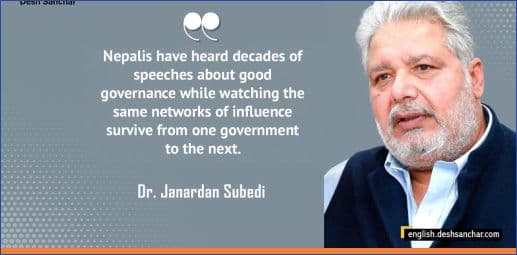
The RSP entered national politics promising a different political culture and presenting the fight against corruption as one of its defining commitments. Nepalis have heard decades of speeches about good governance while watching the same networks of influence survive from one government to the next. But a corruption-free society cannot be created through slogans alone. It requires institutions citizens believe are independent. It requires investigators who can investigate the powerful. It requires officials whose decisions can withstand scrutiny. And it requires political leaders willing to examine institutions even when doing so is politically inconvenient.
This is where the RSP and the present government should be judged. The question is not whether they appointed Rai. They did not. The question is whether they are willing to examine the credibility of the institution he leads, even when doing so means confronting an appointment made by a previous government. That is a much more meaningful test of the RSP’s promise.
And, remarkably, that question is no longer merely theoretical. On August 20, RSP lawmaker Amresh Kumar Singh publicly questioned the CIAA’s independence and impartiality and criticized Rai for failing to distinguish the responsibilities and dignity of an administrative position from those of a constitutional office. Other lawmakers also raised concerns about the commission’s performance. Another RSP lawmaker, Yagyamani Neupane, has questioned whether Rai has the moral grounds to continue in office given the controversies surrounding his name.
So the question has now entered Parliament itself. That makes the matter considerably more serious. The CIAA is supposed to be the watchdog. Yet when citizens begin asking who is watching the watchdog, something has gone seriously wrong. A corruption watchdog whose own credibility is questioned resembles a fire station that citizens suspect of selling matches. The joke writes itself.
Unfortunately, the country is burning.
The parliamentary subcommittee therefore has an opportunity to demonstrate that Parliament is more than a building where politicians take turns shouting at one another while cameras are running. It should ask hard questions. Not theatrical questions. Not politically convenient questions. Hard questions.
What exactly happened? Who made the decision? Under what law? What evidence existed? Who benefited? Who objected? Were politically connected individuals treated differently from ordinary citizens? Were the same standards applied to everyone?
And if the answers are unclear, Parliament should keep asking. Parliamentary oversight is not supposed to be a courtesy visit. It is supposed to be uncomfortable. If everybody leaves the room feeling comfortable, perhaps nobody asked the right questions.
The government also has a responsibility. It should not interpret every criticism of a constitutional officeholder as a political attack. Nor should it automatically defend an appointee simply because questioning him creates political embarrassment.
The issue is not whether Prem Kumar Rai is personally a good man. I do not know him personally. The issue is whether the institution he leads possesses the independence, competence, and credibility expected of a constitutional anti-corruption body. Those are very different questions.
And I will admit my own reaction to the parliamentary video was unusually blunt. Based solely on that performance, I found myself thinking that I would hesitate even to hire him as my assistant. That is a subjective reaction, not a legal judgment. But perhaps it illustrates the larger problem. If a citizen watching from home cannot understand the explanation of the person leading the country’s principal anti-corruption institution, how is that citizen supposed to develop confidence in the institution?
This brings us back to a problem much larger than one commissioner. Nepal has become so accustomed to mediocrity in public office that we sometimes mistake survival for competence. A person becomes an officer. Then a secretary. Then a Chief. Then an “Honorable.” And eventually nobody remembers to ask the most basic question in public administration: Can this person actually do the job?
That question must return to Nepali public life. Competence must matter. Integrity must matter. Independence must matter. Clarity must matter. And accountability must matter most of all.
Nepal’s problem is not that it lacks laws. It has plenty of laws. It is not that it lacks institutions. It has plenty of institutions. It is not even that it lacks committees. Nepal has enough committees to form a second government. What Nepal lacks is institutional courage.
The courage to investigate the powerful. The courage to question one’s own political allies. The courage to admit institutional failure. The courage to remove people who no longer command public confidence. And the courage to say that a constitutional appointment is not a certificate of competence.
If Rai’s tenure survives parliamentary scrutiny, judicial scrutiny, and public scrutiny, so be it. Let the evidence speak. If the allegations are unfounded, establish that clearly. If legitimate questions remain, investigate them according to law.
But Nepal must stop confusing silence with resolution. Nor should it confuse appointment with qualification. The Republic does not need more sacred cows. It already has enough cows. What it needs are institutions capable of examining those cows without first asking which political party owns them.
That is the real test of the CIAA. It is also the test of Parliament. And perhaps it is the test of the RSP’s promise of a different political culture.
But another question deserves attention. When I think about all of this more carefully, I cannot escape the impression that the RSP-led government is increasingly spending political energy on Durga Prasai, a businessman who has presented himself as an outspoken crusader for people with low incomes and for victims of troubled financial institutions, particularly cooperatives, and on what is happening around his house, rather than on the larger problems confronting the nation and its people.
I recognize that this is an impression, not a fact. But political perceptions matter, particularly when a government has promised to do politics differently. If citizens begin to feel that the government is more preoccupied with confronting an individual than with confronting the structural problems that brought people into the streets, that perception deserves attention.
A government cannot afford to spend its political capital primarily on personalities and confrontations. At the same time, the country continues to struggle with corruption, weak institutions, unemployment, economic uncertainty, poor public services, and declining public trust.
The larger question, therefore, is not simply what the government is doing to Durga Prasai. It is what the government is doing for Nepal. That is the standard by which the RSP should ultimately be judged.
Because when the institution designed to investigate abuse of authority begins to look politically compromised, citizens do not merely lose confidence in one commissioner. They begin losing confidence in the very idea of accountability. And once citizens stop believing that institutions are independent, corruption no longer needs to hide. It simply needs a government letterhead.
That is when a republic becomes something more dangerous than corrupt. It becomes cynical. And cynicism is what happens when citizens have seen the same movie too many times and realize that only the actors have changed.
Nepal does not need another performance. It needs institutions that can speak clearly, act independently, and answer the questions citizens have been asking for decades. It needs a government that understands that governing a country is larger than defeating an opponent. And it needs political leaders who understand that the real enemy is not a particular individual, but the institutional culture that allows incompetence, impunity, and political protection to survive.
The watchdog must be watched. The government must be questioned. Parliament must do its job. And citizens must never surrender their right to ask the simplest question of all: Who is watching those who are supposed to watch the state?
May sanity, at last, return to the Republic.
@Desh Sanchar